

More news on this day
As winters grow longer across northern latitudes and Arctic air creeps farther south, Embraer’s KC-390 Millennium is moving to prove that a Brazilian-built airlifter can operate confidently in some of the coldest conditions on earth.
Get the latest news straight to your inbox!
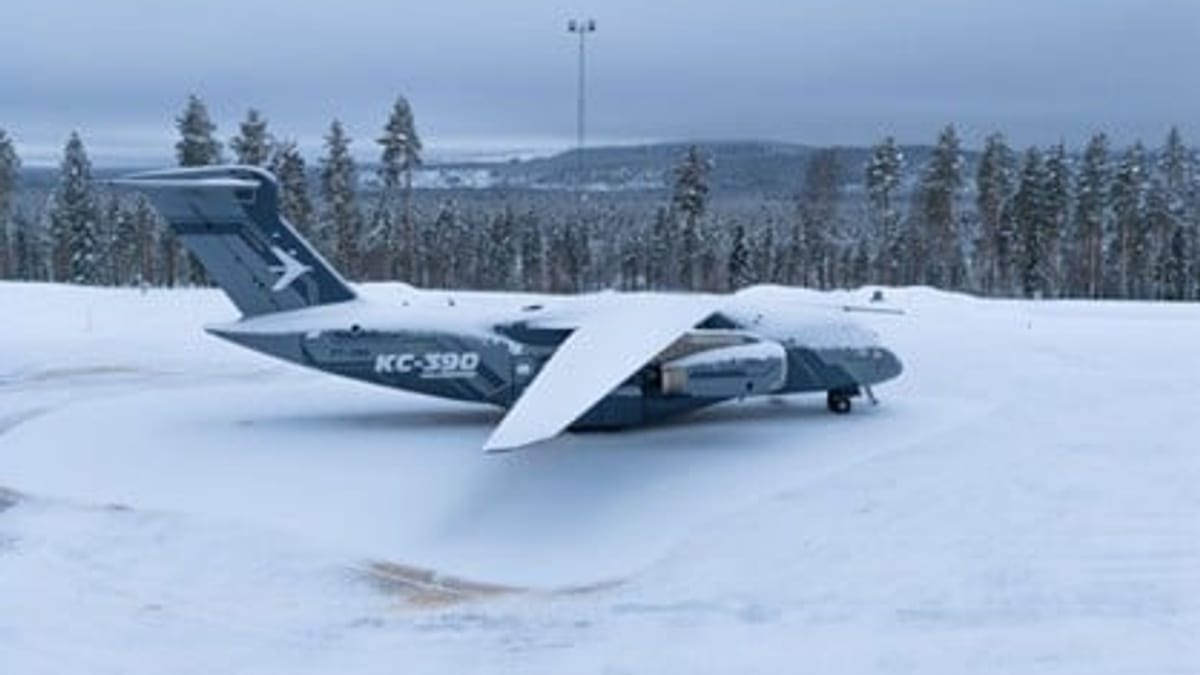
Image by AWN RSS by content source
From Tropical Origins To Subzero Testing Grounds
The twin‑jet KC-390 Millennium was conceived in Brazil, a country far better known for tropical heat than permafrost, yet the aircraft’s latest development chapter has unfolded in snowbound environments. Publicly available information shows that the Brazilian Air Force and Embraer have deliberately taken the aircraft to subzero locations to validate its systems where temperatures routinely plunge well below freezing.
According to open technical summaries of the program, a KC-390 was dispatched to the United States in 2021 for extreme cold testing, exposing the airframe, engines, hydraulics, and avionics to sustained low temperatures. These campaigns focus on ground starts after long cold soaks, performance during icy taxi conditions, and behavior of doors, cargo ramps, and seals when metal contracts and lubricants thicken in the cold.
Further reporting describes follow‑on campaigns in high‑latitude regions such as Alaska, where winter temperatures and wind chill provide a natural laboratory. There, engineers can observe how ice and compacted snow interact with the landing gear, how brake systems cope with frozen taxiways, and how the aircraft’s environmental control system keeps flight decks and cargo holds stable when outside air is deeply negative.
These subzero trials are central to Embraer’s pitch that the KC-390 is no longer just a warm‑weather tactical transport, but a contender for front‑line service in countries where blizzards, freezing fog, and polar nights are part of routine flight planning.
Design Features Geared For Ice, Snow And Low Temperatures
Modern military airlifters must be engineered from the outset with winter operations in mind, and the KC-390 follows that pattern. Public data on the aircraft highlights full‑span leading edge devices and advanced wing profiles that work in concert with de‑icing systems designed to keep critical surfaces clear in known icing conditions.
The aircraft’s two IAE V2500‑E5 turbofan engines are derivatives of a widely used commercial powerplant, adapted for military duty. In cold conditions, their anti‑ice arrangements, nacelle design and intake geometry are intended to reduce the risk of snow and slush ingestion during low‑power taxi, while still delivering strong thrust for short and contaminated runways. Reports on winter trials note particular attention to engine start sequences after long cold soak periods, a key benchmark for any aircraft that might sit on remote aprons overnight.
Cold weather testing has also scrutinized the KC-390’s landing gear and braking systems. On frozen or slush‑covered runways, brakes must deliver predictable deceleration without locking, while gear doors and actuators cycle reliably despite stiffened seals and hydraulic fluid. Observers of the program point to iterative improvements following early test incidents in icing simulations, suggesting that the current aircraft benefits from expanded flight envelope work in adverse conditions.
Inside the cabin and flight deck, the aircraft’s environmental systems are configured to maintain stable temperatures for aircrew and sensitive cargo, even when the outside air temperature at cruise is far below zero. This capability is particularly relevant for medical evacuation, humanitarian cargo and precision instruments that may be loaded at mid‑latitude bases and delivered into polar regions.
Cold Weather Credibility Fuels New Customers
The KC-390’s emerging cold weather pedigree is taking on increasing commercial importance as Embraer wins orders in climates far removed from Brazil. In Europe, Portugal and Hungary have already committed to the type, while the Netherlands and Sweden have selected the C-390 variant as a future replacement for aging Hercules fleets. Publicly available procurement coverage indicates that Sweden’s acquisition, in particular, was shaped by the need for reliable year‑round operations in Nordic winters.
Sweden’s air bases operate through months of snow, ice, and limited daylight, with aircraft expected to support missions from the Baltic to northern Lapland. Analysts note that for Stockholm, a new airlifter had to demonstrate not only payload and speed, but also the ability to launch on short notice when runways are contaminated and crosswinds blow drifting snow across the field. The KC-390’s recent cold weather trials are frequently cited in European defense media as part of the aircraft’s credentials in this respect.
Elsewhere in NATO, Portugal has expanded its planned fleet to six aircraft, with additional purchase options available for alliance partners. Commentators suggest that this framework could ease entry into service for other European countries that also contend with harsh winters, making the KC-390 a shared solution for Arctic logistics, rapid reinforcement, and humanitarian relief in snowbound regions.
Interest from South Korea, another country with severe winters, further underscores the importance of cold weather performance. Public procurement announcements from Seoul highlight multi‑mission flexibility and interoperability, attributes that depend on reliable systems behavior across a wide temperature range, from humid summers to frigid continental cold snaps.
Implications For Humanitarian, Arctic And High‑Latitude Missions
Beyond purely military roles, the KC-390’s cold weather capabilities position it as a candidate for missions that increasingly dominate headlines: disaster relief and support to remote communities in high‑latitude regions. As climate change alters weather patterns, storms can be more intense while cold snaps remain frequent, creating demand for aircraft that can deliver supplies deep into winter.
Observers note that a tactical transport capable of operating from semi‑prepared, snow‑covered runways can be invaluable when roads are impassable and port infrastructure is iced in. The KC-390’s combination of jet speed, rear cargo ramp, and in‑flight refuelling option allows it to cover long distances quickly, then offload vehicles, food, medical equipment, or shelters close to affected populations, even when the thermometer is far below freezing.
Arctic research and sovereignty patrols are also on the radar of potential operators. Countries with far‑north territories require aircraft that can move personnel, fuel, and scientific payloads to temporary ice strips or remote airfields with minimal ground support. The Millennium’s cold weather test record, along with its advertised ability to handle rough fields, suggests that it could fill a niche between smaller turboprops and heavier strategic airlifters.
For civilian agencies and international organizations, the growing user base of KC-390 operators in Europe and Asia may translate into more opportunities for joint missions during winter crises. Shared training and procedures for snow and ice operations could allow mixed fleets to respond more quickly, whether the task is fighting wildfires in a frozen landscape or airlifting aid after a blizzard‑driven infrastructure collapse.
A Growing Role In An Era Of Weather Extremes
As defense planners confront increasingly unpredictable weather, aircraft certification envelopes and real‑world test histories are coming under closer scrutiny. The KC-390 Millennium’s progression from tropical prototype to a platform evaluated in Arctic‑style conditions reflects this shift in expectations.
Public documentation of the program indicates that early lessons from icing simulations and cold weather sorties have been folded back into the design and operational procedures, refining the aircraft’s behavior at the edges of its envelope. With each winter campaign, the Millennium builds a deeper track record in conditions that were once considered niche, but are now part of everyday planning for northern and continental air forces.
For potential buyers weighing replacement options for aging fleets, the message is increasingly clear: future tactical airlifters must perform reliably not only in dust and heat, but also in blizzards, freezing fog and on icy, shortened runways. In that evolving marketplace, the KC-390’s cold weather credentials are becoming as central to its identity as its payload figures and cruise speed.