

More news on this day
Passengers traveling through Kelowna International Airport are facing another day of disrupted plans as a cluster of nineteen delays and eight flight cancellations ripples across regional schedules, affecting carriers including WestJet Encore, Pacific Coastal Airlines, Central Mountain Air and several smaller operators.
Operational Strain at a Key Interior Hub
The latest round of disruptions at Kelowna International Airport comes at a sensitive time for Canada’s domestic network, with regional carriers already operating tight schedules and high load factors in late February. As of Friday, a total of nineteen delayed departures and arrivals, alongside eight cancellations, were recorded on routes linking Kelowna to major hubs such as Vancouver and Calgary, as well as several smaller communities.
While exact causes vary flight to flight, the pattern of knock-on delays across the day suggests a combination of aircraft and crew repositioning challenges, residual winter weather impacts in Western Canada, and congestion at larger connecting airports. Observers note that even a handful of early disruptions into or out of Kelowna can quickly cascade, given that many aircraft are scheduled to operate multiple short sectors per day.
The delays range from modest schedule slips of 30 to 45 minutes to extended hold-ups of more than two hours on selected services. Some passengers have been accommodated on later flights or rebooked via alternative hubs, but limited spare capacity on popular evening departures has left others waiting in the terminal for extended periods.
Airport officials have urged travelers to arrive early, allow extra time for connections, and stay in close contact with their airlines’ digital channels for gate and schedule updates, noting that timing estimates can change quickly as operations recover.
WestJet Encore and Regional Partners Hit Hard
WestJet Encore, which operates a significant share of Kelowna’s short-haul traffic using turboprop aircraft, is among the most visibly affected carriers in the current disruption cycle. Recent flight data show repeated late departures and arrivals on Kelowna links to Calgary and Vancouver, with some services operating more than an hour behind schedule and at least one rotation cancelled outright over the past week.
These operational challenges come as WestJet continues to rebalance its network around Calgary as a primary hub, consolidating some point-to-point routes and relying more heavily on regional feeders through airports like Kelowna. Any interruption in that feeder network can therefore have outsized consequences, forcing passengers to reroute and tightening capacity on the remaining flights that do operate.
Pacific Coastal Airlines and Central Mountain Air, both important lifelines for smaller communities throughout British Columbia, have also reported affected operations. With relatively small fleets serving thin but essential routes, a single delayed aircraft can trigger schedule changes for multiple communities, including travelers heading to and from Kelowna for medical appointments, work trips and family visits.
For many of these passengers, especially those from remote areas with limited alternative transportation, the combination of delays and cancellations can mean overnight stays, missed connections further down the line, and additional out-of-pocket expenses for accommodation and meals.
Weather and Network Knock-On Effects
Although conditions in Kelowna have been relatively manageable, the broader weather picture across Canada and the United States in late February has placed additional strain on airline operations. A series of winter systems tracking across Western Canada and the Pacific Northwest has periodically reduced visibility, required de-icing, and constrained flight flows at key hubs, including Vancouver and Calgary.
Earlier in the month, Vancouver International Airport reported dozens of delays and more than a dozen cancellations in a single day as airlines from Air Canada and WestJet to Pacific Coastal dealt with weather-related constraints and traffic management initiatives. Those events created backlogs in aircraft and crew positioning that can take days to fully unwind, particularly for carriers with smaller regional fleets.
For Kelowna, this means that some of today’s disruptions are the visible end of a longer operational chain. Aircraft arriving late from elsewhere in the network lead to compressed turnaround times, while crews bump up against duty-hour limits. Where schedules cannot be safely maintained, airlines are forced to cancel specific segments, often prioritizing routes with the highest passenger volumes for continued operation.
Industry analysts note that regional routes are especially vulnerable in these circumstances. With fewer daily frequencies than major trunk routes, a single cancellation can wipe out half or more of a day’s capacity between two smaller centers, leaving limited room for rebooking affected travelers.
Passenger Experience and Airline Response
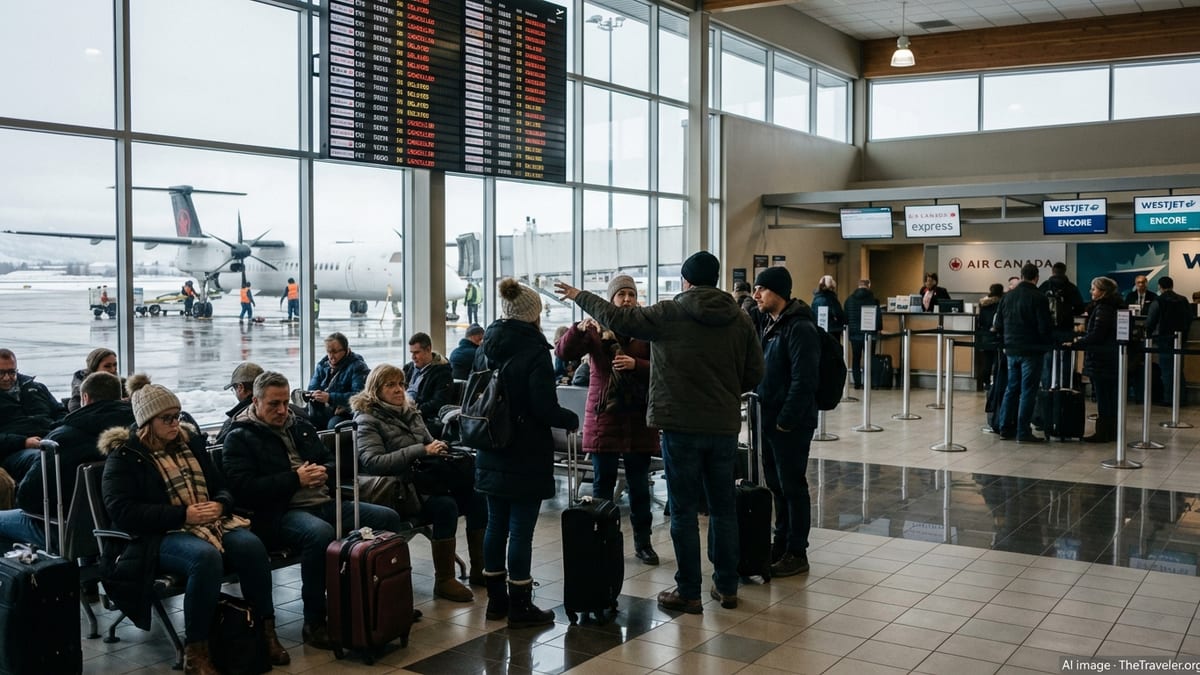
Inside Kelowna’s terminal, the human impact of the disruption has been visible in longer check-in and customer service queues, as well as crowded gate areas during peak periods. Some travelers have reported waiting in line for extended periods to secure rebookings or clarify whether onward connections would be protected if their departing flights continued to slip.
Airlines serving the airport have responded by increasing the use of mobile notifications, airport display updates and public address announcements to keep passengers informed of rolling departure times and gate changes. However, the pace of operational changes can make it difficult to provide certainty far in advance, especially on days when weather or air traffic control restrictions are evolving by the hour.
Compensation and accommodation policies differ by carrier and by the underlying cause of each delay or cancellation. Travelers on affected flights are being encouraged to review their airline’s tariff and passenger rights documentation, retain receipts for unforeseen expenses, and, where appropriate, submit claims once their journeys are complete.
In the meantime, local tourism and hospitality operators in Kelowna have reported a modest uptick in last-minute hotel bookings, particularly near the airport, as some passengers facing missed evening connections opt to stay overnight rather than risk tight transfers in larger hubs.
What Travelers Through Kelowna Should Expect Next
Looking ahead to the coming days, airlines and airport officials in Kelowna are working to restore schedules and minimize further disruption. Operational plans include selective aircraft swaps to increase capacity on busier routes, minor timetable adjustments to create more buffer time between rotations, and targeted use of spare aircraft where available.
For passengers, the most immediate advice remains practical: check flight status frequently on the day of travel, consider earlier departures if onward connections are time-sensitive, and allow additional time at the airport in case of security or check-in backlogs. Those starting their journey in smaller communities served by Pacific Coastal Airlines or Central Mountain Air may also wish to build in extra connection time in Kelowna, given the current fragility of regional schedules.
Travel advisors and industry watchers say that, while the present spike in delays and cancellations is unwelcome, it also highlights the central role Kelowna plays in connecting British Columbia’s Interior to major Canadian hubs. As airlines refine their late-winter operations and conditions stabilize, performance is expected to improve, though regional travelers may continue to see occasional knock-on effects from weather and congestion elsewhere in the network.
For now, passengers passing through Kelowna International Airport are navigating a patchy operational landscape, balancing the promise of quick regional links with the reality of winter-season volatility and tightly stretched airline resources.