

More news on this day
Kenya Airways is stepping up its long-haul ambitions, expanding capacity on the London corridor and consolidating Nairobi as a regional hub, even as continued losses in 2025 highlight the financial tightrope facing Africa’s recovering flag carriers.
Get the latest news straight to your inbox!
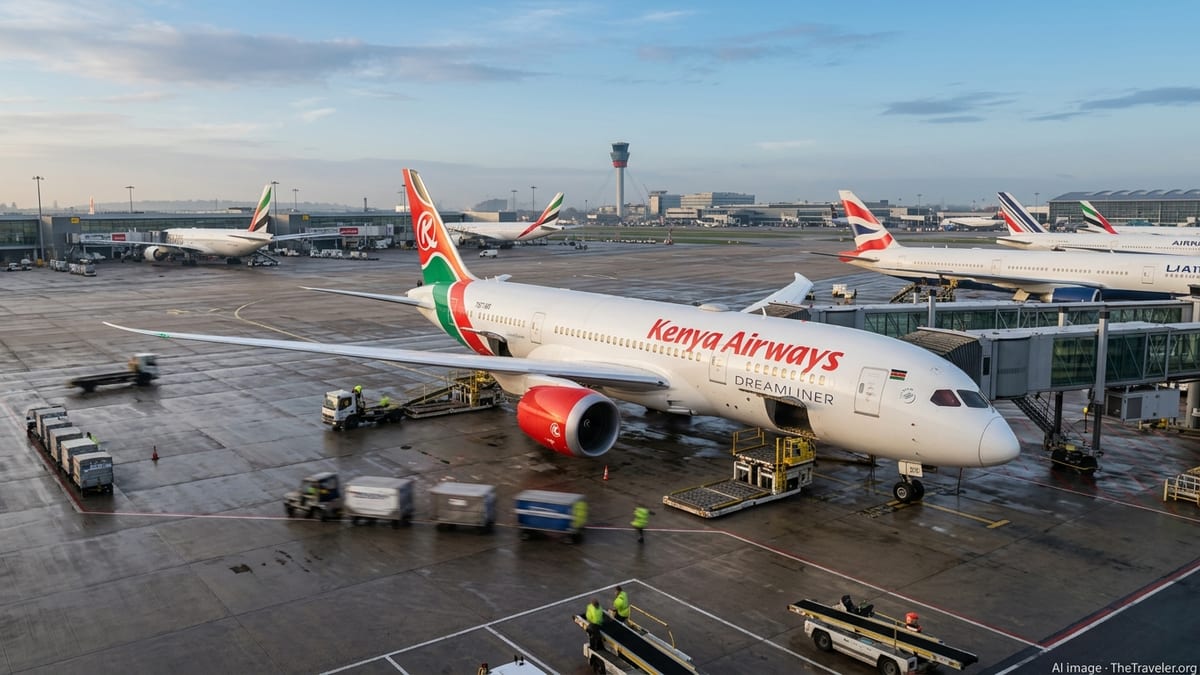
London Capacity Becomes Strategic Battleground
Kenya Airways has placed London at the centre of its post-pandemic network strategy, using the United Kingdom’s capital as a key gateway for Africa–Europe and onward North American traffic. After restoring double-daily Nairobi–London Heathrow services for the 2023/24 winter season, the carrier shifted to Boeing 787-8 aircraft as its primary long-haul workhorse, aligning capacity with improving demand and fuel efficiency priorities, according to specialist schedule trackers and aviation media.
Published schedule data indicates that Kenya Airways adjusted its Nairobi–Heathrow operations in late 2024 and early 2025, temporarily using leased Airbus A330-300 aircraft before reverting to its 787 fleet. The move allowed the airline to sustain seat supply while managing maintenance cycles and fleet constraints, illustrating how critical the Heathrow route has become to overall network performance.
Alongside Heathrow, Kenya Airways is widening its UK footprint with new Nairobi–London Gatwick flights, launched in July 2025. Aviation analysts report that this second London airport gives the airline more flexibility on slots, schedules and pricing, enabling it to target both leisure travellers and the sizeable Kenyan and wider African diaspora in the UK. Together, the dual-London strategy signals a clear bet that premium and VFR (visiting friends and relatives) demand will continue to grow despite economic headwinds.
Industry commentary suggests London’s importance extends beyond point-to-point traffic. Nairobi–London links are increasingly being used to support connecting flows from East, Central and Southern Africa, with Kenya Airways and its partners using Heathrow’s interline capability to feed passengers into broader transatlantic and European networks. This adds pressure on the airline to maintain reliability and competitive product standards on its flagship European corridor.
Nairobi Hub Strengthens as Africa Travel Demand Grows
Nairobi’s Jomo Kenyatta International Airport remains the backbone of Kenya Airways’ strategy, with the carrier orchestrating morning and evening “banks” of arrivals and departures that connect regional African cities to Europe and the Middle East. Operational reports for 2025 show that demand on intra-African and Nairobi–Europe routes stayed robust through the northern summer, helping keep schedules dense even as global macroeconomic uncertainty persisted.
According to sector reports from Kenyan travel and aviation bodies, Africa now accounts for the majority of Kenya Airways’ passenger volumes, underscoring Nairobi’s role as a transfer hub rather than a pure origin-and-destination market. Passenger numbers handled at Jomo Kenyatta International Airport in 2025 exceeded its current design capacity, pointing to sustained demand and the need for both airport and airline capacity upgrades.
Kenya Airways has been adding regional and medium-haul frequencies from Nairobi in response to what it describes in public statements as “steady recovery” and targeted growth opportunities. New and reinstated routes to destinations such as Eldoret and Maputo, alongside increased frequencies on selected African and Middle Eastern sectors, are designed to feed long-haul services, including London, New York and key Gulf hubs.
At the same time, Nairobi’s status as a hub has been tested by operational disruptions, including worker strikes at the main airport in early 2026 that temporarily delayed flights and stranded passengers, as reported by international news agencies. Kenya Airways issued travel advisories and adjusted schedules, highlighting the fragility of hub operations but also the importance of contingency planning as traffic volumes climb toward and beyond pre-pandemic levels.
Loss-Making 2025 Underscores Scale of Turnaround Challenge
Despite clear signs of passenger recovery, publicly available financial statements and local capital-markets commentary show that Kenya Airways remained loss-making in the first half of 2025. The carrier reported a multi-billion Kenyan shilling loss for the period to June 30, 2025, reversing a short-lived return to profitability in 2024 and weighing on its share performance on the Nairobi Securities Exchange.
The 2025 setback reflects a combination of factors that continue to affect many mid-sized network airlines: high finance costs on legacy debt, currency volatility impacting dollar-denominated expenses, and intense competition on key trunk routes. Analysts following the Nairobi market have pointed to Kenya Airways’ half-year 2025 results as a reminder that topline passenger growth alone is not enough to guarantee sustainable profitability.
Nevertheless, the airline’s management has framed 2025 as a year of consolidation and fleet restoration. An official interim results release in August 2025 emphasised continued progress in restructuring obligations, restoring aircraft to active service and fine-tuning the route network. Capacity in available seat kilometres remained below prior-year levels, suggesting a deliberate effort to rebuild cautiously rather than chase volume at any cost.
Market observers note that investors remain wary, with Kenya Airways’ stock ranking among notable laggards on the local exchange in late 2025. However, the same analyses highlight that the airline’s underlying passenger metrics, cargo performance and improving load factors point to operational momentum that could translate into financial stability if cost controls and fleet renewal remain on track.
Fleet, Partnerships and London Strategy Converge
Kenya Airways’ bet on a travel rebound is also visible in its fleet and partnership plans. Aviation industry coverage from 2025 outlines ambitions to grow the fleet from roughly mid-30s aircraft to close to 60 over a five-year horizon, with a mix of replacement and growth jets. The Boeing 787-8 Dreamliner remains the backbone of its intercontinental network, while new-generation narrowbodies such as the 737 MAX are expected to bolster medium-haul efficiency once deliveries commence.
These fleet decisions have direct implications for London services. The move to standardise the Heathrow route on 787s supports product consistency and better unit costs, while additional capacity to Gatwick allows Kenya Airways to spread risk and provide more schedule choice. Industry analysts see this as a textbook example of how a mid-sized hub carrier can leverage aircraft commonality and multi-airport strategies in congested markets.
Partnerships are another pillar of the plan. Kenya Airways has been expanding codeshare and interline cooperation with larger global airlines, particularly on long-haul flows that touch Nairobi. Memoranda of understanding with Gulf and European carriers are intended to deepen connectivity beyond London and Doha, enhance network resilience and attract higher-yield connecting passengers from across Africa.
For UK-bound travellers, this means growing options for one-stop journeys between secondary African cities and London’s two main airports, routed via Nairobi. For Kenya Airways, it creates a more diversified revenue mix in which London is not only an endpoint but also a crucial node in a wider web of partnerships that links Africa to Europe, North America and Asia.
Travelers Face More Choice, but Reliability in Spotlight
For passengers, Kenya Airways’ London and Nairobi expansion translates into more flight options, new departure times and potentially sharper competition on fares, particularly during peak seasons. The addition of Gatwick flights provides alternatives for travellers seeking easier access to southern England or looking to avoid the congestion often associated with Heathrow.
However, the airline’s mixed financial performance and operational strains across the wider aviation system mean that reliability remains under scrutiny. Reports from consumer forums and travel communities in 2024 and 2025 have highlighted sporadic disruption, schedule changes and customer-service challenges, issues that Kenya Airways has said it is addressing through improved communication, digital tools and recovery planning.
Aviation consultancies and industry bodies broadly expect global passenger demand to keep rising through 2025 and 2026, with Africa poised to be one of the fastest-growing regions. Kenya Airways’ decision to double down on its Nairobi hub and London presence positions it to capture a share of that growth, but also commits the airline to delivering consistent operations on some of its most visible routes.
As the carrier navigates another loss-making year, the expansion at London Heathrow and across its Nairobi hub represents both an opportunity and a test. If Kenya Airways can turn resilient passenger demand into durable profits while maintaining reliable service, its London strategy may come to be seen as a pivotal chapter in the airline’s long-running turnaround story.