

More news on this day
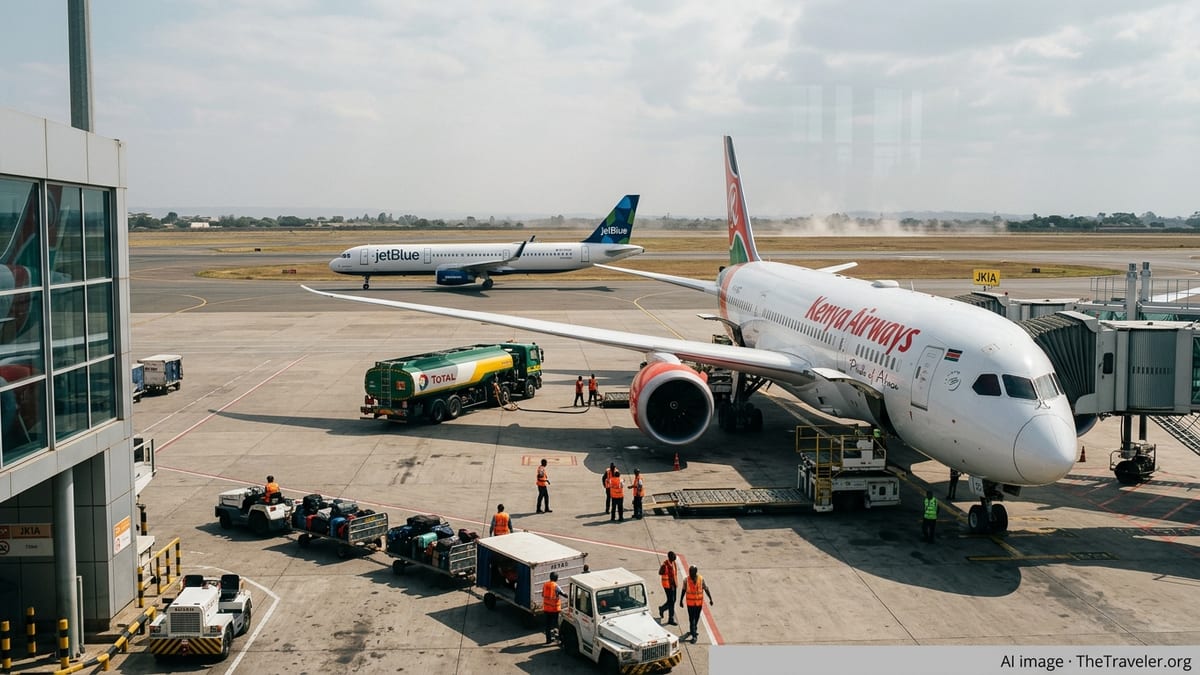
A newly announced partnership between Kenya Airways and JetBlue is set to expand flight options between East Africa and the United States, tapping New York’s John F. Kennedy International Airport as a central hub for smoother, single-ticket journeys.
Get the latest news straight to your inbox!
Details of the New Kenya Airways–JetBlue Partnership
Publicly available information indicates that Kenya Airways has entered into a codeshare agreement with U.S. carrier JetBlue, allowing the Kenyan airline to place its code on select JetBlue-operated domestic flights. The arrangement centers on Kenya Airways’ existing nonstop service between Nairobi and New York, with onward connections on JetBlue from John F. Kennedy International Airport to multiple cities across the United States.
Reports describe the agreement as aimed at improving connectivity for travelers originating in East and Central Africa who need to reach secondary U.S. markets beyond New York. Under a codeshare structure, customers are able to buy a ticket from Kenya Airways that incorporates one or more JetBlue-operated segments, while traveling on a single itinerary that appears under Kenya Airways’ flight code.
The partnership complements, rather than replaces, Kenya Airways’ existing long-haul arrangements. The Nairobi-based carrier already offers daily nonstop flights to New York and works with established partners across Europe and North America. The new link with JetBlue adds another layer of U.S. access by leveraging JetBlue’s large domestic network.
Enhancing U.S. Connectivity from an African Hub
Kenya Airways positions Nairobi’s Jomo Kenyatta International Airport as a strategic gateway for African traffic, and the JetBlue partnership extends that reach deeper into the United States. Coverage from regional business outlets notes that Kenya Airways customers will be able to connect from New York to a range of major American cities, including destinations on the East Coast, in the Midwest, and in the southern United States.
These connections are expected to especially benefit passengers from Kenya Airways’ African network, which spans key markets such as Ethiopia, Tanzania, Uganda, Rwanda, South Africa, and West African points. Travelers can fly into Nairobi on Kenya Airways or partner services, continue on the nonstop Nairobi–New York route, and then connect on JetBlue without having to book separate tickets or recheck bags in New York.
Industry analyses suggest that this type of hub-to-hub linkage is increasingly important for African carriers seeking to capture long-haul demand. By aligning with a U.S. airline that operates a dense domestic schedule, Kenya Airways gains exposure to new origin-and-destination pairs, from mid-sized U.S. cities to coastal gateways, while travelers in those markets receive more one-stop options into East Africa.
Single-Ticket Travel and Customer Benefits
According to coverage from aviation and business media, a central feature of the Kenya Airways–JetBlue agreement is the ability for customers to travel on a single ticket that combines flights operated by both airlines. This typically brings practical advantages, such as through check-in of baggage from the initial departure point in Africa to the final destination in the United States, and coordinated transfer times at New York’s JFK airport.
For travelers, the streamlining can reduce the risk and inconvenience associated with self-connecting on separate tickets, such as navigating multiple check-in processes or handling missed connections independently. A single itinerary generally allows the operating airlines to manage schedule disruptions more coherently, rebooking passengers on later flights within the partnership framework when irregular operations occur.
The agreement is also expected to integrate with existing loyalty and booking systems. While specific mileage-earning and redemption details vary by carrier and program, industry observers note that codeshare arrangements typically enable passengers to credit flights to the frequent flyer program of the marketing airline, expanding earning opportunities on itineraries that include multiple partners.
Strategic Context in Kenya Airways’ Partnership Network
The JetBlue deal comes as Kenya Airways continues to deepen its network of international partnerships. In recent years, publicly available corporate announcements have highlighted expanded codeshares with Delta Air Lines on the Nairobi–New York route, as well as collaborations with carriers such as Air Europa, WestJet, Air India, Virgin Atlantic, and Qatar Airways, all designed to strengthen global connectivity for African travelers.
These arrangements collectively support Kenya Airways’ stated objective of positioning Nairobi as a primary entry and exit point for the African continent. European and Middle Eastern partners extend reach into their respective regions, while North American partners like Delta and now JetBlue provide wider access across the U.S. and Canada. The new U.S. domestic links offered via JetBlue complement long-haul options, filling in gaps to cities not directly served by Kenya Airways or its other partners.
Analysts following the African aviation market have pointed out that such cooperation can be particularly important for airlines operating in competitive long-haul corridors. Rather than launching multiple point-to-point routes, carriers can rely on codeshares and interline agreements to test demand, build brand presence, and offer more destinations with lower commercial risk.
Implications for African and U.S. Travel Markets
The Kenya Airways–JetBlue partnership arrives at a time when travel between Africa and North America is steadily recovering and, in some cases, surpassing pre-pandemic levels. Data cited in industry reports shows increasing interest from both leisure and business travelers, particularly in sectors such as diaspora travel, tourism, trade, and conference traffic.
For Africa, more seamless access to secondary U.S. cities could stimulate new visitor flows and support tourism diversification beyond traditional gateways. Travelers from cities like Boston, Orlando, or Charlotte, for example, may find it easier to book single-itinerary trips to Nairobi, beach destinations on Kenya’s coast, or safari circuits in East Africa.
On the U.S. side, the agreement could enhance outbound travel opportunities to East and Central Africa by making itineraries more visible in booking systems and by reducing the logistical friction of multi-carrier journeys. Travel agents and online booking platforms are expected to incorporate the new codeshare options as inventory becomes available, widening consumer choice for transatlantic and trans-African trips.
Market commentators also note that, as more partnerships of this kind take shape, competition among global alliances and independent carriers may intensify on the Africa–U.S. corridor. For passengers, that competition has the potential to yield better fares, improved schedules, and more flexible routing options, with the Kenya Airways–JetBlue agreement emerging as one of the latest developments reshaping connectivity between the two regions.