

More news on this day
Kenya Airways has successfully flown home hundreds of stranded passengers from Dubai, mounting rare repatriation flights through partially reopened airspace as the fast‑escalating Iran war disrupted normal travel routes across the Middle East.
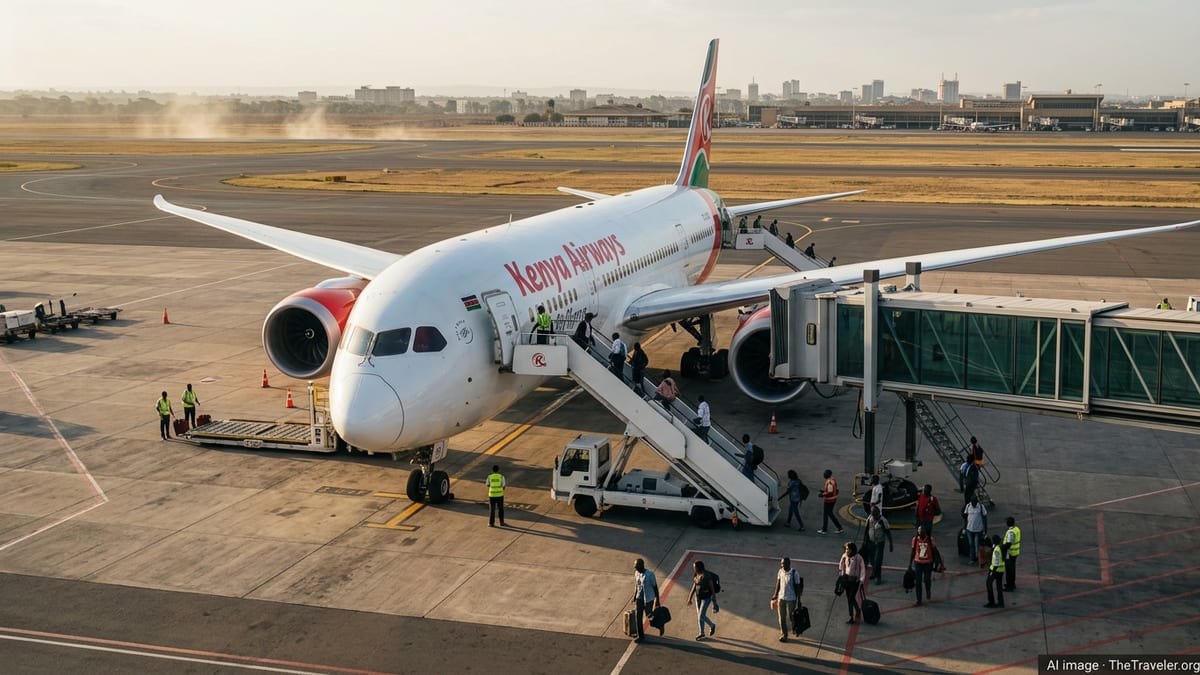
A Lifeline From Dubai as War Shuts Down Regional Skies
The emergency flights, operated between Nairobi and Dubai on March 4 and 5, offered a narrow corridor of escape after sweeping airspace closures left Dubai International Airport largely paralyzed and tens of thousands of travelers stuck in the Gulf’s busiest hub. The United Arab Emirates had imposed a temporary shutdown following coordinated strikes involving Iran, Israel and the United States, before allowing a limited number of tightly controlled movements for humanitarian and repatriation purposes.
Kenya Airways, which had suspended its regular Dubai and Sharjah services on February 28, secured special slot approvals from Dubai authorities to operate what it described as non-scheduled, repatriation-only flights. Seats were prioritized for Kenyan citizens, residents and other eligible travelers who had been unable to leave the UAE once the conflict flared and commercial schedules collapsed.
For many of those passengers, the red-and-green tail of the Kenyan flag carrier symbolized more than a routine journey home. With regional tensions still volatile and the risk of further strikes hanging over major hubs, simply boarding a confirmed flight out of Dubai represented a critical step away from a rapidly evolving conflict zone.
Kenyan officials described the evacuation effort as a coordinated response involving the airline, civil aviation regulators and diplomatic missions, all working against the clock to match limited seat availability with the most urgent cases while maintaining stringent safety controls for crews and aircraft.
From Suspension to Swift Reversal: How KQ Mobilized
On February 28, as the first waves of airspace closures swept across the Gulf and parts of the wider Middle East, Kenya Airways moved quickly to suspend all scheduled flights to Dubai and Sharjah. The carrier cited safety concerns for passengers and crews amid widespread diversions, cancellations and the risk of military activity along traditional flight paths.
Behind the scenes, airline operations teams monitored evolving airspace notices and coordinated with regional aviation authorities to map out safe routing options that bypassed active conflict areas. According to company statements this week, the decision to return to Dubai on a limited basis came only after the UAE confirmed a tightly controlled reopening at Dubai International Airport for repatriation traffic.
Even then, the Nairobi-based airline framed the missions not as a restart of normal services but as a temporary humanitarian bridge. Flight numbers, schedules and passenger eligibility were released in phases, with travelers urged not to proceed to the airport until they received direct confirmation from the airline, a measure intended to prevent crowding in already stretched terminals.
The compressed timeline underscored the logistical challenge: aircraft and crews had to be reallocated, contingency plans drawn up for potential last-minute route changes, and ground handling in Dubai coordinated amid a patchwork of other nations’ evacuation efforts. Aviation analysts in Nairobi noted that for a mid-sized African carrier, executing such flights safely under crisis conditions required both nimble planning and close government backing.
Human Stories Behind the Repatriation Numbers
For the passengers who finally boarded the limited Kenya Airways services, the repatriation flights marked the culmination of several days of uncertainty. Many had watched departure boards at Dubai International Airport turn into a wall of cancellations as regional carriers halted operations and international airlines diverted away from Gulf airspace.
Some travelers had exhausted hotel savings while waiting for a viable exit route, particularly migrant workers and short-stay visitors who found themselves cut off from their original connections. Travel agents in Nairobi reported a surge of frantic calls and messages from families seeking any information on when, or if, their relatives could be flown home.
Kenyan diplomatic staff in the UAE helped compile priority lists, focusing on those with medical needs, expired visas or limited funds. Parents traveling with young children, students and business travelers stranded mid-journey were also among those placed on the repatriation manifests once Kenya Airways secured final approvals for takeoff and landing slots.
Passengers arriving at Nairobi’s Jomo Kenyatta International Airport on Wednesday and Thursday described a mix of exhaustion and relief. Many recounted tense nights punctuated by the sounds of distant explosions and the constant checking of news alerts, uncertain whether air corridors would reopen in time for them to leave.
Safety, Routing and the Complexities of Flying Near a War Zone
Operating any civilian flight near an active conflict zone is a complex calculation, and Kenya Airways’ Dubai missions unfolded against one of the most volatile aviation backdrops since the early stages of the global pandemic. With multiple Middle Eastern states closing their skies and others restricting overflights, planners had to build routes that kept aircraft clear of military operations while still remaining commercially and operationally feasible.
Aviation experts say this often involves flying longer, more northerly or southerly tracks, adding time and fuel costs but significantly reducing risk. In the case of the Nairobi–Dubai corridor, crews worked with updated navigation data and air traffic control guidance to thread a path through a fragmented airspace map, where a single new notice could force last-minute reroutes or even turnbacks.
The repatriation flights also demanded heightened vigilance from crew members trained to handle crisis scenarios, from contingency descent plans to reinforced cockpit procedures. Kenya Airways has emphasized that no departure was cleared without a fresh assessment of regional security conditions and confirmation that both departure and arrival airports could support safe operations.
Insurers, too, played a role, adjusting war-risk coverage as the conflict evolved. Industry observers noted that the willingness of African national carriers such as Kenya Airways to conduct targeted evacuation missions highlights the strategic importance of having domestically controlled fleets capable of responding rapidly when foreign airlines pull back.
What Comes Next for Stranded Travelers and Kenya’s Flag Carrier
While this week’s flights brought critical relief for hundreds of Kenyans and other travelers, the broader disruption across the Middle East remains severe. Large portions of regional airspace are still restricted, and airlines continue to cancel or reroute services through alternative hubs as the Iran war grinds on.
Kenya Airways has stressed that its Dubai repatriation flights do not signal a full restoration of its Gulf schedule. Instead, executives say they are treating each potential movement as a discrete operation, contingent on evolving security assessments and further approvals from UAE authorities. Additional ad hoc flights remain possible if demand and safety conditions align.
For now, Kenyan officials are urging citizens still in the region to stay closely in touch with embassies and to register their details in case more evacuation windows open. Travelers with existing tickets have been advised to monitor communication channels from the airline rather than attempting to rebook through third parties in an already crowded market for outbound seats.
The crisis has also sparked a wider debate in Kenya about national resilience in times of geopolitical shock. Lawmakers and industry figures are calling for clearer contingency playbooks for evacuating citizens from key global hubs, stronger regional coordination with other African carriers, and investment in route flexibility so that Nairobi can remain connected even when traditional transit centers like Dubai are forced offline. For the passengers who stepped off Kenya Airways’ repatriation flights this week, however, the focus was far simpler: they were home, and they were safe.