

More news on this day
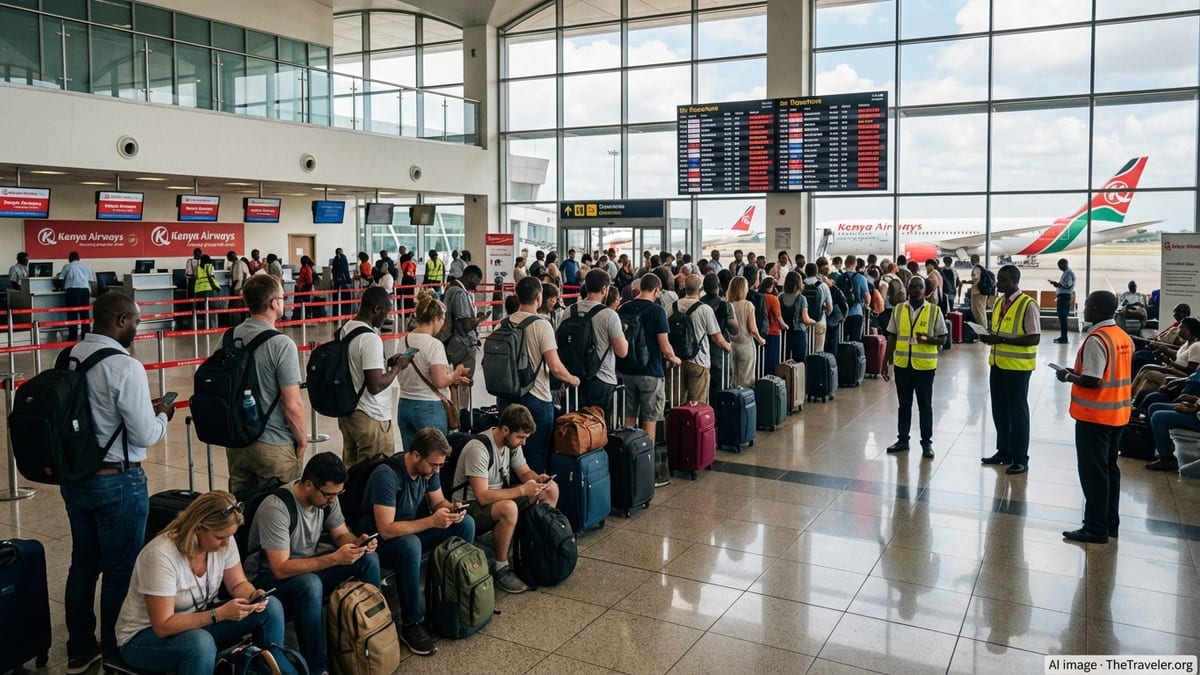
Thousands of travelers passing through Nairobi’s Jomo Kenyatta International Airport this week were confronted with snaking queues, handwritten departure boards and hours-long waits as a sudden aviation workers’ strike morphed into the latest operational crisis for Kenya Airways and its partners, rippling far beyond Kenya’s borders and forcing passengers to rethink their travel plans across Africa and beyond.
How the Kenya Airways Crisis Unfolded
The latest turbulence for Kenya’s national carrier was triggered not by financial headlines but by industrial action on the ground. Aviation workers, including key air traffic control staff, downed tools after a long-running dispute with authorities over pay, benefits and stalled collective bargaining agreements. Within hours, operations at Jomo Kenyatta International Airport in Nairobi, the airline’s main hub, were severely disrupted, with some flights delayed by up to six hours and others unable to depart at all.
Kenya Airways, already managing a delicate turnaround after years of losses and past labor unrest, was forced to issue urgent travel advisories. Passengers were told not to go to the airport without checking the status of their flights and were warned that significant delays were likely. Schedules were hastily redrawn as the carrier sought to keep at least part of its regional and long-haul network running despite limited air traffic control capacity and strained airport staffing.
As the strike entered its second day, Kenya Airways signaled to customers that delays of up to four hours on departures were possible, even as it coordinated closely with aviation authorities and airport operators. Only after a return-to-work agreement was reached between the Kenya Aviation Workers Union and the government did the airline begin the complex task of normalizing operations, clearing backlogs and rebooking stranded travelers.
Why This Matters Far Beyond Nairobi
For many travelers, Kenya Airways is not just a national flag carrier but a crucial connecting airline linking African cities with Europe, the Middle East and Asia. Nairobi’s Jomo Kenyatta International Airport is one of the region’s most important hubs for both business and leisure traffic, and any disruption there has an outsized knock-on effect. The latest crisis therefore reverberated far beyond Kenya’s borders, affecting passengers who may never have planned to leave the terminal in Nairobi.
Transit passengers found that even if their long-haul segments were technically operating, misaligned connections and ground delays could derail carefully timed itineraries. Some travelers missed onward flights to safari gateways like Maasai Mara and the Kenyan coast, while others saw trips to neighboring countries such as Tanzania, Rwanda and Uganda abruptly upended. Tourism operators and travel agencies reported a fresh wave of last-minute itinerary changes, refunds and emergency hotel bookings.
The ripple effects extended into cargo and business travel too. Kenya’s aviation sector is a key conduit for high-value exports, including fresh flowers, produce and manufactured goods. Disruptions to flight schedules added pressure to supply chains that depend on reliable, time-sensitive air links. For corporate travelers and conference organizers, uncertainty over route stability and punctuality at a hub like Nairobi can influence decisions on where to schedule meetings or base regional operations.
Inside the Labor Dispute Driving the Disruptions
At the heart of the recent crisis lies a protracted labor dispute between aviation workers and authorities, centered on long-standing grievances over pay, working conditions and delayed implementation of collective bargaining agreements. The Kenya Aviation Workers Union argued that previous commitments on issues such as contract terms, staff grading and benefits had not been fully honored, prompting it to issue a strike notice and, ultimately, to withdraw labor when talks stalled.
The walkout affected more than just one company. Air traffic control operations were impaired, and airport services across terminals were disrupted, leaving passengers stranded in concourses and, in some cases, sitting on aircraft waiting for clearance to depart. The Kenya Airports Authority and the Kenya Civil Aviation Authority responded with contingency measures, but the impact on operations was immediate and highly visible to travelers.
A breakthrough came after high-level mediation involving the transport and labor ministries, airport authorities and union leaders. The parties agreed on a return-to-work formula that included commitments to address unresolved issues and protect workers from victimization over the industrial action. With the union suspending the strike, flight operations began to normalize, though the backlog of disrupted services meant that delays and schedule adjustments continued for some time.
For Kenya Airways specifically, the labor dispute underscored its dependence on a wide ecosystem of aviation workers it does not directly employ but without whom its aircraft cannot operate safely or on time. The episode highlighted the vulnerability of carriers that are closely tied to state-run infrastructure, labor negotiations and regulatory decisions.
Passenger Experiences: From Missed Safaris to Visa Headaches
On the terminal floors and at departure gates, the crisis translated into long queues, confusion and frayed tempers. Travelers reported waiting for hours with limited information while departure boards filled with the word “delayed” and staff struggled to keep up with rebooking and customer service demands. Families were inadvertently separated when access to certain terminal areas was restricted, and some foreign visitors found themselves in a bureaucratic bind as visas expired while they were still stuck in the country.
The disruption came at a time when tourism to Kenya has been rebounding, driven by renewed interest in safaris, beach holidays on the Indian Ocean coast and city breaks in Nairobi. For tour operators, the strike was a stark reminder that even perfectly planned itineraries can be vulnerable to sudden shocks in aviation. Missed connections to domestic flights and regional links forced last-minute changes to lodge stays, park entries and ground transfers, creating additional costs and logistical headaches.
Travelers in premium cabins and loyalty program members were not immune. Lounge access provided some comfort, but when air traffic control restrictions limit the number of aircraft that can take off or land, even priority passengers face delays. Some airlines operating codeshares with Kenya Airways had to arrange alternative routings for their customers or provide hotel accommodation when minimum connection times could not be met.
For many affected passengers, the main complaint was not just the delays themselves but the uncertainty and lack of real-time updates. The crisis highlighted the importance of clear communication during disruptions, especially in a hub airport where many travelers are unfamiliar with local procedures and rely heavily on digital notifications and airline staff guidance.
Short-Term Outlook: Are Flights Really Back to Normal?
With the strike suspended and a return-to-work agreement in place, authorities have emphasized that operations at major Kenyan airports are now normalizing. Kenya Airways has been working to restore its full schedule, reassign crews and aircraft and clear the backlog of stranded passengers. Low-cost subsidiary Jambojet, which had canceled dozens of flights and operated only a fraction of its network at the height of the disruption, has also reported a return to more regular service.
Travelers, however, should expect a transitional period in which punctuality remains uneven. When an airline and airport system experience a shock of this scale, knock-on effects can linger for several days, as aircraft and crews are repositioned and maintenance windows are recalibrated. Some routes may experience altered departure times, equipment changes or residual delays as airlines fine-tune their operations and prioritize certain services.
Industry analysts note that the swift resolution of the strike has helped limit long-term damage to Kenya’s aviation reputation, but the episode has inevitably raised questions among international travelers and tourism partners about reliability. Future bookings could be influenced by perceptions of stability, especially among first-time visitors weighing multiple African hub options for safaris or regional business travel.
For now, most carriers using Nairobi as a gateway are urging passengers to maintain their travel plans while building in extra time for connections and staying alert to updates. The key message: flights are running again, but flexibility remains advisable in the short term.
What This Means for Your Upcoming Trip
If you are scheduled to fly with Kenya Airways or connect through Nairobi in the coming days or weeks, the latest crisis should prompt a careful review of your itinerary rather than an automatic cancellation. Airlines generally offer waivers or flexible rebooking options in the wake of widespread disruptions, and many affected passengers have already been moved onto alternative flights or routes as operations stabilize.
Travelers with tight same-day connections, especially those linking international arrivals with domestic or regional departures, may wish to extend layovers where possible or consider overnight stops in Nairobi to build in a safety margin. Those planning safaris or multi-stop trips involving internal flights should stay in close contact with tour operators, who can help adjust ground arrangements if flight times shift.
It is also prudent to double-check visa requirements and entry rules, making sure you have enough validity to cover an unexpected delay. Some travelers caught up in the strike discovered that their visas had technically expired while they were still in the country, adding an avoidable bureaucratic complication to an already stressful experience.
Insurance coverage is another key consideration. Policies vary widely in how they treat labor disputes and operational disruptions, so reviewing the fine print before departure can determine whether you are entitled to compensation for hotel stays, missed tours or alternative transport. Comprehensive travel insurance that explicitly covers strikes and schedule changes can provide a valuable safety net when flying through busy regional hubs.
Practical Steps to Protect Your Travel Plans
The events in Nairobi underscore a set of practical steps that can help reduce the impact of similar crises wherever they occur. First, always monitor your booking in the 48 hours before departure, using airline apps, text alerts and email notifications. While ground staff may be overwhelmed during a disruption, digital tools can often provide earlier warnings of schedule changes or gate reassignments.
Second, consider how your itinerary would cope with a multi-hour delay. Building in longer connection times, especially when traveling with checked luggage or connecting to smaller regional airports, can often prevent a missed onward flight from turning into an overnight ordeal. If a hub is experiencing known turbulence, it may be wise to avoid scheduling critical meetings or nonrefundable activities too close to your arrival time.
Third, maintain flexibility in your accommodation and ground transport plans. Free-cancellation hotel bookings near key hubs such as Nairobi can be a useful fallback if late-night delays force an unplanned stopover. Similarly, choosing refundable rail or road transfers where possible can help avoid sunk costs if your arrival time changes.
Finally, keep essential items with you in your carry-on, including medications, a change of clothes and chargers. During the Kenya Airways crisis, some stranded passengers were unable to access checked luggage for extended periods, turning minor delays into far more uncomfortable experiences. Being prepared for an unexpected wait can make a significant difference when airports come under strain.
Could This Signal Deeper Changes in East African Air Travel?
Beyond the immediate disruption, the latest crisis raises broader questions about the future of Kenya Airways and the wider East African aviation landscape. The carrier has long been a symbol of national pride and a strategic asset for tourism and trade, yet it has also weathered repeated financial challenges, debt restructurings and labor disputes. Each new shock tests the airline’s ability to maintain confidence among passengers, investors and international partners.
Some industry observers argue that the swift mediation between government, regulators and unions in this case could pave the way for more structured dialogue on labor and operational issues in the sector. A more predictable framework for addressing worker grievances and funding airport infrastructure may help reduce the risk of sudden strikes that catch travelers off guard.
At the same time, rival hubs in the region are closely watching developments in Nairobi. Competing airports and airlines in neighboring countries see reliability as a competitive advantage, particularly for long-haul travelers choosing where to connect. If Kenya can demonstrate that it has learned lessons from the latest crisis, strengthened communication with passengers and stabilized labor relations, it could reinforce its position as a preferred gateway to East Africa.
For global travelers, the key takeaway is that the aviation map of Africa is dynamic, and decisions taken in the aftermath of this Kenya Airways crisis will shape route networks and connection patterns for years to come. Staying informed about developments at major hubs like Nairobi, and building flexibility into travel plans, will remain essential strategies for anyone exploring the region.