

Travel across East Africa was thrown into disarray on Monday, February 16, as a strike by aviation workers at Nairobi’s Jomo Kenyatta International Airport led to widespread flight delays, cancellations and scenes of mounting frustration among thousands of stranded passengers at one of the continent’s busiest hubs.
Strike Erupts at East Africa’s Busiest Gateway
The disruption began early Monday when members of the Kenya Aviation Workers Union launched an industrial action targeting key operations at Jomo Kenyatta International Airport, including air traffic control and ground handling. The go slow quickly cascaded through the airport’s tightly scheduled operations, forcing airlines to delay or cancel departures and leaving arriving aircraft holding for clearance on the tarmac.
Departing flights from Nairobi were reported to be delayed by up to four hours, with some planes kept at the gate as pilots waited for takeoff slots. Passengers already seated on board described being held in their seats for extended periods while crews relayed sparse updates about air traffic control delays and staffing shortages.
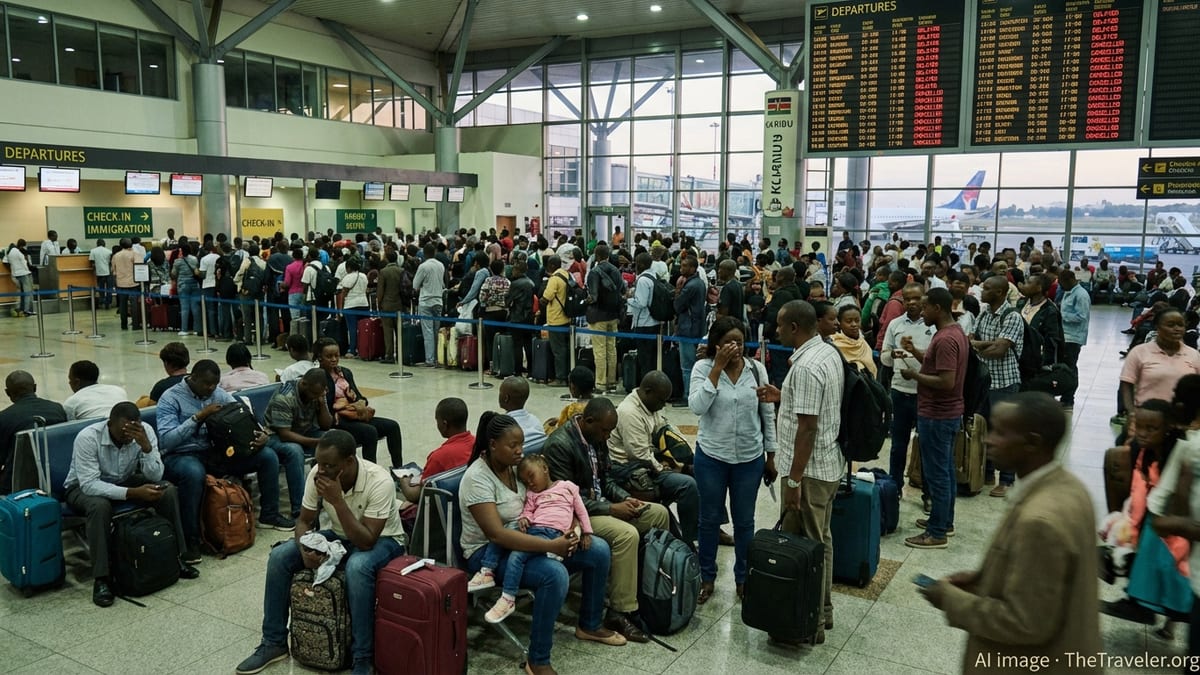
By midday, long queues had formed at check in counters and security screening points in both international and domestic terminals, as airport staff struggled to manage crowds amid reduced manpower. Families on school holidays, business travelers on tight schedules and tourists on safari itineraries alike found their plans suddenly upended.
Authorities confirmed that the labor action affected not only Jomo Kenyatta International Airport but also several smaller airports around the country, compounding the national impact on domestic travel and regional connectivity.
Union Demands Boil Over After Years of Dispute
At the heart of the strike is a long running dispute between the Kenya Aviation Workers Union and the Kenya Civil Aviation Authority over implementation of a collective bargaining agreement. Union leaders say the deal, which dates back several years, has not been honored in full and that repeated attempts at dialogue have failed to produce substantive progress.
Workers are demanding better pay, improved benefits and safer working conditions, arguing that staffing levels and compensation have not kept pace with the surge in passenger traffic and the operational demands placed on Kenya’s main aviation gateway. They also point to rising living costs in Nairobi, saying stagnating wages have eroded their purchasing power.
The union had issued a formal strike notice a week earlier, warning that failure to resolve the stalemate would lead to industrial action and a possible shutdown of Kenyan airspace. Negotiations over the weekend did not yield a breakthrough, setting the stage for Monday’s dramatic escalation.
Union representatives insist they resorted to a strike only after other avenues were exhausted, accusing authorities of dragging their feet and underestimating the workforce’s resolve. Government officials, meanwhile, have urged a return to the negotiating table, citing the economic harm caused by disrupting a key transport and trade artery.
Passengers Stranded, Terminals Overflowing
Inside the airport, stranded travelers spent hours sitting on suitcases, slumped against terminal walls or pacing departure halls in search of information. Many reported conflicting messages from airlines and airport staff about expected departure times, with electronic boards cycling through rolling delay notices.
Families with children struggled to find food, seating and quiet spaces in congested waiting areas. Some travelers reported running out of local currency as they waited for clarification on whether to rebook, seek hotel rooms or remain at the airport overnight. Passengers in transit with tight connections through Nairobi faced particular anxiety as onward flights departed without them.
Scenes of frustration played out at airline service desks, where snaking lines of customers demanded rebooking, refunds or accommodation vouchers. Others turned to social media to voice complaints about the lack of clear communication and to share photos of crowded boarding areas, backed up security checkpoints and growing tempers.
For international tourists concluding safaris or beach holidays, the disruption tarnished what had otherwise been a positive experience of Kenya. Several foreign travelers interviewed at the terminals expressed concern about missed connections back to Europe, North America and the Middle East, and the additional costs of visa extensions, hotels and reissued tickets.
Kenya Airways and Airport Authority Scramble to Respond
Kenya Airways, the national flag carrier and JKIA’s largest tenant, issued a travel advisory urging passengers not to proceed to the airport without a confirmed flight status. The airline acknowledged that air traffic control delays were affecting both arrivals and departures, and warned of schedule adjustments as it sought to prioritize stranded passengers.
Operational teams for Kenya Airways and other carriers worked through the day to reshuffle crews and aircraft, reassign passengers to available seats and coordinate with authorities on safe departure sequencing. Contingency rosters were activated to ensure that critical safety and ground functions could continue at a reduced but stable level.
The Kenya Airports Authority, which operates JKIA, said contingency plans had been implemented to minimize disruption and safeguard safety standards. Officials emphasized that all aircraft movements continued to be managed within established aviation procedures, even as staffing shortfalls slowed operations.
Airport managers also appealed for calm, asking passengers to remain in close contact with their airlines for the latest information. They signaled a willingness to engage in constructive dialogue with union leaders, but stressed the need to balance workers’ demands with the broader public interest in keeping the country’s main international gateway functioning.
Regional Travel and Tourism Feel the Shockwaves
The strike’s impact extended far beyond Nairobi’s terminals. As East Africa’s primary aviation hub, Jomo Kenyatta International Airport plays a critical role in connecting regional capitals to long haul routes serving Europe, the Middle East, Asia and North America. Delays and cancellations in Nairobi quickly rippled across airline networks.
Tour operators reported scrambling to adjust itineraries for safari clients whose flights into or out of Kenya were disrupted. Some tour groups returning from national parks and coastal resorts were rerouted to alternative airports or placed in emergency hotel accommodation while they awaited new departure times.
Business travelers and international conference delegates found themselves stuck in transit, missing meetings and official engagements in Nairobi and other regional cities. Cargo operations, including high value perishables such as fresh flowers and produce destined for overseas markets, faced delays that could translate into significant financial losses.
Regional carriers that rely on Nairobi as a transfer point also experienced knock on effects, with aircraft and crews out of position and connecting passengers missing onward services. Aviation analysts warned that if the disruption were to continue for several days, the financial toll on airlines, tourism operators and exporters could be substantial.
Authorities Promise Orderly Recovery but Warn of Backlogs
By late Monday, aviation regulators and airport authorities said recovery efforts were under way to clear the backlog of delayed flights. The Kenya Civil Aviation Authority indicated that operations were gradually stabilizing, though it acknowledged that normal schedules would take time to restore.
Officials described a structured approach to clearing the backlog, with priority given to long haul international departures, time sensitive cargo and flights carrying large numbers of connecting passengers. Domestic routes and shorter regional services were rescheduled around these priorities, leading to further adjustments for travelers on intra African journeys.
Industry observers noted that even after a formal resolution of the strike, JKIA could take several days to fully return to its pre disruption rhythm. Aircraft and crews remain out of position, slots must be reallocated and passengers need to be re accommodated across already busy services. Airlines are expected to run fuller than usual flights as they work through the build up of stranded travelers.
Authorities have urged passengers with travel scheduled in the coming days to remain in contact with their airlines, expect possible changes to departure times and allow extra time at the airport. They also reiterated that safety would not be compromised in the drive to restore normal operations more quickly.
Human Stories Behind the Headlines
Amid the operational statistics and political statements, the human dimension of the strike has been most visible in the crowded concourses and waiting areas of Jomo Kenyatta International Airport. Behind every delay notification is a missed family reunion, a postponed job interview or an interrupted holiday.
Parents traveling with young children spoke of the difficulty of keeping them fed, rested and entertained in packed terminals with limited seating. Elderly passengers and those with reduced mobility faced additional challenges navigating long queues and standing in line for hours as tempers frayed around them.
For many Kenyan travelers, the disruption revived memories of previous strikes and infrastructure challenges at JKIA, prompting questions about the resilience of the country’s transport system and the effectiveness of long term planning. Some expressed sympathy for the workers’ demands, but argued that ordinary citizens and visitors should not bear the brunt of unresolved institutional disputes.
The episode has also highlighted the reliance of global travel on often invisible teams of airport workers, from air traffic controllers and baggage handlers to security staff and cleaners. Their absence for even part of a day underscored how crucial their roles are in keeping passengers and planes moving smoothly across continents.
What Travelers Should Expect in the Coming Days
For travelers scheduled to transit through Nairobi in the days ahead, aviation experts advise a cautious and flexible approach. Even if formal industrial action is called off quickly, residual delays and occasional cancellations are likely as airlines and airport authorities work through the backlog.
Passengers are being encouraged to monitor flight status closely and remain alert to notifications from airlines about changed departure times, terminal shifts or rebooked itineraries. Those holding separate tickets for onward connections may face particular vulnerabilities and are urged to reconfirm all segments before starting their journeys.
Travel agents and tour operators are already reviewing contingency plans that might include rerouting some itineraries through alternative hubs in the region should the disruption persist longer than expected. For now, however, Jomo Kenyatta International Airport remains central to most schedules across East Africa, leaving the travel industry watching closely for signs that operations are firmly back on track.
As negotiations between union leaders and aviation authorities continue, the episode serves as a stark reminder of how quickly industrial disputes can ripple through global mobility. For thousands of passengers who spent the day in crowded terminals instead of at their intended destinations, Kenya’s main travel gateway has rarely felt more under siege.