

Each spring, millions of travelers flock to the Netherlands with one goal in mind: to stand among the tulips. Yet first-time visitors are often surprised to learn that there is a big difference between Keukenhof Gardens, the world-famous spring flower park, and the surrounding tulip fields that stretch for kilometers across the Dutch countryside.
Understanding how these two experiences differ in atmosphere, access, and logistics is key to planning a satisfying tulip trip and avoiding disappointment.
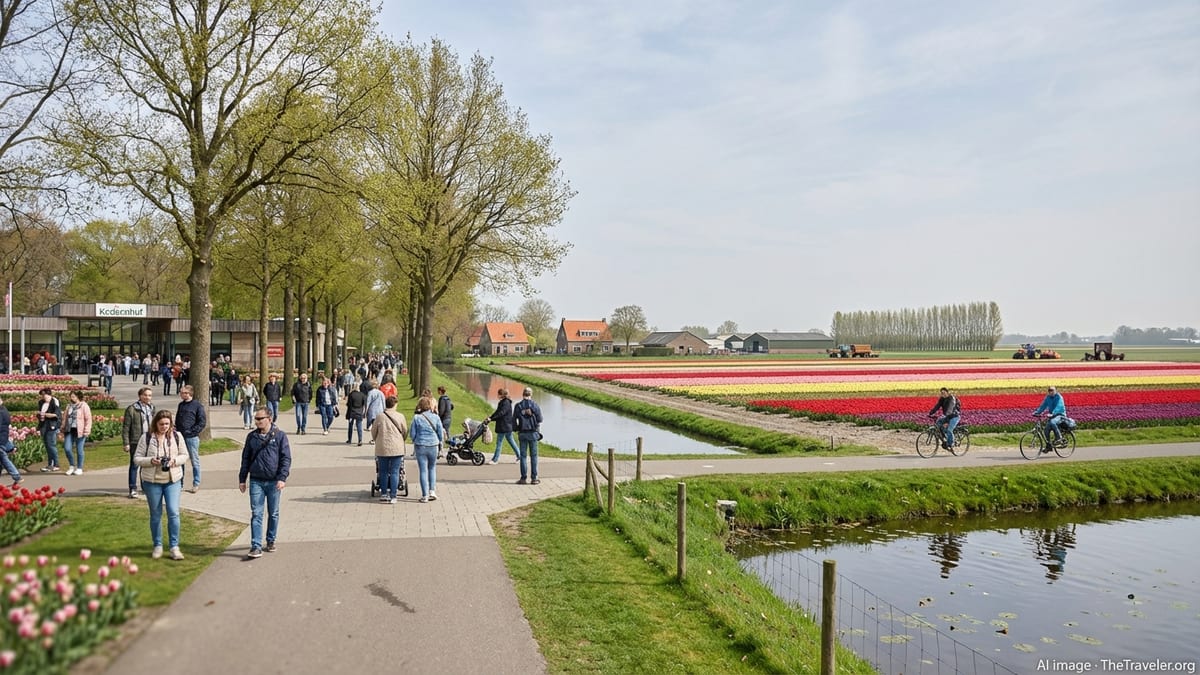
Keukenhof Gardens in Context
Keukenhof Gardens, located near the town of Lisse in the heart of the Dutch bulb-growing region, is a curated spring park rather than a working farm. Often called the Garden of Europe, it opens to the public for just eight weeks each year, typically from around March 20 to May 11, and closes for the rest of the year while gardeners prepare the next season’s displays. Within its fences, more than seven million flower bulbs are planted by hand in intricate designs that change annually.
This short season concentrates visitor numbers. In recent years Keukenhof has attracted well over a million visitors in less than two months, making it one of the busiest attractions in the Netherlands during spring. Timed-entry tickets, crowd management and extensive facilities reflect this scale. Keukenhof is designed as a walkable park with broad paths, pavilions, cafés, rest areas, art installations and family-friendly play zones. It is a complete day out, suitable for visitors who want comfort and services as well as flowers.
By contrast, the famous tulip fields that you see in postcards and social media images are part of the broader agricultural landscape. They surround Keukenhof and spread across regions such as the Bollenstreek between Haarlem and Leiden, the Noordoostpolder in Flevoland and parts of Zeeland. These are commercial bulb farms, first and foremost. Their purpose is to grow and harvest bulbs, not to host visitors. There may be no ticket booth, parking area, toilets or signposts, and in many places you would not even know you are approaching a renowned photo spot until colored stripes appear beyond the roadside ditch.
What You Actually See: Design Park vs Working Landscape
Inside Keukenhof, the experience is about composition and variety. Garden designers plan sweeping beds of tulips, daffodils and hyacinths in carefully chosen color palettes. Some paths lead through woodland-style plantings under mature trees; others edge reflective ponds or open lawns. Indoors, themed floral shows present unusual bulb varieties and elaborate arrangements that you would rarely see in farm fields. Because different flower types bloom at different times, gardeners stagger plantings to keep the park attractive from opening day through closing day.
The agricultural tulip fields, by contrast, are about scale and repetition. From a distance, they form broad bands of solid color, sometimes stretching to the horizon. Up close, each field usually holds just one variety. The effect is powerful but minimalist: a pink sea here, a red-and-yellow pattern there, a sudden strip of deep purple beside a canal. You will not find manicured lawns or artfully curved beds. Instead, you see neat rows, irrigation channels, farm buildings and farm machinery: a working landscape whose beauty is almost accidental to its commercial purpose.
Bloom timing feels different too. Keukenhof’s planting strategy and use of multiple bulb varieties help ensure some part of the park is always in good shape during its spring opening window. In the fields, however, tulips follow the weather. A cold March can delay color until mid-April, while an early warm spell might bring fields into bloom sooner and prompt farmers to top the flowers earlier to divert energy back into the bulbs. As a result, the fields may look spectacular for only a few weeks, and not necessarily for the entire period that Keukenhof is open.
Access, Tickets and Practicalities
Access is one of the clearest differences between Keukenhof and the surrounding fields. Keukenhof functions like a major tourist attraction with fixed opening hours, ticketed entry and clearly defined facilities. For the 2025 season, for example, the park is scheduled to open from March 20 to May 11, typically from early morning until early evening. Tickets must be purchased for a specific time slot, and popular days such as weekends and holidays often sell out in advance. There is paid parking, organized coach tours from cities like Amsterdam and Rotterdam, frequent seasonal buses from Schiphol Airport and Leiden, and clear signage from nearby roads.
The tulip fields generally do not have opening hours or ticket systems because they are not formal attractions. Many fields lie directly along public roads and cycling paths, and it is perfectly acceptable to admire or photograph them from these public areas. However, the land itself is private property. Walking between the rows, trampling soil or picking flowers without permission can damage bulbs and is a serious concern for local farmers. In recent years, tourism boards and growers have launched campaigns urging visitors to stay out of the fields unless they are visiting a farm that explicitly welcomes guests.
To bridge the gap between visitor interest and farm needs, some growers have created dedicated visitor-friendly locations. Places such as De Tulperij or The Tulip Barn near Lisse, along with pick-your-own gardens in the wider region, offer controlled access to fields designed for photography and flower picking. Here you pay an entry fee or pay per stem, and you are free to wander among the rows without harming commercial crops. These sites complement Keukenhof for travelers who want both artistic gardens and immersive field experiences.
Crowds, Atmosphere and Photography
The atmosphere at Keukenhof reflects its popularity. On a sunny April weekend the broad paths can feel like busy city streets, with visitors from all over the world strolling between pavilions and lining up for established photo spots. Early morning and late afternoon entry slots, as well as weekdays outside of holidays, typically offer a calmer experience. Because Keukenhof is such a known quantity in the age of social media, it has also embraced its role as a photography magnet. You will find staged backdrops, decorative props, and vistas designed to look perfect through a camera lens.
In the fields, the mood depends heavily on where you go and when. Strips of color close to Keukenhof and easily accessible from major roads are often busy with tour buses, cyclists and cars pulling over for photos. Yet it takes only a small detour into the countryside to find quieter scenes. Travelers who rent a bike in Lisse or Hillegom, or who drive deeper into the bulb region or up to the Noordoostpolder, can still find near-solitude among the rows. In these quieter spots you are more likely to hear tractors and birds than tour-group chatter.
Photography etiquette shifts accordingly. At Keukenhof, you are free to walk beside the beds and photograph flowers up close, but stepping into the flower beds themselves is prohibited to protect plantings. In the fields, responsibility lies more with the visitor. Standing at the edge of a field or using a telephoto lens can create the illusion of being surrounded by flowers without trespassing. Increasingly, local authorities stress this kind of respectful behavior as tourism numbers climb. Influencer shots taken in the middle of private fields have contributed to a mistaken belief that visitors can freely enter any field they choose; understanding the difference can help you make ethical decisions with your camera.
Timing Your Trip: Seasons and Bloom Windows
When it comes to planning a tulip-focused trip, timing is everything. Keukenhof’s season is fixed well in advance, offering a clear target for travelers long-haul and short. For 2025, as an example, the park plans to open on March 20 and close on May 11, a pattern that closely matches recent years. Within that window, different weeks have different character. Early in the season, you may see more crocuses, daffodils and hyacinths, along with early tulip varieties and impressive indoor displays. By mid-April, outdoor tulip beds typically reach their full glory, provided temperatures have been reasonably normal.
The fields operate to a looser schedule dictated by nature and farm economics. Broadly, the tulip season in the Netherlands runs from mid-March to early May, but the period when outdoor fields look like the classic striped carpets usually peaks from mid-April to late April. Lower temperatures extend the bloom; unseasonal warmth can accelerate it. Farmers also top the flowers, sometimes surprisingly early for visitors, to protect the bulbs. That means a field that looked spectacular one weekend can be a sea of green stems the next.
If your main goal is to see as many outdoor tulip fields in bloom as possible, local experts often recommend planning for the second half of April while accepting that there are no guarantees. Travelers who want a safer bet on color, regardless of field conditions, might choose to center their plans on Keukenhof, where garden design, indoor shows and staggered plantings extend the window of visual impact. Checking official flowering reports and regional tourism updates in the weeks before your trip can help you fine-tune expectations, but flexibility will remain your greatest ally.
Costs, Convenience and Types of Traveler
Costs differ significantly between a Keukenhof-focused visit and a field-hopping road trip. Keukenhof charges a set admission fee per person, with additional costs for parking and optional extras such as bike rental, canal boat rides around the park’s perimeter or guided tours. For a family or group, this can add up to a substantial but predictable expense. In exchange, you gain access to a compact, extremely photogenic environment with food outlets, toilets, signposted walking routes and frequent public transport options from major Dutch cities.
Exploring the tulip fields outside the park can be much cheaper, at least on paper. There is no fee to drive or cycle through the Bollenstreek or Flevoland, and viewing fields from public roads is free. However, costs arise in other ways. Renting a car or bikes, booking accommodation near the fields, and paying for entrance to visitor-friendly farms or pick gardens can quickly narrow the gap. Because tulip season coincides with other spring events such as King’s Day, hotel rates in hotspots like Amsterdam and Haarlem often rise sharply in late April, affecting both styles of trip.
The type of traveler you are will shape which experience feels right. Keukenhof is ideal for those who prefer structure and services: families with children, visitors with mobility considerations, first-time international travelers nervous about navigating rural roads, and anyone who wants to see a vast range of bulb varieties in a single day. Independent travelers who love the open road, quiet photography sessions and unplanned roadside stops may gravitate towards the fields instead. For many visitors, the most rewarding option is not choosing one over the other, but combining both: a day in Keukenhof for curated splendor, followed by a day or two cycling or driving through the countryside to absorb the agricultural scale.
Ethics, Sustainability and Local Impact
The rise of social media has propelled both Keukenhof and the Dutch tulip fields to global fame. Striking aerial images and influencer posts have fueled demand, but they have also intensified pressure on local communities and landscapes. At Keukenhof, this manifests as crowding on peak days, queues at photo spots and the need for more infrastructure to manage waste, parking and transport. The park has responded by using timed entry tickets and encouraging visitors to travel by public transport where possible, aiming to spread footfall more evenly through the day.
In the fields, the impact is more delicate. Farmers report damage to crops from visitors who walk into rows to capture the perfect shot or who pick flowers for souvenirs. Even a few footsteps between rows can compact soil and harm bulbs, reducing yields. Recognizing that many visitors are unaware of the consequences, Dutch tourism campaigns now emphasize clear guidelines: stay out of commercial fields, never pick flowers from farmers’ land, and use official viewing points or visitor farms if you want to be among the tulips.
Both environments ask travelers to consider sustainability. Choosing public transport or cycling over rental cars, visiting outside the most crowded weekends, and supporting local businesses in smaller towns rather than only in Amsterdam all help spread the economic benefits of tulip tourism. Respect for private property and patience in popular photo spots go a long way toward preserving both Keukenhof’s carefully maintained beds and the farmers’ livelihoods in the surrounding bulb region.
The Takeaway
Keukenhof Gardens and the Dutch tulip fields share the same flowers but provide very different experiences. Keukenhof is a meticulously designed spring park with predictable opening dates, extensive services and a kaleidoscope of bulb varieties arranged for maximum artistic impact. It is the best single-stop introduction to Dutch spring for visitors of all ages, especially those with limited time or a preference for organized logistics.
The tulip fields, by contrast, belong to the living fabric of the Netherlands. They change year by year and week by week, governed by weather and farming needs rather than tourist timetables. When conditions align, they offer some of the most unforgettable landscapes in Europe: broad, quiet expanses of color under open skies, often shared with only a few other travelers or none at all. They also demand more from visitors in terms of planning, flexibility and respect for private land.
In practical terms, you do not need to choose one or the other. With thoughtful planning it is entirely possible to spend a morning wandering Keukenhof’s winding paths and pavilions, then rent a bike or join a short countryside tour to see the fields that supply bulbs to gardens around the world. Whether you favor curated beauty or agricultural authenticity, understanding the difference between Keukenhof Gardens and the tulip fields will help you set realistic expectations, travel more responsibly and return home with richer memories than any single photo can capture.
FAQ
Q1. Is Keukenhof the same thing as the tulip fields I see in photos?
Keukenhof is a landscaped spring garden park in Lisse, while the famous striped tulip fields are commercial bulb farms spread across several Dutch regions. Keukenhof offers designed flower beds, indoor shows and facilities, whereas the fields are working agricultural land focused on bulb production.
Q2. When is Keukenhof open, and how does that compare to tulip field season?
Keukenhof typically opens for about eight weeks from mid-March to mid-May, with exact dates announced each year. Tulip fields usually look their best for a shorter window, often from mid to late April, depending on the weather and when farmers top the flowers to protect the bulbs.
Q3. Do I need a ticket to see the tulip fields like I do for Keukenhof?
You must buy a timed-entry ticket to visit Keukenhof, and parking or transport usually costs extra. The general tulip fields do not have ticket booths because they are private farms, but specialized visitor farms or pick gardens may charge entry or per-stem fees for safe access among the rows.
Q4. Can I walk into any tulip field to take photos?
No. Most tulip fields are private property, and walking between the rows can damage bulbs and soil. You should stay on public roads or paths and avoid entering fields unless you are at a farm that clearly invites visitors into designated photo or picking areas.
Q5. Which is better for families with children: Keukenhof or the fields?
Keukenhof is usually easier for families because it has playgrounds, wide stroller-friendly paths, toilets, food outlets and clear maps. The fields can be wonderful for a short cycle or drive, but they lack formal facilities and require careful supervision near roads and water-filled ditches.
Q6. How can I see both Keukenhof and the tulip fields in one trip?
Many visitors spend one day at Keukenhof and another cycling or driving through the Bollenstreek or other bulb regions. During the season, you can rent bikes near Keukenhof or in nearby towns, join organized tours that include both the park and surrounding fields, or use a combination of trains and seasonal buses.
Q7. What is the best time of day to avoid crowds at Keukenhof?
Early morning right after opening and late afternoon in the final hours tend to be quieter than the middle of the day. Weekdays outside of major holidays are typically less crowded than sunny weekends, so timing your visit carefully can significantly improve your experience.
Q8. If I am visiting in early April, will I still see tulips?
In early April, you are likely to see many spring flowers in Keukenhof, including hyacinths, daffodils and early tulips, with more tulips appearing as the month progresses. In the fields, large-scale tulip color may not yet have peaked, especially after a cold March, so expectations should remain flexible.
Q9. Is it possible to visit Keukenhof without renting a car?
Yes. Seasonal buses run to Keukenhof from hubs such as Schiphol Airport and Leiden, and many tour operators offer coach trips from Amsterdam and other cities. These options are popular with visitors who prefer not to drive and make reaching the park straightforward during the spring opening period.
Q10. If I have only one day in the Netherlands for tulips, should I prioritize Keukenhof or the fields?
If you have just one day and want a guaranteed, concentrated tulip experience, Keukenhof is the safer choice because it offers extensive plantings, indoor displays and facilities regardless of exact field conditions. If you are comfortable driving or cycling and accept more uncertainty in exchange for open landscapes and fewer crowds, focusing on the fields may suit you better, especially in mid to late April.