

More news on this day
Passengers transiting Singapore Changi Airport are facing renewed uncertainty as Qatar Airways, Gulf Air and several regional carriers cancel or pare back key flights linking the hub to Doha, Bahrain, Manila and other major cities amid continuing Gulf airspace disruption.
Get the latest news straight to your inbox!
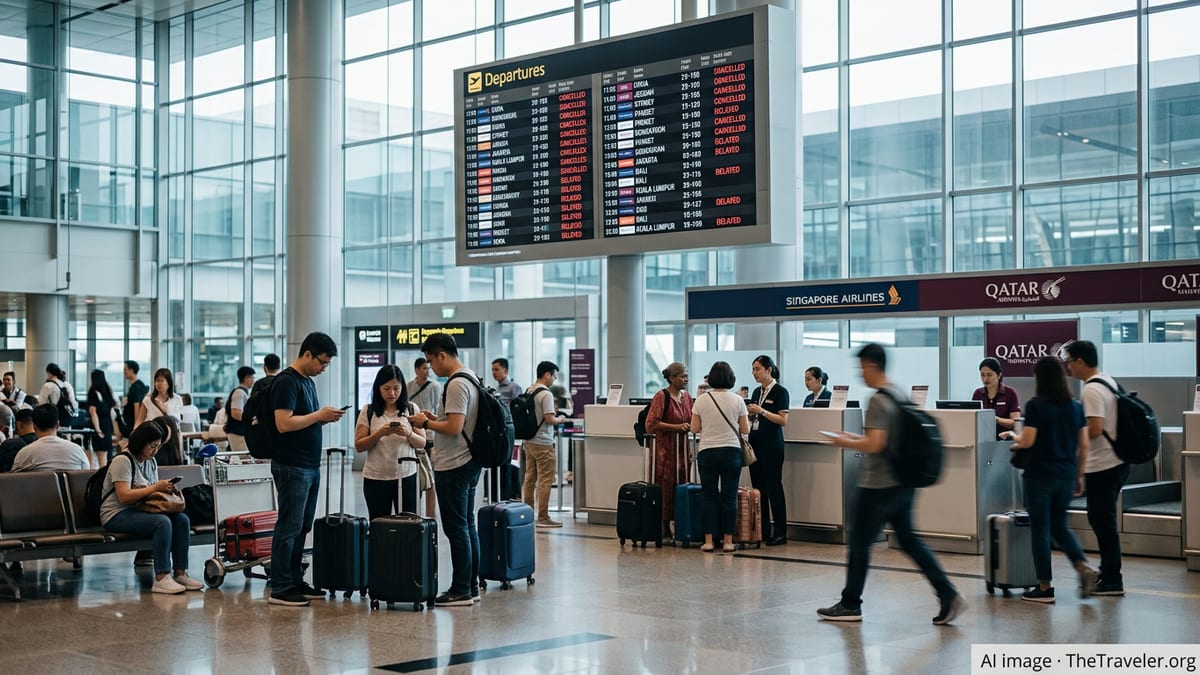
Fresh Wave of Cancellations Hits Changi Schedules
Updated schedules and regional media coverage indicate that airlines with key hubs in the Gulf continue to trim their operations through Singapore Changi, triggering a new round of disruption for connecting traffic. Qatar Airways, which normally operates multiple daily services between Singapore and Doha, is running a sharply reduced schedule as Qatari airspace remains constrained, with many commercial flights still suspended or rerouted. Gulf Air services tied to Bahrain are also affected as Bahrain’s airspace has faced persistent operational limits, leaving some of its Changi rotations canceled or removed from sale.
Publicly available flight information shows that several Qatar Airways departures between Singapore and Doha over the second half of March have either disappeared from booking systems or are marked as canceled, reflecting the airline’s shift to a limited-service model focused on select long-haul links. Gulf Air’s regional network cutbacks, driven by Bahrain’s ongoing airspace issues, are contributing to a reduction in nonstop connectivity between Changi and the Gulf, where Doha and Bahrain usually serve as vital onward gateways to Europe, the Middle East and Africa.
Changi’s overall traffic remains far from a full-scale shutdown, with many Asian and European carriers maintaining operations. However, the specific combination of Gulf hub disruptions and selective flight cancellations is disproportionately affecting passengers who rely on Doha or Bahrain for long-haul connections, particularly during the busy late‑March travel period.
Routes to Doha, Bahrain, Manila and Beyond Affected
According to airline timetables and booking engines, the most visible impact for Singapore-based travelers is on flights to Doha, a key transit point for Europe, the Middle East and parts of Africa. Qatar Airways has moved to a skeleton schedule structured around a narrow band of arrival and departure waves at Doha’s Hamad International Airport, leaving previous daily frequencies either reduced or temporarily dropped. This reshaping of the Doha network means that some Singapore passengers who once enjoyed multiple connection options now find only one or no viable same-day itineraries.
Bahrain-linked services are experiencing similar turbulence. Gulf Air, whose operations depend heavily on Bahrain’s national airspace, has seen repeated interruptions since the latest Gulf security crisis escalated. Schedules that once supported smooth Bahrain–Singapore–Asia connections have been punctured by cancellations and aircraft redeployments, diminishing the reliability of Bahrain as a connecting hub for Southeast Asian itineraries.
The instability is also spilling over onto wider regional routes. Flights between Singapore and Manila, which are often connected onward via Doha or other Gulf hubs for Europe-bound journeys, are facing knock-on effects as airlines juggle aircraft assignments and adjust timings to comply with airspace restrictions. While core point-to-point services between Singapore and Manila continue on multiple carriers, itineraries that rely on Gulf transfers are more vulnerable to late schedule changes, leaving travelers exposed to missed connections and forced rerouting.
Travelers booked onward to destinations such as Jeddah, Riyadh, Istanbul, major European capitals and secondary Asian cities via Doha or Bahrain are discovering that seemingly secure itineraries may be altered with only a few days’ notice, as airlines align their schedules to what is operationally possible under restricted Gulf airspace.
Regional Tensions and Airspace Limits Keep Operations Constrained
The disruption at Singapore Changi is closely tied to developments in the wider Gulf region. Recent missile and drone incidents in and around Qatar have led to successive closures and partial reopenings of Qatari airspace, with authorities allowing only limited emergency and evacuation traffic for periods of time. As a result, standard commercial operations at Doha have been slow to normalize, and airlines reliant on Doha as a mega hub have been forced to carefully ration their flights and prioritize certain trunk routes.
Similarly, Bahrain’s airspace has been subject to heightened security controls, constraining Gulf Air’s ability to operate its usual pattern of flights. Public reports describe a situation in which Bahrain remains one of the more severely affected Gulf states, with knock-on consequences for flight planning across the region. The combined effect is a patchwork of active and suspended corridors that complicates long-haul scheduling and increases the likelihood of last-minute adjustments.
Aviation analysts note that carriers like Qatar Airways, Gulf Air, Emirates and Etihad are accustomed to rerouting around regional hotspots, but the current wave of tensions is affecting core airspace directly above their home hubs. This leaves fewer viable alternatives and increases the operational cost of preserving even a thin network of services to key markets such as Singapore. The result at Changi is an irregular pattern of arrivals and departures, where some flights resume on a limited basis while others remain off the board for days or weeks.
For passengers, the underlying geopolitical drivers may feel distant, yet they translate into concrete complications at the gate: extended ground time, unexpected overnights, and a greater dependence on last-minute rerouting via non-Gulf hubs in East Asia or Europe.
Passengers Scramble for Alternatives and Reroutes
In response to the evolving cancellations, affected travelers at Singapore Changi are increasingly turning to alternative routings outside the Gulf. Reports shared across traveler forums describe passengers being rebooked from Qatar Airways services via Doha onto partner carriers such as Singapore Airlines or other Asian and European airlines, often via hubs like Seoul, Tokyo, Frankfurt or Istanbul. Some travelers have secured reroutes within a day or two of their original departure, while others have had to accept significant date changes or different cabin products.
Experiences vary widely. Some accounts highlight relatively smooth rebookings onto non-Gulf carriers at comparable travel times, particularly where alliance or codeshare agreements are in place. Others describe longer hold times with airline call centers, complex multi-stop alternatives, or the need to negotiate manually for rerouting beyond the Gulf region. The unpredictability of which specific flights will operate on any given day has led some travelers to hedge their plans by booking fully refundable backup tickets on non-Gulf airlines.
Travel advocates advise that passengers with imminent departures through Doha or Bahrain closely monitor their booking status and day-of-departure flight information, noting that many schedule changes are being processed only a few days in advance. Travelers are also encouraged to review fare rules and local passenger rights regulations, which in some jurisdictions provide clear entitlements to refunds or rerouting when flights are canceled by the carrier.
At Changi, where operations across most Asian and intra-Pacific routes remain stable, the scramble is most pronounced among those whose itineraries depend on Gulf connections to reach Europe, the Middle East or Africa. For these passengers, flexibility on dates, routings and even destination airports is emerging as a key factor in successfully completing journeys.
What Travelers Using Changi Should Do Now
For passengers planning to transit Singapore Changi in the coming days and weeks, publicly available guidance from airlines and airport information channels points to a few practical steps. Travelers booked on Qatar Airways, Gulf Air or other Gulf-based carriers are urged to check their reservation status directly with the airline before heading to the airport, as automated notifications may lag behind live schedule changes. In particular, itineraries involving Doha or Bahrain should be reviewed carefully for any overnight layovers or misaligned connections created by revised timetables.
Experts in consumer air travel recommend that, where possible, passengers consider building in longer transfer windows when their journeys rely on a Gulf connection from Singapore. This may help absorb minor timing changes without triggering missed onward flights. Those with time-sensitive trips, such as business travel or onward cruises, may wish to explore point-to-point options on carriers that route through alternative hubs, even if this entails slightly longer flying times or higher fares.
Travel insurance policies that cover schedule disruption and missed connections are also under renewed scrutiny. Policyholders are encouraged to verify whether cancellations related to regional conflict or airspace closure are covered events, and to keep detailed records of any unexpected expenses, including hotels and meals, in case reimbursement claims are needed later.
With the situation in Gulf airspace still fluid, industry observers expect Singapore Changi to remain operationally robust but strategically cautious, with airlines adjusting Gulf-related services as conditions evolve. For passengers, the most reliable approach for now appears to be vigilance and flexibility: monitor bookings closely, be ready to accept alternative routings, and factor in the possibility that Gulf-linked flights from Singapore could change or disappear from schedules at short notice.