

More news on this day
Passengers flying through Singapore Changi are facing fresh disruption after a string of flight cancellations by Gulf Air, Qatar Airways and other regional and Asian carriers, cutting key connections to Bahrain, Doha and Manila and forcing last minute rebookings across already crowded routes.
Get the latest news straight to your inbox!
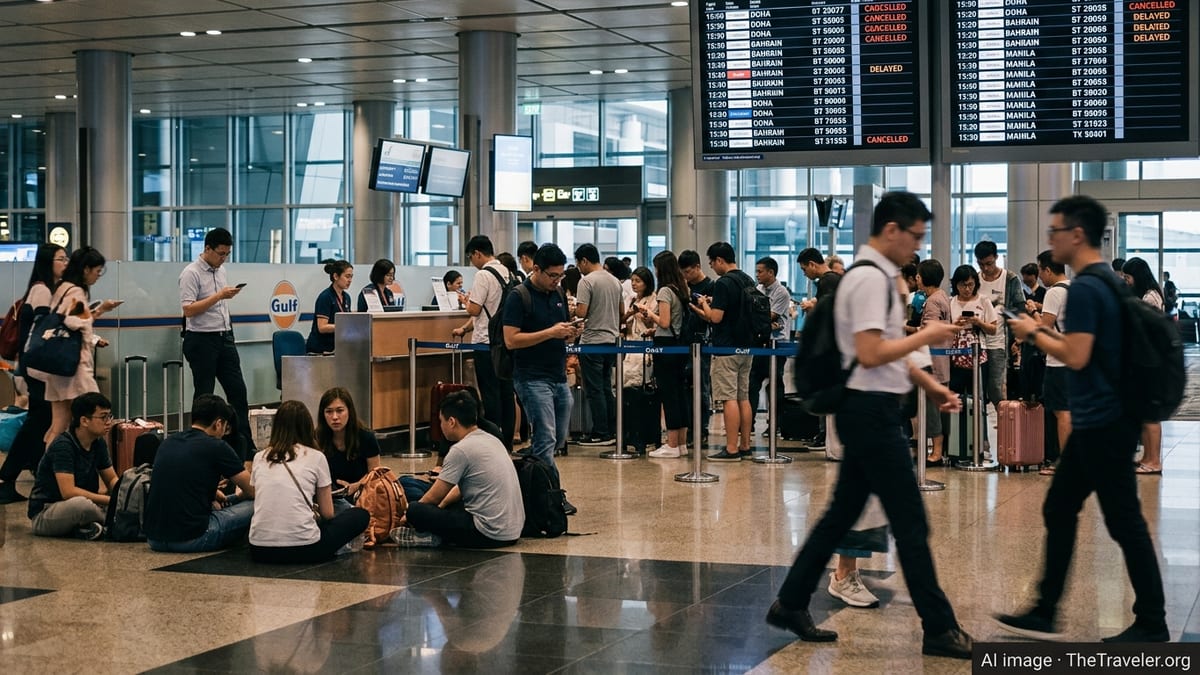
Seven Targeted Flights Pulled From Schedules
Publicly available schedules and passenger reports indicate that at least seven key flights linking Singapore with Bahrain, Doha and Manila have been withdrawn or temporarily suspended over recent days. The affected services are centered on Gulf Air’s Bahrain link, Qatar Airways itineraries connecting via Doha, and select Southeast Asian services that feed long haul networks to the Middle East and beyond.
In Singapore, the most immediate impact is being felt on overnight and early morning departures that traditionally handle a mix of business travelers, Filipino overseas workers, and leisure passengers heading to Europe and the Gulf. Flight tracking data and timetable changes show previously daily or near daily departures now appearing as “cancelled” or “not operating” for multiple days in a row, rather than as one off irregularities.
Reports from travel forums and social media suggest that the cancellations are concentrated on flights where demand has become highly volatile due to regional airspace closures around Qatar and continuing uncertainty in the wider Gulf region. Airlines appear to be prioritizing a smaller number of trunk services and consolidating passengers, instead of operating lightly loaded point to point flights from Singapore.
While the number of flights involved is limited compared with the hundreds of movements at Changi each day, the targeted nature of the cuts means that affected travelers often lose their only direct or fastest one stop option to Bahrain, Doha or Manila on their chosen travel dates.
Regional Tension and Airspace Constraints Behind the Cuts
The latest disruptions are unfolding against the backdrop of an ongoing conflict involving Iran and Qatar that has led to intermittent closures and restrictions of Qatari airspace since late February 2026. According to international news coverage and open aviation data, Hamad International Airport in Doha has been operating under heightened constraints, with waves of cancellations and reroutings rippling across airlines that rely on the Doha hub for connections between Asia, Europe and Africa.
Gulf Air’s operations have also been affected by safety driven airspace decisions around Bahrain and the northern Gulf. A recent passenger advisory document from Gulf Air, widely circulated by travel outlets, outlines a phased recovery scenario that assumes a full return to normal operations only from April 2026 onwards, following assessments by civil aviation authorities and international safety bodies. Until that recovery takes hold, flights to and from hubs such as Singapore remain vulnerable to last minute revision.
Qatar Airways, which has been at the center of the Doha airspace disruption, continues to adjust its schedule on a rolling basis, particularly on routes where alternative routings or partner airlines are available. Travelers on Singapore to Europe itineraries transiting Doha have reported short notice cancellations or re timings in mid March, with some journeys rerouted via other Asian or Middle Eastern hubs.
In addition to geopolitical tension, seasonal operational pressures are compounding the problem. Earlier in the year, Qatar Airways and other carriers cited adverse winter weather in Europe, staffing constraints and air traffic control issues as contributing factors to irregular operations. The convergence of these challenges with the current airspace restrictions is now being felt on secondary but strategically important routes like Singapore Bahrain and Singapore Doha.
Knock On Effects for Manila and Southeast Asia
The cancellations are not limited to direct Gulf links. Manila, one of Southeast Asia’s busiest outbound markets, is experiencing indirect disruption as schedules are reshaped around the Gulf hubs. Passengers traveling between Manila and Europe or the Middle East via Singapore have reported lost connections or longer layovers following changes to Gulf Air and Qatar Airways segments.
Filipino workers returning to or from jobs in the Gulf, who often rely on competitive one stop itineraries via Singapore, are among those most affected. With some Singapore Doha and Singapore Bahrain services removed on selected days, itineraries that once required a single connection can now involve two or more stops or an overnight stay, increasing both travel time and cost.
Regional carriers that operate between Singapore and Manila are also adjusting capacity in response to shifting demand. Industry observers note that when Gulf links are reduced, some travelers shift to itineraries that route via other Asian hubs such as Kuala Lumpur, Bangkok or Hong Kong. This knock on effect can crowd popular Southeast Asian routes and narrow the choice of affordable seats available at short notice.
Published coverage of airline booking trends in early 2026 indicates that demand for alternative routings around the Gulf region has been rising steadily since the onset of the Iran Qatar tensions. Singapore, traditionally marketed as a stable and efficient transfer point, now finds its role temporarily complicated by events taking place far beyond its own airspace.
How Airlines Are Handling Rebookings and Refunds
In response to the rolling schedule changes, Gulf Air has circulated updated guidance allowing free rebooking or refunds for affected passengers within specific travel windows. Recent travel advisories highlight an extended rebooking period into mid May 2026 and indicate that hotel and meal support is being provided in some cases for stranded travelers on disrupted itineraries involving Bahrain.
Qatar Airways has introduced its own set of flexible options during the airspace closure period, according to policy summaries published by travel agencies and consumer information sites. These generally include complimentary date changes within a defined range from the original departure, or full refunds where flights are cancelled. However, passenger experiences shared online suggest that processing times and the ease of securing preferred new dates can vary considerably.
Some travelers transiting Singapore on Qatar Airways report being rebooked onto partner carriers, including other major Asian airlines, when Doha bound segments are withdrawn. In a number of cases, rebookings have bypassed the Gulf entirely, instead routing via alternative hubs to reach Europe or North America. While this can preserve travel plans, it may require longer journey times and changes to cabin products or frequent flyer accrual.
Travel advisors note that policies are being reviewed repeatedly as the situation evolves, and that what is possible on one day may not be available the next. Passengers are therefore being encouraged by consumer advocates and travel media to monitor booking management tools closely and to document all communications around cancellations, rebookings and refund requests.
What Affected Travelers Through Singapore Should Do Now
For passengers with upcoming trips touching Singapore and involving Bahrain, Doha or Manila, the latest disruptions highlight the importance of proactive planning. Industry guidance suggests checking the status of every flight segment, not only the Singapore departure, and paying close attention to aircraft changes or retimed departures that may indicate further schedule adjustments.
Flexible tickets, while often more expensive, may offer additional protection in the form of lower change fees or broader rebooking windows. Travel insurance products that specifically cover airspace closures, security events or extended delays can also provide financial cushioning, though policy terms vary widely and should be reviewed carefully before purchase.
Travelers connecting through Singapore who are particularly risk averse are increasingly considering alternative routings that avoid the Gulf region entirely, even when their flights have not yet been cancelled. Options include transiting via other established Asian hubs with strong links to Europe, the Middle East and North America, though capacity constraints and higher fares are possible as more passengers make similar choices.
With the regional situation still fluid as of late March 2026 and airline recovery timelines pointing to a gradual normalization rather than an immediate return to full schedules, passengers relying on Gulf links from Singapore may face continued uncertainty in the weeks ahead. Careful monitoring, early engagement with airlines or booking agents, and willingness to consider alternative routes remain key to keeping travel plans on track.