

More news on this day
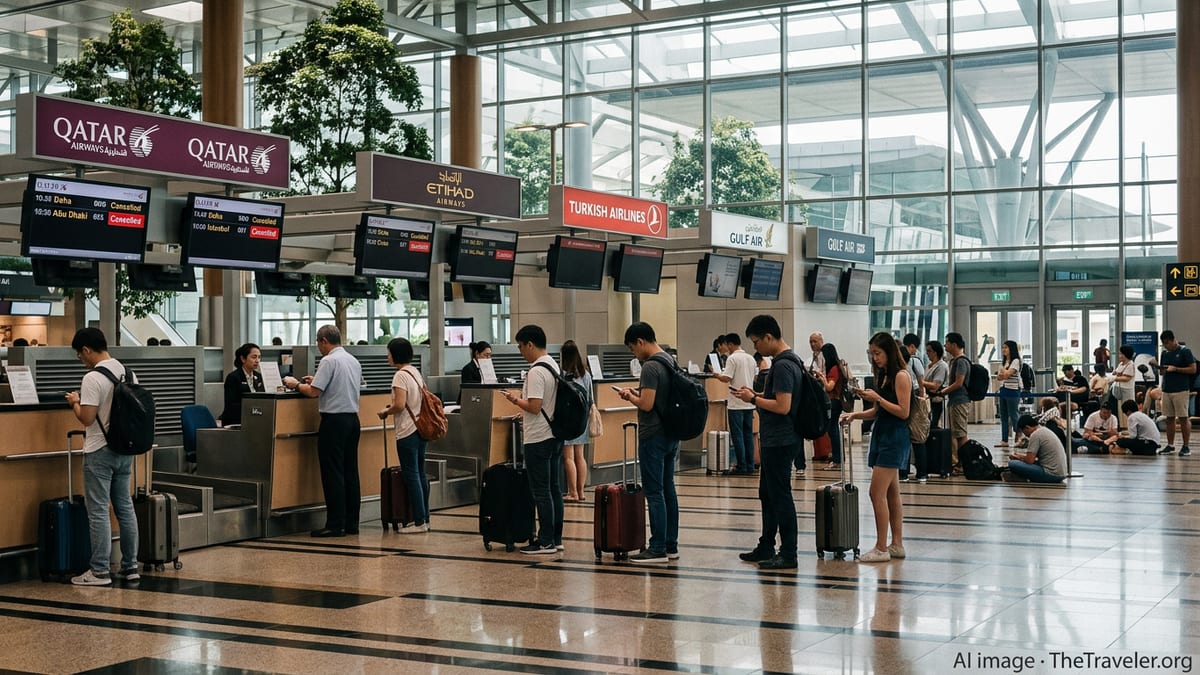
Passengers flying through Singapore Changi Airport are facing a new round of turbulence as Gulf Air, Qatar Airways, and other regional carriers cancel or curtail key services to Doha, Bahrain, Manila, and several onward destinations amid ongoing airspace closures and security concerns across the Gulf.
Get the latest news straight to your inbox!
Fresh Cancellations Hit Singapore–Doha and Singapore–Bahrain Routes
Updated schedules and publicly available flight-status data indicate that several Qatar Airways and Gulf Air flights linking Singapore Changi Airport with Doha and Bahrain have been removed from near-term timetables or listed as cancelled over the second half of March 2026. Travelers report finding previously confirmed itineraries from Singapore to Doha marked as cancelled in airline apps while alternative routings are offered via third-country hubs.
For Qatar Airways, Singapore–Doha has traditionally been a key link into its global network, feeding connections to Europe, Africa, and the Americas. In recent days, however, multiple passengers connecting from Singapore to Athens, London, and North American cities via Doha have reported abrupt cancellations of the Singapore–Doha leg, often only days before departure. Some itineraries are being reconstructed around different gateways, extending travel times and introducing long layovers.
Gulf Air’s Singapore–Bahrain operation has also been affected as Bahrain’s airspace remains under heightened restriction in the wake of regional tensions. Travel-focused advisories note that Gulf Air is operating a significantly reduced schedule, and in some cases has grounded services entirely on specific dates, which has removed a direct link from Singapore to the Bahraini capital and onward to Saudi Arabia and other Gulf states.
The result is a tightening of point-to-point and connecting options from Singapore into the Gulf, particularly on days when both Bahrain and Qatari routings are constrained at the same time. Travelers heading for business hubs like Doha, Manama, and beyond are increasingly dependent on reroutes through alternative Middle Eastern or Asian hubs.
Regional Airspace Closures Ripple Through Changi’s Network
The latest disruptions are closely tied to ongoing airspace closures and security measures around Qatar and Bahrain following recent Iranian strikes and regional military activity. Public reports on aviation conditions in the Gulf region describe Qatar’s airspace as having reopened only under limited, emergency-style conditions, with standard commercial schedules still operating far from normal. Bahrain’s airspace, likewise, has faced restrictions that complicate routine passenger operations.
These constraints have introduced complex routing challenges for airlines attempting to maintain links between Southeast Asia and the Gulf. Instead of operating direct paths across affected corridors, some carriers have had to consider longer, more northerly or southerly routings, which increase flight times, fuel costs, and crew duty requirements. In some cases, the operational trade-offs have led to proactive cancellations of entire rotations rather than flying heavily delayed, circuitous routes.
Singapore Changi, which functions as a major Southeast Asian gateway for both Qatar Airways and Gulf Air, is feeling the knock-on effect. A number of passengers report being rerouted onto partner airlines via cities such as Istanbul, Manila, or other Asian hubs to bypass the most heavily impacted airspace. While such workarounds keep some journeys viable, they add connections and uncertainty for travelers accustomed to streamlined one-stop itineraries via Doha or Bahrain.
Other airlines that rely on Gulf corridors, including carriers based in the United Arab Emirates and neighboring states, are also adjusting schedules and routings. Even when services continue to operate, they may do so with extended block times or altered departure windows, which can complicate onward connections for passengers starting their journeys in Singapore.
Impact on Manila-Linked Itineraries and Wider Asia Connections
The disruption is not confined to traffic terminating in the Gulf. Qatar Airways and other Middle Eastern carriers have long marketed one-stop travel between Southeast Asia and the Philippines, with Manila serving as a key endpoint for labor, family, and leisure travel. Recent passenger accounts indicate that some Doha–Manila sectors have been cancelled or re-timed, leaving travelers with broken journeys or last-minute reroutes via third countries.
Travelers flying from Singapore to Manila via Doha are among those most affected. In several cases, the Doha–Manila leg has been removed while the first sector remains on the books, effectively stranding the connection. Some passengers report being rebooked on partner airlines such as Philippine flag carriers on routings that completely bypass Doha and instead connect through regional hubs closer to the Philippines.
These changes are compounded by Manila’s own capacity and slot-management challenges at Ninoy Aquino International Airport, which is already heavily congested. Any influx of rerouted Gulf passengers into Manila places extra pressure on already busy terminals and limited runway capacity. While most of the current disruption stems from airspace issues in the Gulf rather than Philippine infrastructure, the combined effect is a more fragile travel chain for itineraries spanning Singapore, Doha or Bahrain, and Manila.
Beyond the Philippines, connections from Singapore via Doha or Bahrain to secondary cities across South Asia, the Middle East, and parts of Europe are also experiencing instability. Where safe corridors are available, airlines are favoring larger, trunk routes, leaving some thinner city pairs temporarily reduced or paused.
What Passengers at Changi Need to Check Before Flying
With schedules changing frequently, travelers flying from Singapore to Doha, Bahrain, Manila, or onward destinations through Gulf hubs are being advised by travel-industry guidance and airline notices to treat their bookings as fluid rather than fixed. Publicly accessible airline apps, booking-management tools, and airport departure boards may display different information at different times, and changes can occur even within days of departure.
One emerging pattern in traveler reports is that not all segments of a multi-leg journey update at once. A first leg from Singapore may still show as confirmed while a critical onward sector from Doha or Bahrain has quietly disappeared or been reclassified as cancelled. Passengers are therefore encouraged by consumer advocates to verify the status of every flight segment individually and to watch for schedule changes or aircraft swaps that may signal trouble ahead.
In the event of cancellation, most Gulf carriers operating through Changi are offering a mix of date changes, refunds, and rerouting options, sometimes via partner airlines and alternative hubs. However, availability on replacement flights can be tight on peak days, and some travelers report longer customer-service wait times as call centers work through a backlog of disrupted itineraries.
Given the fluid security and airspace environment, travel planners are suggesting that passengers build additional buffers into their trips, particularly for time-sensitive journeys or those involving onward connections in Europe or North America. Flexible tickets, travel insurance that explicitly covers airspace-related disruption, and alternative routings that avoid the most affected corridors are increasingly being viewed as prudent choices for departures from Singapore in the coming weeks.
Outlook for Services Linking Singapore to the Gulf
Forecasts for a full restoration of regular Gulf services from Changi remain uncertain. Aviation observers note that any normalization of Qatar and Bahrain airspace is likely to be gradual, starting with limited-capacity corridors and tightly controlled operations before moving back to the dense schedules seen before the latest crisis. In the meantime, airlines are publishing rolling schedule updates, often only a few weeks at a time, which keeps passengers in a holding pattern over trips planned for later in the year.
Qatar Airways has signaled through public statements and travel advisories that it intends to rebuild its network once civil aviation authorities declare the relevant airspace fully safe. Until that point, the carrier is expected to continue operating a patchwork of services that prioritize evacuation, essential travel, and the most commercially critical routes, rather than the comprehensive grid of connections that previously funneled many Singapore-origin passengers through Doha.
Gulf Air’s situation is similarly tied to decisions by Bahrain’s aviation regulators regarding the reopening and usage of national airspace. As long as constraints remain in place, its ability to operate a stable long-haul schedule out of Bahrain, including services to Singapore, will be limited. The airline may rely more heavily on regional links and partnerships to maintain at least some connectivity for passengers starting or ending their journeys in Southeast Asia.
For travelers in Singapore, the practical takeaway is that flights to Doha, Bahrain, Manila, and onward points via Gulf hubs are likely to remain volatile in the near term. Those with essential travel plans are turning to a mix of alternative routings, flexible bookings, and close monitoring of airline communications to navigate an evolving situation that continues to reshape long-established air corridors linking Southeast Asia with the Middle East and beyond.