

More news on this day
Hundreds of passengers moving through Thailand’s busiest tourist gateways are facing fresh disruption after a cluster of key flights operated by Jetstar, Condor, Cathay Pacific and regional carriers were cancelled, severing links to Melbourne, Sydney, Kuala Lumpur, Hong Kong and other major hubs at the height of the peak travel period.
Five High-Impact Cancellations Ripple Across Thailand Routes
Thailand’s role as a regional hub has magnified the impact of a seemingly small number of cancellations. Aviation data and local airport reports on 22 and 23 February indicate that at least five critical services touching Bangkok and Phuket were withdrawn at short notice, affecting onward connectivity across the Asia–Pacific network.
Among the hardest hit were leisure travellers booked on Jetstar services between Bangkok and Australia, with at least one Melbourne-bound and one Sydney-bound flight grounded as airlines struggled with tight aircraft rotations and weather-disrupted schedules further south. The cancelled departures left holidaymakers and returning residents scrambling for scarce seats on later flights via Singapore and Kuala Lumpur.
Regional links have also been strained. A Malaysia-bound service from Thailand to Kuala Lumpur, marketed to connect with long-haul departures to Europe and the Middle East, was scrubbed just hours before departure, forcing passengers into overnight hotel stays or long overland transfers. For many, the scrapped flight meant missed onward connections, nonrefundable hotel nights and last-minute ticket purchases at elevated fares.
On the North Asia corridor, Cathay Pacific’s operations around Bangkok and Hong Kong have come under pressure due to wider disruption across the region. While Hong Kong International Airport has reported dozens of delays and a handful of cancellations tied to weather and congestion, passengers in Thailand have felt the knock-on effects in the form of a cancelled Hong Kong-bound departure that would typically feed dozens of long-haul connections to Europe and North America.
Jetstar, Condor and Cathay Pacific Under Scrutiny
The wave of disruption has shone a spotlight on the performance of several carriers heavily relied upon by tourists in Thailand. Jetstar, a key low-cost operator for Australians heading to Bangkok and Phuket, has juggled aircraft availability amid a broader pattern of delays and cancellations affecting services in and out of Sydney and Melbourne. Even a single cancelled wide-body or high-density narrow-body rotation can unravel schedule integrity for days, especially during peak season.
German leisure airline Condor, which serves Thailand as part of its long-haul holiday network from Europe, has also seen its regional reliability questioned as storms, crew positioning issues and congested airspace over Asia have narrowed its operational margins. While Condor’s overall number of cancellations in the current disruption cycle appears limited, the loss of even one Thailand-bound flight strands an entire aircraft of predominantly leisure travellers on complex itineraries that often combine multiple airlines.
Cathay Pacific, a premium full-service carrier that historically functions as a bridge between Southeast Asia and the rest of the world via Hong Kong, has been contending with widespread delays and several cancellations across Asia’s key hubs. Data from major airports including Hong Kong, Tokyo, Seoul, Delhi and Shanghai over the weekend show thousands of delayed flights and more than 50 cancellations region-wide, underscoring how easily operations can be destabilized when multiple weather systems and slot constraints overlap.
For travellers in Thailand booked on Cathay Pacific services to Hong Kong and beyond, the cancellation of a single flight can mean an unplanned extra night in Bangkok, the loss of premium cabin award seats booked months in advance, or the need to accept rerouting via alternative hubs such as Singapore or Doha. Business passengers heading into the workweek have been especially exposed, with popular Sunday and Monday bank flights carrying heavy loads and limited backup options.
Bangkok and Phuket Feel the Strain
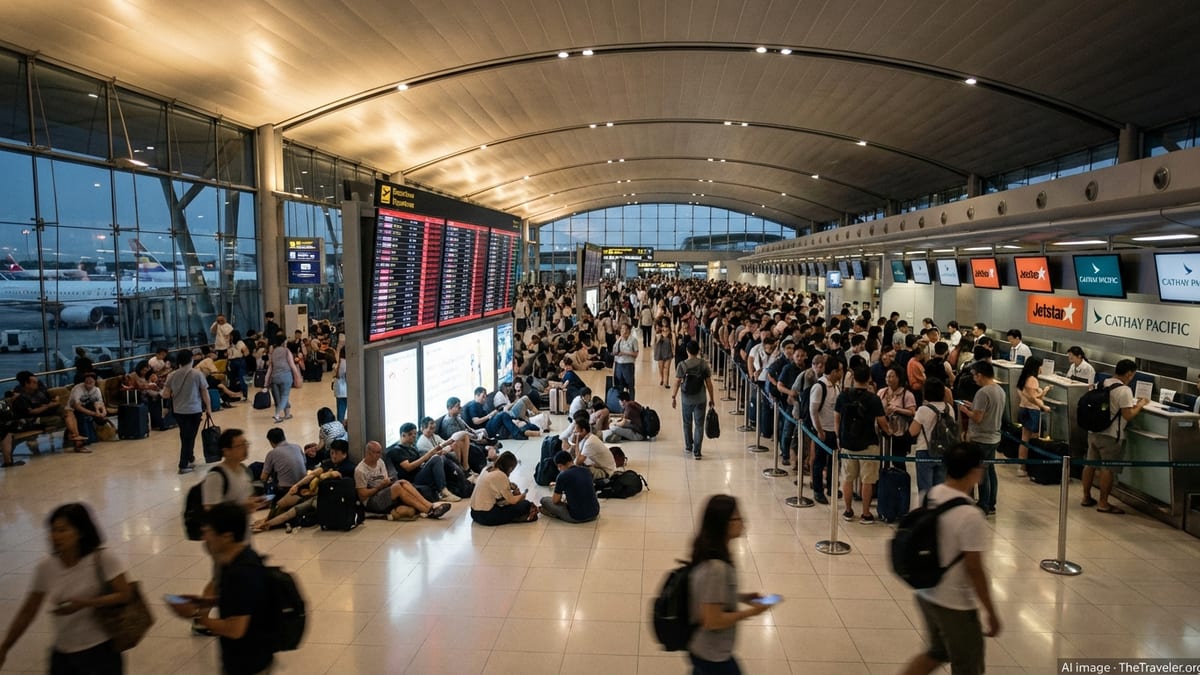
Bangkok’s Suvarnabhumi Airport and Don Mueang Airport, together with Phuket International Airport, form the backbone of Thailand’s international connectivity, particularly for tourists. When cancellations hit, these gateways quickly become pressure points. Ground images and eyewitness accounts from the weekend described long queues at transfer and ticketing desks, busy customer service counters, and departure boards peppered with status changes as airlines worked through rolling schedule adjustments.
In Bangkok, the cancellation of a Cathay Pacific Hong Kong-bound service left passengers bound for North Asia, Europe and North America competing for limited seats on later departures. Many were offered rerouting via alternative Cathay services or onto partner airlines, but peak-season load factors above 90 percent meant that immediate same-day solutions were often impossible. Families travelling together were sometimes split across different flights and routings to get everyone moving.
Phuket, a leisure-focused airport that depends heavily on seasonal charter and low-cost capacity, has also faced operational stress. While the absolute number of cancellations there has remained relatively small, a single lost flight to Sydney, Melbourne or Hong Kong can wipe out an entire day’s direct options for those destinations. Travellers reported being rebooked on convoluted itineraries involving stops in Kuala Lumpur, Singapore or Bangkok, extending journeys by many hours.
Airport operators in Thailand have emphasized that despite the disruption, terminals remain open and functional, with additional staff drafted to assist with rebooking and crowd management. Still, the experience for many has been one of uncertainty and frustration, particularly where language barriers or complex, self-constructed itineraries have made it harder to secure timely assistance.
Regional Weather and Operational Pressures Behind the Chaos
The cancellations tied to Jetstar, Condor, Cathay Pacific and others are not occurring in isolation. Across Asia and the Pacific, the past 48 hours have seen thousands of delays and dozens of cancellations at key hubs including Hong Kong, Jakarta, Delhi, Mumbai, Seoul, Shanghai and Beijing. Severe weather patterns, from localized thunderstorms to broader seasonal systems, have combined with preexisting congestion and tight crew schedules to push the regional network to its limits.
In Australia, major carriers such as Qantas, Air New Zealand and Emirates have contended with hundreds of delayed services and nearly 50 cancellations in Sydney, Melbourne and Brisbane alone on 23 February. Because many Thailand routes are operated as part of longer aircraft rotations that also serve Australia and New Zealand, upstream disruption in those markets has spilled over into Southeast Asia.
Operationally, airlines are also grappling with limited slack in their fleets, particularly for wide-body aircraft used on trunk routes between Asia and Australia. When storms, air traffic control restrictions or unscheduled maintenance events hit, there are fewer spare aircraft available to step in. Carriers sometimes choose to consolidate loads or proactively cancel a single roundtrip pairing to protect the broader schedule, a strategy that can reduce system-wide chaos but is deeply disruptive for those booked on the affected flights.
Crew duty-time regulations represent another pressure point. When earlier segments in a rotation suffer extended delays, pilots and cabin crew can quickly bump up against legal work-hour limits, requiring airlines to cancel or significantly retime subsequent legs. For passengers in Thailand, that can present as a late-night notification that the following morning’s long-haul service to Melbourne, Sydney or Hong Kong will not operate as planned.
Knock-On Effects for Melbourne, Sydney, Kuala Lumpur and Hong Kong
The cancelled Thailand flights have had outsized consequences in the cities at the other end of the route map. Passengers waiting in Melbourne and Sydney for inbound aircraft from Bangkok and Phuket have faced last-minute gate changes, rolling delays and, in some cases, complete cancellations when the expected inbound jet failed to arrive on schedule or at all.
Travel agents in both cities reported a spike in urgent rebooking requests from clients due to late-notice messages from Jetstar and other carriers. With many February and March departures already operating close to capacity, options for same-day alternatives have been thin, pushing some travellers onto indirect routings via Singapore, Kuala Lumpur or Denpasar, or forcing them to delay travel by 24 hours or more.
In Kuala Lumpur, the loss of a Thailand-linked service has complicated the plans of passengers using the Malaysian capital as a low-cost gateway between Southeast Asia and Australia. Many itineraries stitched together on separate tickets, often combining a Thai domestic leg with a regional carrier onward to Kuala Lumpur and then a long-haul flight, have come unstuck as the first link in the chain disappeared. Without protected connections, passengers have been left to absorb the cost of missed onward flights or negotiate with multiple airlines for partial relief.
Hong Kong, for its part, is managing its own turbulence. A busy day of delays and cancellations at Hong Kong International has coincided with the issues in Thailand, putting additional strain on Cathay Pacific’s ability to reaccommodate disrupted travellers. Long lines have formed at transit desks as passengers arriving from or attempting to reach Thailand seek new ways to connect to long-haul services bound for Europe and North America.
What Affected Travellers Are Experiencing on the Ground
For those caught in the middle of the disruption, the past 24 to 48 hours have been characterized by fast-changing information, long waits and difficult choices. Some passengers in Bangkok and Phuket reported receiving cancellation notices via airline apps or email only after arriving at the airport, while others first learned of the problem when departure boards flipped from "delayed" to "cancelled".
Accommodation has been a particular concern. When cancellations are tied to weather or air traffic control restrictions, airlines may be less likely to provide complimentary hotel rooms, leaving travellers to fend for themselves in popular tourist cities where last-minute rooms can be expensive. Families and budget travellers have described splitting up between cheaper guesthouses, airport seating areas and overnight buses to keep costs manageable.
Business travellers have faced their own set of challenges. Many had structured tight itineraries around key meetings in Hong Kong, Melbourne or Sydney, relying on late-evening or weekend departures from Thailand to maximize working time. The timing of the cancellations, hitting crucial banked flight periods and high-demand days, has led to missed meetings, postponed negotiations and increased use of video conferencing as a last-minute workaround.
Social media platforms have been filled with images of crowded Thai terminals, snaking queues at service counters and travellers trying to rebook flights on mobile phones while sitting on the floor near charging stations. While some passengers have praised airline staff for their efforts under pressure, others have voiced frustration over limited communication and the difficulty of securing timely updates across different booking channels.
New Guidance: What Travellers Should Do Now
With disruption ongoing and schedules still vulnerable to further weather and operational shocks, experts recommend that anyone travelling between Thailand and cities such as Melbourne, Sydney, Kuala Lumpur and Hong Kong in the coming days take a series of practical precautions. First, travellers are advised to monitor flight status closely through official airline apps and airport information channels starting at least 24 hours before departure, and to enable notifications for changes.
Where possible, passengers booked on separate tickets for multi-leg journeys should consider consolidating their bookings under a single carrier or alliance, which generally offers better protection in the event of cancellations. For those who must maintain separate tickets, building in longer connection windows can provide a buffer if an initial leg from Thailand is delayed or cancelled. Travel insurance that explicitly covers missed connections and schedule changes is also recommended, particularly for itineraries involving multiple airlines.
At the airport, arriving early has become more important than ever. With rebooking desks and customer service lines under strain, travellers who check in at the first sign of disruption stand a better chance of securing the limited alternative seats available. Keeping digital copies of all relevant documents, including booking confirmations, e-tickets and any communication from airlines regarding cancellations, can help speed up discussions at the counter.
Finally, travellers should be prepared for flexible routing. In the current environment, getting home or to a key destination may require accepting a less direct path, such as routing from Bangkok to Singapore or Kuala Lumpur and then onward to Australia, or from Phuket via Hong Kong and a secondary Asian hub. While such options can add hours to the journey, they often represent the fastest realistic way to reach the final destination when core nonstop services have been withdrawn, even temporarily.