

More news on this day
Fresh Iranian launches of Khorramshahr 4 ballistic missiles toward Israel have intensified an already spiralling aviation crisis across the Middle East, with the United Arab Emirates now joining Qatar, Kuwait, Saudi Arabia, Bahrain, Lebanon, Jordan, Cyprus and others in imposing sweeping airspace restrictions that have stranded tourists and severed critical flight corridors between Europe, Africa and Asia.
Missile Salvos Trigger New Wave of Airspace Closures
The latest barrage, fired late on March 5 toward Tel Aviv and the area around Ben Gurion Airport, marked the first confirmed operational use of the Khorramshahr 4 in the current war, according to regional officials and independent analysts. The weapon, one of Iran’s heaviest medium range ballistic missiles, was touted by Tehran as a signal that its long range arsenal remains intact despite days of intense US and Israeli strikes.
While Israel’s multilayered air defences intercepted many of the incoming missiles, aviation authorities across the region responded conservatively, widening existing no fly zones and preserving blanket closures over key flight information regions. Officials in the United Arab Emirates, Qatar, Kuwait, Saudi Arabia and Bahrain said the renewed salvos underscored the risk of debris or errant projectiles endangering civilian aircraft at cruising altitude.
In practice, that meant the partial reopening some states had announced earlier this week was quickly rolled back or frozen. Jordan, Lebanon, Cyprus and several Eastern Mediterranean states maintained severe restrictions on overflights bound to or from Israel, while carriers continued to avoid airspace over Iraq and western Iran. For travellers, the effect was a new round of sudden cancellations and diversions stacked on top of days of disruption.
Global aviation trackers estimated that upwards of 20,000 flights have been cancelled or rerouted since the conflict erupted in late February, with the majority of long haul Europe Asia and Africa Asia services forced to abandon the Gulf and Levant as transit hubs. Airlines warned that the latest Khorramshahr 4 launches may prolong those detours for days, if not weeks.
Tourists Stranded as Gulf and Levant Hubs Grind to a Halt
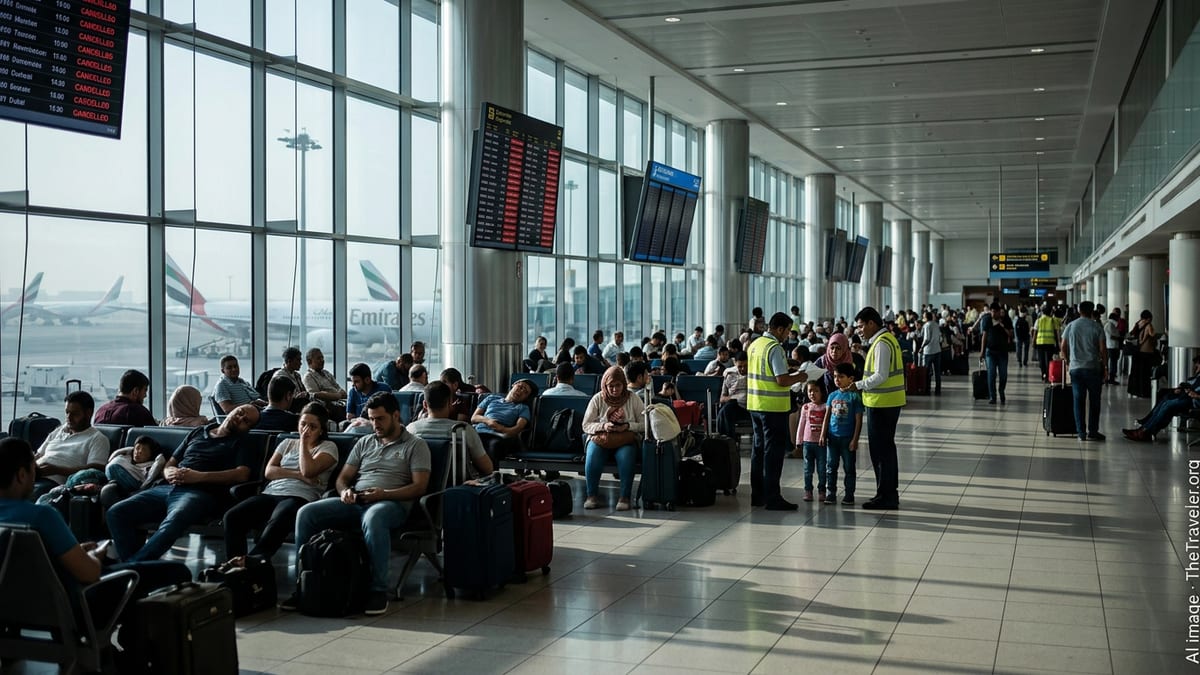
At Dubai International and Abu Dhabi International, normally among the world’s busiest transfer points, depature boards on Friday were still dominated by red markings, with only a trickle of outbound flights operating on special corridors coordinated with regional militaries. Travellers slept on terminal floors, queued for food vouchers and rebookings, and searched for any available seat out of the region, regardless of destination.
Similar scenes played out in Doha, Kuwait City, Manama, Riyadh, Jeddah and Dammam, where local authorities have been juggling civil defence measures with the logistical task of housing and feeding thousands of stranded visitors. In Beirut and Amman, outbound capacity remained extremely limited, complicated by the risk of spillover attacks across the Israeli Lebanese and Israeli Jordanian borders.
The knock on effects extended far beyond the Middle East itself. Tourists bound for safari holidays in East Africa, beach breaks in Sri Lanka or business trips to Southeast Asia found themselves unexpectedly stuck in transit cities such as Athens, Istanbul, Larnaca and Cairo after their onward flights via Gulf hubs were cancelled at short notice. Others never reached the region at all, stranded instead at European and Asian origin airports when their itineraries, built around Middle Eastern connections, collapsed.
Consular hotlines in Europe, North America and Asia reported a surge in calls from citizens stranded somewhere along disrupted routings that once stitched together global travel. Governments have been scrambling to map where their nationals are concentrated and coordinate with airlines on ad hoc solutions, from group rebookings via longer detours to special charter flights that skirt closed airspace.
Airlines Reroute, Suspend and Charter Amid Operational Maelstrom
Major Gulf carriers, including Emirates, Etihad Airways and Qatar Airways, have attempted to maintain skeletal operations where security assessments and clear corridors allow, but executives concede that network planning has become a day by day exercise. Schedules are being redrawn repeatedly as missile trajectories, interception zones and military flight priorities shift with each new bout of fire.
International airlines from Europe, South Asia and East Asia have either suspended services to the region entirely or drastically reduced frequencies, choosing to bypass the Middle East with longer polar and Central Asian routings. Carriers that do continue to touch the Gulf are often deploying widebody aircraft on short notice as relief flights, consolidating passengers from multiple cancelled services into a handful of departures cleared to transit safer corridors.
Low cost and regional airlines are among the hardest hit, lacking the fleet flexibility and deep interline agreements that allow larger groups to move passengers across alternative hubs. Many have simply frozen ticket sales for Middle Eastern routes through at least the coming week, warning customers that normal operations will not resume until there is a sustained de escalation in missile activity.
Behind the scenes, airline operations centres have been in near constant contact with national air defence commands and civil aviation regulators, adjusting flight levels and routings to steer well clear of suspected launch areas and interceptor engagement zones. Risk thresholds, already tightened since earlier drone and missile incidents near Gulf and Red Sea airspace, have been ratcheted higher after the Khorramshahr 4’s debut demonstrated Iran’s ability to project power deep into the region.
Regional Tourism Faces a Sudden and Severe Shock
The newly widened closures come at a sensitive moment for Middle Eastern tourism, which had been enjoying a strong rebound after the pandemic and earlier regional tensions. The United Arab Emirates, Saudi Arabia and Qatar have poured billions into mega attractions, cruise terminals and cultural events intended to cement their status as global leisure and business hubs.
That strategy depends heavily on the free flow of visitors through flagship airports in Dubai, Abu Dhabi, Doha and Riyadh, as well as secondary gateways in Bahrain, Kuwait, Sharjah, Muscat and Larnaca. With those hubs now constrained or shuttered, hotel occupancies have whiplashed: properties that were full of holidaymakers only days ago are suddenly hosting waylaid passengers on emergency rates negotiated with airlines and embassies.
In cities such as Dubai, Abu Dhabi and Doha, local tour operators reported mass cancellations for desert safaris, cultural excursions and cruise excursions. Conference organisers in Riyadh, Jeddah, Manama and Kuwait City, many of whom had pitched their events on the promise of seamless Gulf connectivity, have been forced to postpone or pivot to hybrid formats as delegates struggle to secure flights.
Levantine and Eastern Mediterranean destinations are feeling the shock as well. Lebanon and Jordan, which rely on steady flows of visitors to offset broader economic strains, face the prospect of an abrupt decline in arrivals just as peak spring travel season approaches. Cyprus, which had positioned itself as a safe, sunny staging point for itineraries that loop through the Middle East, is now fielding anxious calls from travellers worried that any proximity to the conflict zone could strand them.
Governments Race to Evacuate Nationals and Reassure Travellers
Governments across Europe, Asia and the Americas have issued increasingly stark travel advisories, with several echoing the language of United States officials who have urged citizens in affected Middle Eastern states to leave while commercial options still exist. Diplomatic missions in the United Arab Emirates, Qatar, Kuwait, Saudi Arabia, Bahrain, Lebanon, Jordan and Cyprus are compiling lists of vulnerable tourists, including unaccompanied minors, the elderly and those with medical needs.
Some states have begun arranging government backed evacuation flights, using national carriers or chartered aircraft to extract citizens from hubs where limited slots remain available. Others are working with airlines to prioritise outbound seats from Gulf airports for stranded travellers whose original journeys did not even include a Middle Eastern stop, but who were rerouted there as the crisis unfolded.
For now, authorities and aviation experts stress that there is no indication of deliberate targeting of civilian airliners, and note that layered air defence systems around key hubs have so far proven capable of intercepting projectiles that stray near populated areas. Yet the sheer density of missile and drone activity in recent days, capped by the Khorramshahr 4 launches, has convinced regulators that the only responsible course is to keep skies clear until the tempo of fire slows significantly.
With no clear diplomatic off ramp in sight, travellers are being urged to check flight status constantly, maintain flexible plans and avoid planning new itineraries that depend on Gulf or Levantine connections. For the tourism and aviation industries across the Middle East, the hope is that this extraordinary standstill will be brief. The fear is that it marks the start of a prolonged recalibration of how the world moves through a region that has spent the past decade selling itself as the crossroads of global travel.