

More news on this day
Hundreds of travellers were left sleeping on the floor and queuing for hours at Riyadh’s King Khalid International Airport on March 1 as at least 98 flight cancellations and around 30 significant delays rippled through the hub, a stark local snapshot of the global aviation turmoil unleashed by United States and Israeli strikes on Iran.
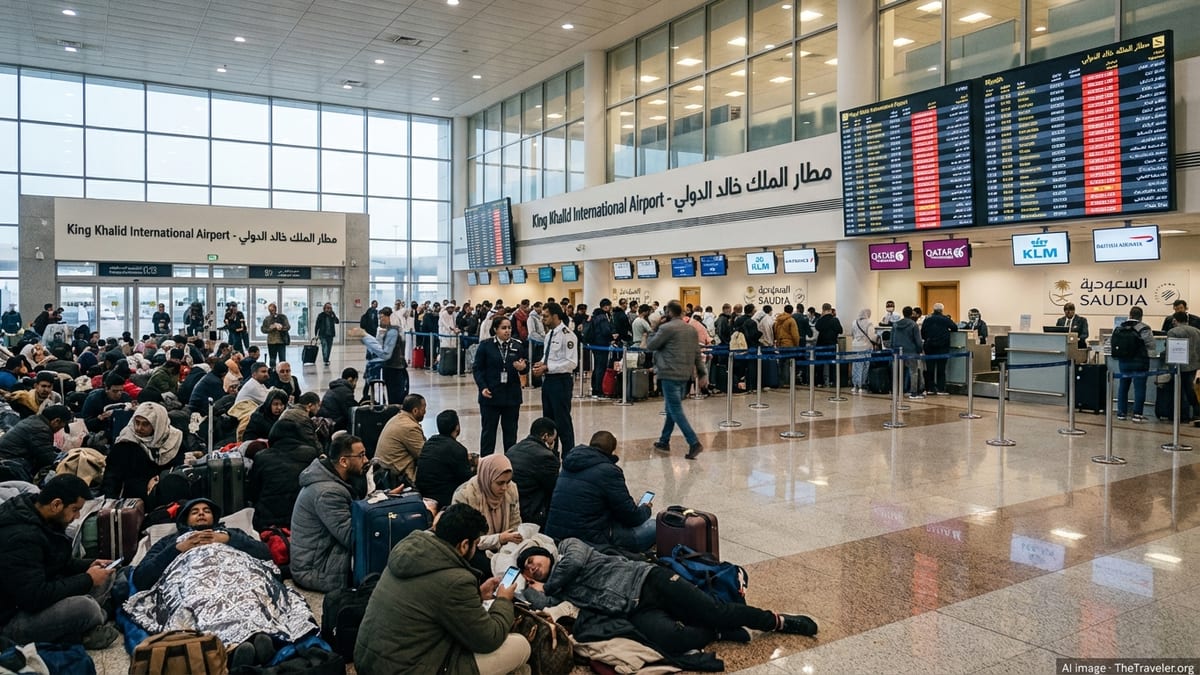
Riyadh Hub Buckles Under Sudden Wave of Cancellations
Operational data from Saudi aviation officials and airline advisories indicated King Khalid International Airport, the busiest gateway in Saudi Arabia’s capital, bore the brunt of the initial disruption inside the Kingdom. Saudia, the national carrier, cancelled or heavily retimed dozens of services to regional hubs including Dubai, Abu Dhabi, Doha, Bahrain and Kuwait City after overnight airspace closures severed major corridors across the Gulf.
Foreign airlines with strong connecting traffic through Riyadh were also hit. Qatar Airways, KLM, Air France and British Airways scrubbed or rerouted a series of flights bound for or overflying the Gulf, contributing to a combined tally at King Khalid of roughly 98 cancellations and 30 extended delays by early Sunday afternoon local time, according to airport and airline staff on site. Passengers reported scenes of confusion as departure boards flipped repeatedly between “scheduled,” “delayed” and “cancelled.”
The turmoil came less than 24 hours after coordinated US and Israeli strikes on targets in Iran triggered sweeping airspace closures across much of the Middle East. Aviation analytics firms estimate that well over 1,800 flights to the wider region were cancelled over the weekend, with Saudi Arabia’s main airports in Riyadh, Jeddah, Dammam and Madinah jointly recording hundreds of cancellations and delays as airlines scrambled to rewrite schedules.
At King Khalid, extra security and customer-service teams were drafted into the crowded terminals to manage swelling queues at ticket counters and transfer desks. Loudspeaker announcements urged travellers to remain near their gates and check airline apps rather than lining up repeatedly for information that ground staff themselves were receiving in real time.
US-Israel Strikes on Iran Trigger Regional Airspace Shutdown
The disruptions trace back to the pre-dawn hours of February 28, when the United States and Israel launched a series of coordinated strikes against military and strategic sites inside Iran. Within hours, Iran and several neighbouring states, including Iraq, Kuwait and Bahrain, restricted or closed their airspace to civilian traffic, citing safety concerns and the risk of further missile or drone activity.
By Saturday evening, there was effectively a broad no-go zone for commercial aviation covering swathes of the Middle East. Key transit countries such as the United Arab Emirates and Qatar announced temporary, partial closures that in practice halted normal flows through Dubai, Abu Dhabi and Doha, three of the world’s most critical connecting hubs linking Europe and North America with South and East Asia.
Flight tracking services showed near-empty skies over much of the region, with transcontinental services forced into long detours over Turkey, the Caucasus or the Arabian Sea. Carriers weighed the operational cost of additional fuel and crew time against the security calculus, with many opting to cancel outright rather than attempt complex reroutes around still-evolving military activity.
The knock-on effect for Saudi Arabia was immediate. While its own airspace remained more open than that of some neighbours, the closure of nearby corridors and the partial shutdown of Gulf hubs removed vital waypoints from airline networks. Services that ordinarily hop from Riyadh to Dubai or Doha before carrying passengers onward to London, Amsterdam or Athens suddenly had nowhere to connect.
Ripple Effects in Dubai, London, Athens, Amsterdam and Beyond
As King Khalid’s departure boards turned crimson with cancellations, the reverberations were felt in airports across three continents. In Dubai, normally one of the world’s busiest international hubs, all regular passenger operations were effectively halted after missile and drone strikes damaged aviation infrastructure and prompted emergency safety checks. Travellers who would typically connect from Riyadh or Jeddah through Dubai to destinations in Europe and Asia were instead stranded in Saudi Arabia or diverted to alternate hubs as far away as Muscat and Istanbul.
In Europe, major destinations for Gulf traffic were quickly overwhelmed. London’s Heathrow and Gatwick airports reported clusters of stranded passengers from the Middle East following last-minute cancellations by Emirates, Qatar Airways and British Airways on routes that overfly or connect through the conflict zone. At Amsterdam’s Schiphol and Athens International Airport, KLM, Air France and other European carriers struggled to accommodate travellers who had begun journeys in Riyadh, Jeddah or Dammam and now found their onward legs scrubbed or rerouted at short notice.
Airlines activated disruption playbooks that included hotel vouchers, meal coupons and fee-free rebooking, but capacity constraints meant many travellers were told they could face waits of 48 hours or longer. With aircraft and crew stranded out of position across multiple continents, network planners warned that the fallout would not be contained to a single weekend but could ripple through timetables for days.
Travel agents in Europe and the Gulf described a surge in demand for seats on any remaining services that avoided the closed airspace, driving up fares to London, Paris and other major cities. Some passengers reported buying entirely new tickets via circuitous routes through Central Asia or East Africa when original bookings became unusable.
Passenger Ordeal in Riyadh: Long Queues, Thin Information
Inside King Khalid International Airport itself, the human side of the disruption was on full display. Families returning from school holidays in Europe, labourers connecting to South Asia and business travellers bound for financial centres such as London and Dubai found themselves camped out on terminal floors, their luggage serving as makeshift pillows as they waited for news.
Several passengers described difficulty getting timely updates from their airlines, as customer-service hotlines were jammed and mobile apps lagged behind fast-moving operational decisions. Screens showed flights as “boarding” or “on time” only to flip abruptly to “cancelled,” forcing travellers to rejoin long lines at service desks in the hope of rebooking.
Saudia said it had activated its Emergency Coordination Center and was waiving change fees for affected travellers, while advising passengers not to travel to the airport without confirmed new itineraries. Other carriers, including Qatar Airways and European network airlines, issued similar guidance, urging customers departing Riyadh to verify their flight status repeatedly on official channels.
Airport staff, for their part, attempted to keep basic amenities functioning under pressure. Cafes and convenience stores stayed open late to cope with demand, and additional seating was moved into the busiest waiting areas. Yet with international arrivals continuing to trickle in from routes unaffected by the closures, crowding intensified and tempers occasionally frayed.
Uncertain Timeline for Recovery Across Global Networks
Aviation analysts warn that the disruption centred on King Khalid and other Middle Eastern airports may take several days to unwind, even if the security situation stabilises quickly. Airlines must reposition aircraft that diverted mid-journey, reassign crews who have exceeded duty-time limits, and rebuild tightly calibrated schedules that were designed around now-closed air corridors.
For travellers, that translates into an extended period of uncertainty. Some carriers have already suspended sales on certain Gulf and Levant routes for the coming days, effectively freezing new bookings while they work through backlogs of stranded passengers. Others have adjusted flight times and routings to skirt the most sensitive airspace, increasing journey durations and complicating connections in Europe and Asia.
In Riyadh, airport authorities reiterated that safety remains paramount and that operations are being coordinated closely with national regulators, air navigation agencies and military counterparts. Officials emphasised that further cancellations and delays at King Khalid and other Saudi airports remain possible as the regional security picture evolves.
For now, travellers across the network are being urged to build in extra time, monitor their flights obsessively and be prepared for abrupt changes, as the shockwaves from the US-Israel strikes on Iran continue to reverberate through the world’s skies.