

More news on this day
Tourism Malaysia’s Chinese New Year reception at Kuala Lumpur International Airport’s Terminal 1 has drawn record-breaking crowds this festive season, giving a powerful boost to Singapore Airlines, AirAsia, Malaysia Airlines, Emirates and Cathay Pacific as Malaysia positions KLIA as a premier regional hub ahead of the Visit Malaysia 2026 campaign.
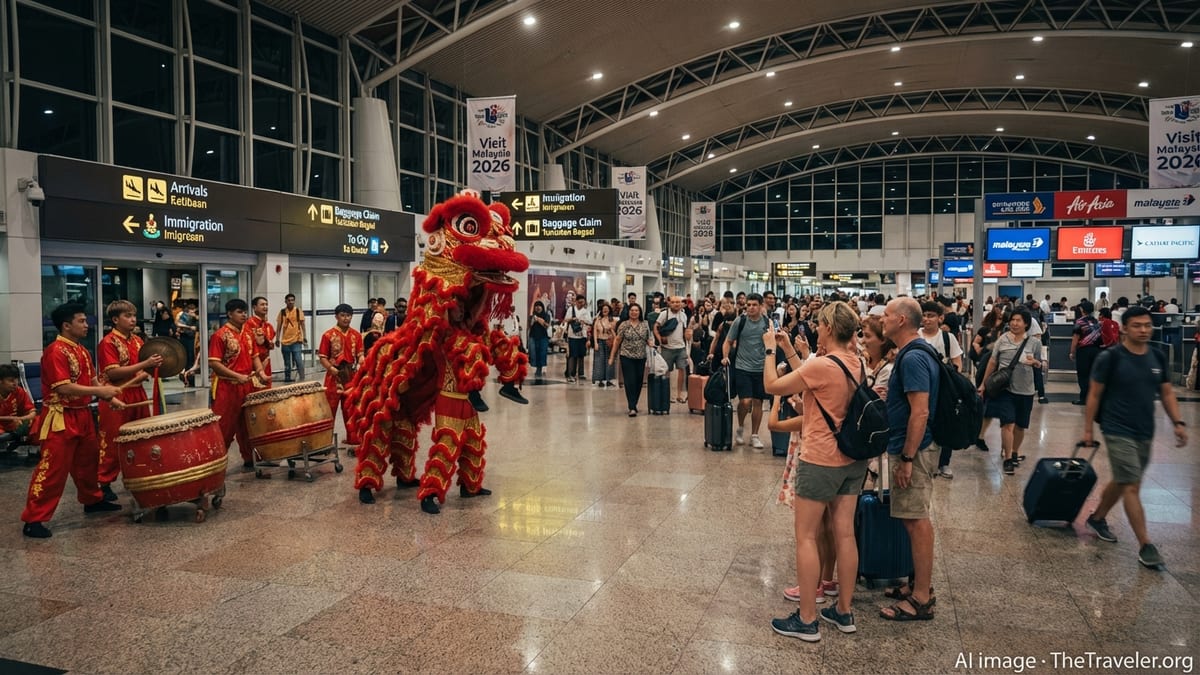
Festive Arrivals Hall Turns Into National Tourism Showcase
Terminal 1 at Kuala Lumpur International Airport has been transformed into a festive stage this Lunar New Year, as Tourism Malaysia ramps up its now-annual Chinese New Year welcome for inbound travellers. Building on airport celebrations that have grown steadily in recent years, this year’s edition has been described by officials and airport managers as the most heavily attended yet, with dense arrival hall crowds from early morning through late evening banked around cultural performances and photo zones.
Tourism Malaysia has been using KLIA as a front-line showcase for the country’s multicultural identity, pairing traditional lion dance performances and yee sang-tossing ceremonies with appearances from Visit Malaysia 2026 mascots and costumed cultural troupes. The result is that passengers emerging from immigration are met not by a quiet arrivals corridor, but by drums, cymbals and choreographed lion troupes weaving between families and tour groups.
Airport managers say the event has taken on new strategic importance as Malaysia prepares for its role as ASEAN chair and intensifies efforts to convert transit passengers into longer-stay visitors. With visa-free entry for travellers from key markets such as China and India now in place through 2026, officials are betting that a memorable first impression at KLIA will translate into more repeat visits and stronger word-of-mouth across social media in Asia’s largest outbound markets.
The scale of this year’s turnout reflects broader traffic trends. KLIA has already climbed into the ranks of Southeast Asia’s busiest airports and has been recording double-digit growth in international volumes, helped by a growing list of airlines and expanded connections to China, the Middle East and the wider Asia Pacific region. That momentum has given fresh urgency to Tourism Malaysia’s decision to lean on high-visibility airport events as a form of live marketing.
Record Traffic at KLIA Underscores Malaysia’s Tourism Rebound
The record-breaking crowds at the Chinese New Year event come as Kuala Lumpur International Airport posts some of its strongest traffic metrics since the pandemic. Recent operational data show monthly passenger totals in the multi-million range, with international volumes outpacing domestic growth as long-haul networks return and new regional routes are added. Malaysia Airports, which operates KLIA, has highlighted sustained double-digit annual growth in passenger movements, with December figures alone topping six million travellers across terminals.
Malaysia’s broader tourism recovery provides the backdrop for the festive surge. Visitor arrivals have leapt beyond pre-pandemic benchmarks, and tourism spending has climbed sharply on the back of relaxed entry rules, aggressive airline capacity increases and a steady pipeline of new routes to secondary cities in China and emerging markets across Asia. Officials have framed the Visit Malaysia 2026 campaign as a chance not just to restore, but to significantly exceed, earlier tourism records.
Within this context, KLIA Terminal 1 is being positioned as the country’s primary shop window. Airport management has invested in passenger flow systems, upgraded security processing and refreshed commercial zones to ensure that even on record-traffic days the terminals can handle surges without major delays. A separate wave of technology upgrades is being rolled out in phases, aiming to push more travellers through self-service touchpoints and biometric gates while keeping the arrivals hall itself free for cultural activations and tourism showcases.
The payoff is visible during the Chinese New Year peak. Passenger volumes during festive weekends now rival Malaysia’s busiest long-holiday periods, but queues at immigration, baggage belts and customs have remained manageable, allowing crowds to gather around Tourism Malaysia’s performances without choking off critical passenger flows. For the country’s flagship airlines and international partners, a smooth high-season experience is becoming a key selling point when marketing Kuala Lumpur as a preferred transfer and destination hub.
AirAsia Leads Domestic Connectivity in the Festive Rush
Low-cost giant AirAsia has emerged as one of the most visible winners from the Chinese New Year surge, leveraging its dominant domestic network to shuttle holidaymakers between the Malaysian peninsula and key cities in Sabah and Sarawak. For this year’s festive period, the airline has scheduled more than 4,400 flights across a 13-day window, including roughly 150 additional domestic services layered on top of its usual timetable to cope with peak demand.
Company executives say AirAsia is working closely with the federal government to keep travel affordable during major festivals, offering subsidised fares on a range of routes between West and East Malaysia and adding complimentary baggage allowances on selected services. These measures have helped fill aircraft during the busiest travel days while allowing families and migrant workers to secure seats without paying the premium prices that often accompany last-minute holiday travel.
Operationally, the airline has also been coordinating more closely with Malaysia Airports to smooth turnarounds during compressed departure banks, which tend to cluster in the days immediately before Chinese New Year and in the mid-festival return window. AirAsia crews and ground handlers have been deployed in larger numbers at KLIA’s terminals, working extended shifts to keep aircraft rotations on schedule despite heavy congestion on taxiways and at contact stands.
Beyond the domestic market, AirAsia is using the festive rush to deepen its regional footprint. Additional services have been laid on to popular short-haul leisure destinations, while selected routes into southern China and Indochina have seen capacity boosts timed to coincide with holiday travel peaks. The carrier views these seasonal surges as a test bed for longer-term expansion decisions, tracking load factors and booking patterns to determine which markets can sustain higher year-round frequencies.
Malaysia Airlines Taps Long-Haul Demand and Premium Leisure
Flag carrier Malaysia Airlines has focused its Chinese New Year strategy on a different slice of the market, pivoting toward long-haul and premium leisure travellers who use Kuala Lumpur as a gateway to the wider region. In the past year the airline has reinstated and added long-distance routes, including services to European capitals, as it rebuilds its network and seeks to reclaim a larger share of full-service traffic through KLIA.
During the current festive period, the airline has seen robust bookings on routes connecting Kuala Lumpur to major hubs in Australia, the United Kingdom and continental Europe, as members of the Malaysian diaspora return home and foreign visitors combine holiday trips with stopovers in Southeast Asia. Load factors on select trunk routes have climbed into very high territory, and revenue managers have leaned on dynamic pricing to balance strong demand against the need to remain competitive with rival carriers.
At KLIA Terminal 1, Malaysia Airlines has been a central partner in Tourism Malaysia’s Chinese New Year welcome events, co-branding parts of the arrivals experience and providing cabin crew ambassadors who mingle with arriving travellers. Uniformed staff have been on hand to guide passengers through the terminal, assist with onward connections and appear in media coverage of the celebrations, reinforcing the national carrier’s role as a symbol of Malaysian hospitality.
Network planners at the airline are closely watching how the Chinese New Year spike interacts with broader structural changes in the market, including visa-free entry for Chinese and Indian citizens and the rapid build-out of capacity by competitors in the Gulf and North Asia. The carrier’s long-haul strategy now rests on using Kuala Lumpur’s lower-cost base and improving airport infrastructure to offer a competitive alternative to entrenched mega-hubs in Singapore, Bangkok and the Middle East.
Singapore Airlines and Cathay Pacific Ride the Regional Hub Wave
For regional heavyweights Singapore Airlines and Cathay Pacific, the record crowds at KLIA’s Chinese New Year event underscore a wider trend in Asia: the re-emergence of multi-hub travel patterns as passengers mix and match carriers for complex itineraries. Both airlines operate busy schedules linking their home hubs to Kuala Lumpur, bringing in passengers who then connect onwards on Malaysia-based carriers or continue their journeys by road and rail.
Singapore Airlines has maintained a strong presence in the Kuala Lumpur market for years, serving one of the world’s busiest short-haul international corridors. During this Chinese New Year period, additional capacity and high load factors on Singapore to Kuala Lumpur flights have been driven by Malaysian workers and students based in the city-state returning home, as well as by international travellers using Changi as a long-haul gateway before hopping up to KLIA for regional explorations.
Cathay Pacific, meanwhile, is benefitting from the restoration of Hong Kong’s role as a major North Asia hub and from the resurgence of demand between Greater China and Southeast Asia. Kuala Lumpur flights have seen especially strong interest from Chinese travellers connecting through Hong Kong under more flexible visa arrangements, as well as from Malaysians using Hong Kong as a springboard to North Asia, North America and beyond. The airline has been fine-tuning schedules to improve connectivity for both inbound and outbound flows around the festive period.
Executives at both carriers highlight that joint promotional campaigns with Tourism Malaysia, including fare sales tied to the Visit Malaysia 2026 branding and airport-side advertising at KLIA Terminal 1, are increasingly important in winning mindshare. While neither airline is based in Malaysia, both rely on sustained demand for Kuala Lumpur as a destination and as a spoke in their larger global networks, making the success of events like the Chinese New Year welcome critical to their regional performance.
Emirates Leverages KLIA to Feed Long-Haul Networks
Gulf carrier Emirates has also felt the uplift from the Chinese New Year rush, with Kuala Lumpur to Dubai services recording heavy bookings in the run-up to the festival. Many of these passengers are either Malaysians working in the Middle East and Europe returning home via Dubai, or international travellers combining multi-country itineraries that take them from Europe to Malaysia and on to East Asia through the carrier’s global hub.
Emirates has steadily rebuilt capacity into Kuala Lumpur, reinstating multiple daily widebody services and positioning itself as a preferred option for premium and connecting travellers who value extensive onward choices. Chinese New Year provides a natural stress test for this strategy, with the airline needing to manage high cabin loads while ensuring that transit times in Dubai remain attractive for time-sensitive passengers heading to and from Malaysia.
The airline has joined Tourism Malaysia and Malaysia Airports in joint marketing efforts that present KLIA as an integral part of a broader East meets West travel corridor. Promotional materials pushed during the holiday season showcase itineraries that pair city breaks in Dubai with beach and nature-focused escapes in Malaysia, appealing particularly to travellers from Europe and the Gulf who are seeking winter sun combined with cultural experiences.
For Emirates, the success of its Kuala Lumpur services during peak seasons like Chinese New Year is a barometer of the market’s health and of the competitiveness of Malaysian tourism offerings relative to regional rivals. Strong performance this year will likely strengthen the case for further capacity increases, whether through upgauged aircraft, additional frequencies or enhanced code-share partnerships with Malaysia-based carriers.
Visa-Free Entry and New China Routes Drive Holiday Momentum
The festive scenes at KLIA are also a direct result of policy choices made in Putrajaya. Malaysia’s decision to extend visa-free entry for Chinese and Indian travellers for stays of up to 30 days through 2026 has been one of the most consequential moves in its recent tourism playbook. Arrivals from China in particular have rebounded sharply, with millions of visitors recorded in the most recent full-year figures and growth rates far outstripping many other source markets.
This surge has been accompanied by a rapid build-out of air connectivity to Chinese cities. In the past year, a string of airlines have inaugurated or expanded services linking Kuala Lumpur and secondary Malaysian airports to destinations such as Xi’an, Hangzhou, Haikou, Qionghai and Chengdu. That additional capacity has filtered through to KLIA Terminal 1, where a noticeable share of the Chinese New Year crowd consists of first-time visitors from emerging Chinese cities taking advantage of simplified entry rules and more convenient flight options.
Tourism Malaysia has tailored its Chinese New Year airport programming with this demographic in mind. Mandarin-speaking hosts, bilingual signage and specially curated door gifts are designed to make Chinese visitors feel immediately at home upon arrival. Social media-friendly elements, including live-streamed lion dance performances and selfie spots featuring Malaysian landmarks, are aimed at amplifying the country’s visibility on popular Chinese platforms during one of the peak sharing periods of the year.
For airlines, the combination of visa-free entry and targeted airport events translates into more predictable demand and an easier sell when launching or scaling services. Carriers from China, Southeast Asia and the Gulf are all indicating that Malaysia’s streamlined entry regime and active tourism marketing are key factors in route planning, with several openly linking new capacity deployments to the Visit Malaysia 2026 timeline.
KLIA’s Growing Hub Status Reshapes Regional Competition
The record crowds at Tourism Malaysia’s Chinese New Year event are the most visible symptom of a deeper shift taking place at Kuala Lumpur International Airport. As traffic climbs and airline counts rise, KLIA has vaulted into the upper tier of Southeast Asia’s hubs, now ranking among the region’s busiest airports by departing seats and passenger movements. This has put it in more direct competition with established giants such as Singapore’s Changi, Bangkok’s Suvarnabhumi and Jakarta’s Soekarno Hatta.
Malaysia’s strategy for KLIA focuses on combining volume growth with a differentiated passenger experience grounded in cultural hospitality. Holiday-season showcases like the Chinese New Year welcome are one pillar of that approach, giving KLIA a distinct identity as an airport where national festivals are brought directly into the terminal space rather than kept at arm’s length. Officials believe that this blend of efficiency and cultural warmth can help the airport capture a larger slice of connecting traffic, particularly from travellers seeking alternatives to more clinical hub environments.
The success of the latest Chinese New Year event will likely inform how Malaysia Airports and Tourism Malaysia design future campaigns for other major festivals, including Hari Raya and Deepavali. Early indications suggest that partners such as Singapore Airlines, AirAsia, Malaysia Airlines, Emirates and Cathay Pacific are eager to remain involved, viewing these events as high-visibility opportunities to reinforce their brands with an international audience already primed for travel.
With Visit Malaysia 2026 on the horizon and passenger numbers still on an upward trajectory, the record-breaking crowds at KLIA Terminal 1 this Chinese New Year may prove to be a curtain-raiser for an even more ambitious slate of airport-based tourism activations. For the airlines that anchor the country’s connectivity, the spectacle is more than a photo opportunity; it is a tangible sign that Malaysia’s aviation and tourism ecosystem is once again operating at full throttle, and looking outward with renewed confidence.