

More news on this day
Significant disruption across parts of Europe has left KLM and Air France passengers stranded in Amsterdam, Paris, and Stuttgart, with publicly available data and media coverage indicating dozens of cancelled and heavily delayed flights and raising fresh questions about how travelers can best protect their itineraries when airline operations suddenly unravel.
Get the latest news straight to your inbox!
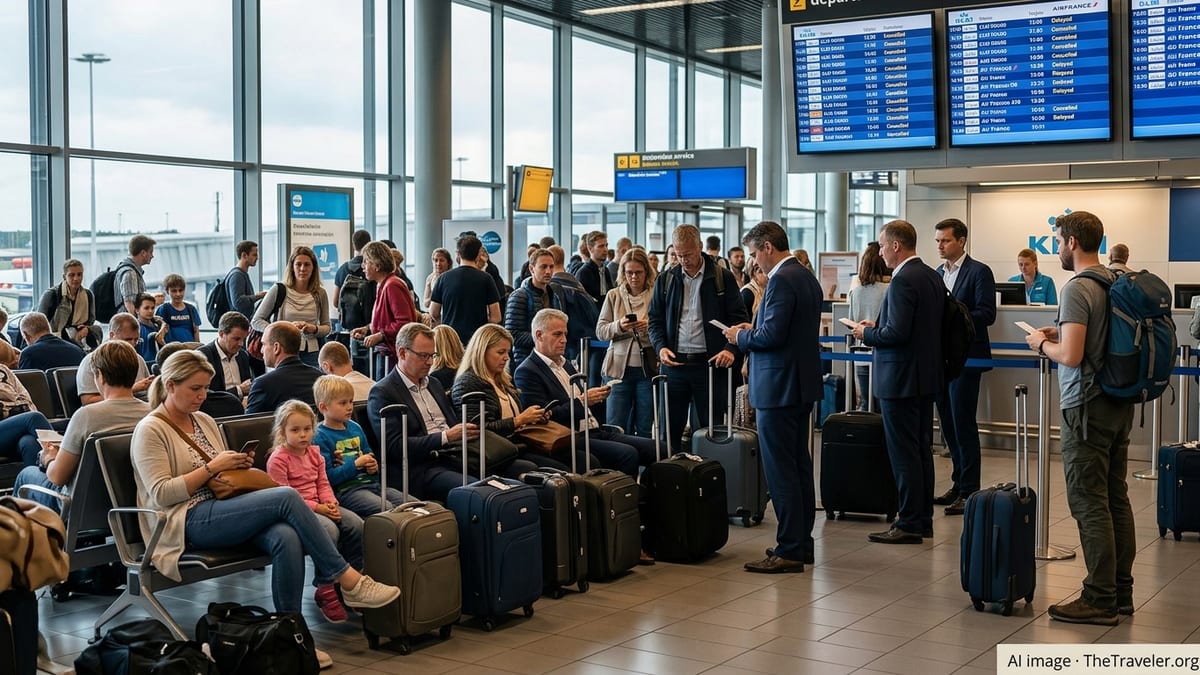
What Is Happening in Amsterdam, Paris, and Stuttgart
Flight-tracking dashboards and airport information boards on March 23 show extensive disruption across KLM and Air France networks, centered on their key hubs at Amsterdam Schiphol and Paris Charles de Gaulle, with knock-on effects reported at Stuttgart Airport. Dozens of flights have been cancelled or retimed, leaving passengers facing long queues, missed connections, and overnight stays.
At Amsterdam, KLM’s primary hub, cancellations and delays are concentrated on short and medium-haul services within Europe, where aircraft and crew rotations are most sensitive to schedule changes. In Paris, Air France is facing a combination of cancellations and significant delays, particularly on intra-European and regional routes that rely on tight turnaround times.
Stuttgart, while smaller than the two hub airports, has seen its own share of disruption as feeder flights operated by or on behalf of the Franco-Dutch group struggle to maintain schedules. Reports from travelers indicate crowded departure halls, long waits at customer-service desks, and limited same-day rebooking options on some routes.
Publicly available information suggests that the situation is fluid, with airlines continuing to adjust schedules during the day. Travelers with flights later on March 23 and into March 24 are being urged via airline apps and airport advisories to check the status of their journeys before heading to the airport and to anticipate longer processing times if they need to rebook in person.
Operational Pressures Behind the Latest Wave of Cancellations
The current wave of disruption appears to be driven by a mix of operational factors that have repeatedly challenged European carriers over the past two winters. Weather-related constraints have periodically reduced runway and airspace capacity at major hubs, forcing airlines to trim schedules in advance or on the day of operation. When this coincides with already tight staffing and aircraft availability, even modest capacity cuts can lead to cascades of cancellations.
Recent seasons have also highlighted how quickly knock-on effects can build at Amsterdam and Paris. When aircraft and crews are out of position after storms, fog, or strong crosswinds, carriers may need several days to fully restore normal operations, especially on high-frequency European routes. In such circumstances, airlines often prioritize long-haul departures and higher-demand trunk routes, which can leave thinner regional services more vulnerable to cancellation.
Beyond weather, published analysis of airline performance this winter has pointed to continuing pressure on ground handling, maintenance capacity, and call-center resources. When multiple issues occur at once, including technical checks on aircraft or staffing shortfalls in key operational roles, airlines may proactively cancel lower-priority flights to preserve overall network stability.
For passengers, these behind-the-scenes dynamics mean that disruption can occur even when local conditions at a departure airport appear calm. A flight departing Paris or Stuttgart might be cancelled or heavily delayed because the inbound aircraft or crew is trapped elsewhere in the network, rather than due to any visible problem in the terminal itself.
What Passengers Can Expect at the Airport
Travelers caught in today’s disruption are reporting familiar scenes across the three affected airports: long lines at transfer desks, crowded seating areas near departure gates, and periods of limited information as airlines work through congested rebooking systems. In some cases, passengers are receiving push notifications or emails about cancellations only shortly before scheduled departure times, leaving limited room to adjust plans.
At Amsterdam and Paris, both major connecting hubs, missed connections are a significant issue. When an early feeder flight is cancelled or delayed, onward long-haul journeys can be jeopardized, especially where only one daily departure is available. Some travelers are being rebooked onto flights departing a day or more later, while others are being rerouted via alternative hubs or alliance partners where seats are available.
Accommodation and meal arrangements vary depending on the cause of the disruption and local capacity. During peak periods of irregular operations, nearby hotels can fill quickly, and passengers may face waits for vouchers or guidance on where to stay. Airport facilities can also become stretched, with longer queues for security, food outlets, and restrooms as stranded passengers remain landside or in transit areas for extended periods.
Given the strain on in-person support, travelers are turning to digital tools and self-service options, but these can also slow or crash under heavy demand. Some passengers are reporting repeated error messages when attempting to change flights via airline apps or websites, underscoring the value of having multiple channels available to monitor and adjust bookings.
How to Adjust Your Travel Plans
For travelers with upcoming trips on KLM or Air France through Amsterdam, Paris, or Stuttgart over the next 24 to 48 hours, the most important step is to monitor flight status closely. Airline apps and airport departure boards typically provide the earliest indications of delays or cancellations. Checking repeatedly, rather than waiting for a single notification, can provide a crucial time advantage if seats on alternative flights are limited.
When a cancellation occurs, many passengers can rebook through self-service channels. Airline websites and mobile apps often allow travelers to select alternative flights on the same route at no additional fare, subject to availability. Acting quickly is essential, as the most desirable replacement options, such as same-day departures or direct routings, tend to be snapped up first.
Where self-service tools fail or do not display suitable options, travelers may need to try multiple support channels, including phone lines and social media messaging, recognizing that hold times can be lengthy during major disruptions. In some cases, searching for alternative routings that avoid the most affected hubs, even with an extra connection, can significantly reduce total delay.
For those already at the airport, it can be useful to identify quieter service points, such as transfer desks in less crowded piers or partner airline counters that are authorized to assist with rebooking. However, passengers should weigh the time spent queueing against the potential to secure changes online or via phone while remaining seated.
Your Rights and Practical Steps Under European Air Passenger Rules
Travelers whose flights are cancelled or heavily delayed within, to, or from the European Union are generally covered by EU air passenger regulations, which set out rights to rerouting, refunds, care, and, in some circumstances, financial compensation. The specific entitlements depend on factors such as the length of delay, the distance of the flight, and whether the disruption is due to extraordinary circumstances beyond the airline’s control.
In the case of weather-related capacity reductions, strong winds, snow, and air-traffic-control restrictions are often classified as extraordinary circumstances, which can affect eligibility for cash compensation even when passengers still have a right to meals, refreshments, and, where necessary, hotel accommodation. By contrast, disruptions stemming from technical issues with the aircraft or certain staffing and operational problems may fall under different criteria and can sometimes give rise to compensation claims.
Passengers are advised to keep all receipts for out-of-pocket expenses such as meals, ground transport, and hotels during the disruption, as some costs may be recoverable depending on the circumstances and the airline’s policies. It is also prudent to document delays by taking timestamped photos of departure boards and boarding passes, and to save any written communication from the airline regarding the cause of the disruption.
Travel insurance can provide an additional layer of protection, especially for travelers on complex itineraries or those connecting to cruises, tours, or time-sensitive events. Policies vary widely, but some include coverage for missed connections, trip interruption, or additional accommodation expenses that go beyond what airlines are obliged to provide under European rules. Reviewing policy details before traveling, and contacting insurers promptly when problems arise, can make it easier to submit any eventual claim.