

More news on this day
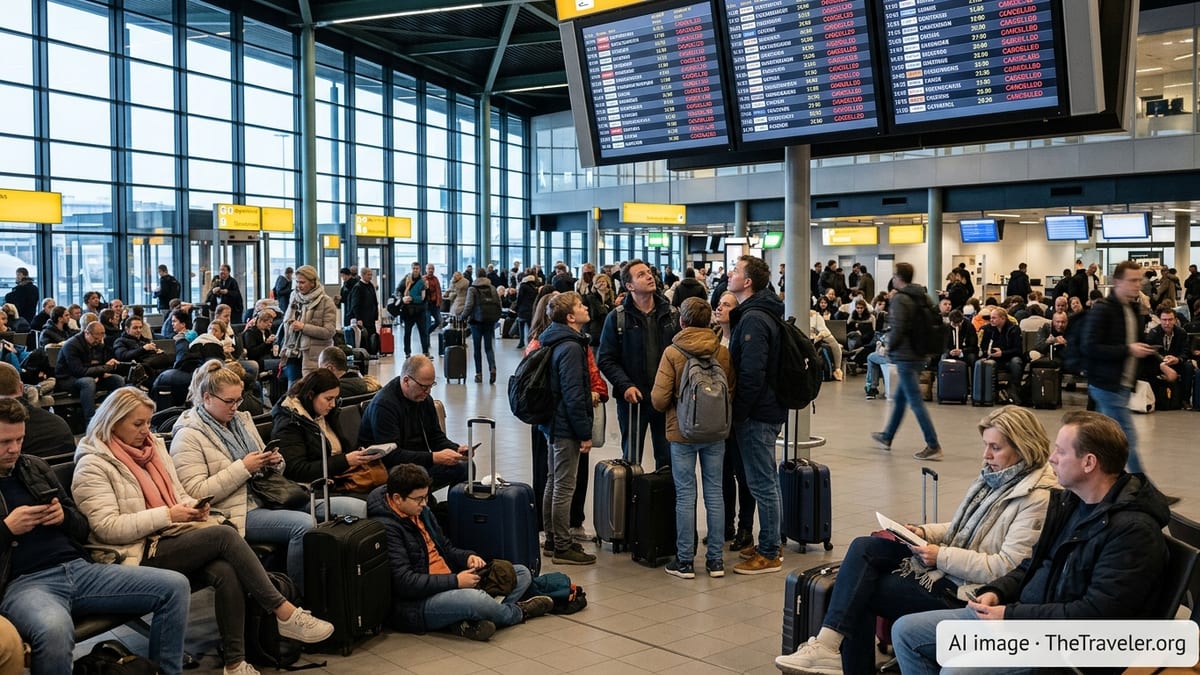
Hundreds of travelers across Europe are facing unexpected overnight stays and missed connections as KLM and Air France deal with widespread operational disruptions, leaving passengers stranded in key hubs including Amsterdam, Paris, and Stuttgart and prompting renewed questions about what air passengers can reasonably expect when flight schedules collapse.
Get the latest news straight to your inbox!
What Is Happening in Amsterdam, Paris, and Stuttgart
Published coverage and real-time tracking data point to a fresh wave of cancellations and delays across the Air France–KLM network, with Amsterdam Schiphol and Paris Charles de Gaulle hardest hit and knock-on effects reported at secondary airports such as Stuttgart. The pattern is consistent with previous disruption episodes this winter, when reduced runway capacity, weather constraints, and air traffic control limits forced airlines to trim schedules with little notice.
Amsterdam, the principal hub for KLM, has seen a series of days where dozens of flights were either cancelled outright or significantly delayed, particularly on short-haul routes around Europe. Publicly available information shows KLM focusing on preserving long-haul operations while consolidating or scrapping select regional flights, which has left many passengers stuck in the Netherlands awaiting rebooking.
In Paris, Air France has been adjusting departures and arrivals as technical issues and airspace constraints ripple through its schedule. Reports indicate that some services are being cancelled the day of departure, while others are retimed by several hours. Stuttgart and other smaller airports are feeling the effects when feeder flights into the main hubs are pulled, cutting off onward connections for travelers heading to long-haul destinations.
While the precise mix of causes varies day to day, the outcome for passengers is similar: crowded terminals, long lines at service desks, and limited same-day alternatives. For travelers with onward connections, the hub disruptions in Amsterdam and Paris are particularly challenging because missed links can cascade into multi-day delays.
Main Causes Behind the Latest Wave of Cancellations
Recent analyses of operations at KLM and Air France highlight several converging factors behind the current disruption. Weather remains a recurring trigger, with fog, strong crosswinds, or snow at Amsterdam and Paris lowering runway capacity and prompting airports to instruct airlines to trim schedules. When this happens, carriers tend to cancel flights that have multiple alternative departures or that connect large hubs, which often means European short-haul services are first in line for cuts.
Alongside weather, air traffic control restrictions and congested airspace over Western Europe continue to limit flexibility. When sectors become overloaded, departure slots are pushed back or withdrawn, and airlines are forced to reshuffle aircraft and crews. Publicly available timetables show that even small shifts in slot times can render previously planned rotations impossible, leading to late-notice cancellations.
Operational reliability and maintenance needs also play a role. Aircraft taken out of service for unplanned checks or technical issues reduce the available fleet at a time when demand is strong and schedules are already tight. Industry observers note that when a single aircraft drops out of a rotation, the impact can ripple through multiple cities, including regional airports such as Stuttgart that depend on a limited number of daily flights.
Finally, crew duty-time limitations can turn what might have been a long delay into a full cancellation. Once pilots or cabin crew reach their regulated maximum working hours, they cannot legally continue operating. With rosters already stretched, airlines may not have backup crews ready, especially late in the day, forcing the cancellation of the remaining sectors on that aircraft’s schedule.
What Stranded Passengers Are Experiencing on the Ground
Social media posts and passenger forums depict familiar scenes in Amsterdam, Paris, and Stuttgart: long queues at transfer and ticketing desks, departure boards filled with red “cancelled” notices, and travelers searching for scarce hotel rooms near the airport. Many describe receiving cancellation alerts via apps or email only a few hours before departure, followed by limited guidance on the next steps.
At hub airports, passengers with missed connections are often automatically rebooked on the next available flight, but that can be a day or more later when demand is high and backlogs build. Some travelers report being moved onto itineraries that add extra stops through partner hubs, while others are left without confirmed new bookings for several hours as systems update.
Accommodation and meal support vary depending on the stated cause of disruption and local policies. Public information indicates that, when disruptions are attributed to weather or broader air traffic issues, airlines may provide fewer benefits than when problems stem from technical faults within their control. This distinction can be confusing for travelers who see other carriers continuing to operate from the same airport while their own flight is cancelled.
At smaller airports like Stuttgart, passengers can face additional challenges because fewer alternative flights are available and customer service staff may be shared among multiple airlines. That can extend waiting times and make it harder to find same-day options, especially for long-haul itineraries that depend on tight connections in Amsterdam or Paris.
Your Rights Under European Passenger Protections
Travelers affected by these disruptions fall under the framework of European air passenger rules, which set out clear entitlements when flights are cancelled or heavily delayed. Public guidance on these rules explains that, in many circumstances, passengers are entitled to a choice between a refund of the unused ticket or rerouting to their final destination at the earliest opportunity.
Compensation is more nuanced. When cancellations or long delays are caused by factors considered within an airline’s control, such as many technical problems, eligible passengers on flights departing from or arriving in the European Union on an EU carrier may be entitled to a fixed cash payment, depending on flight distance and length of delay. However, when cancellations are attributed to extraordinary circumstances such as severe weather or certain air traffic control restrictions, compensation may not apply even though care and assistance must still be provided.
Duty-of-care obligations can include meals, refreshments, and, when an overnight stay becomes necessary, hotel accommodation and transport between the airport and the hotel. The precise level of support often depends on the length of the delay and local implementation of the rules, but published guidance encourages passengers to keep receipts for reasonable expenses when airlines are unable to issue vouchers in time.
Because the classification of a disruption as weather-related or operational can significantly affect eligibility for compensation, travelers are increasingly turning to claims portals, national enforcement bodies, or independent arbitration schemes when they believe a denial is unjustified. Publicly available case summaries show mixed outcomes, with some passengers successfully challenging the airline’s reasoning and others seeing decisions upheld.
How to Adjust Your Travel Plans if You Are Affected
For travelers scheduled to fly with KLM, Air France, or their codeshare partners in the coming days, practical steps can reduce the risk of becoming stranded. Checking flight status frequently in the 24 hours before departure is essential, particularly for early-morning and late-evening flights that are more vulnerable when schedules are tightened. Many recent disruptions have been announced on relatively short notice, so relying solely on initial booking confirmations is risky.
If a cancellation alert does arrive, acting quickly can improve options. Passenger experiences shared online suggest that parallel strategies often work best: using the airline’s app or website to search for alternative flights while also attempting to reach call centers. When hub airports are crowded, some travelers report faster results by contacting overseas customer service numbers for the same airline group, though availability varies.
For those already at the airport, it can be tempting to join the nearest queue, but that may not always be the fastest route to a solution. Some travelers in Amsterdam and Paris have described securing new itineraries by phone or digital chat while others from the same cancelled flight remained in line at desks. Taking photos of departure boards, keeping copies of cancellation messages, and saving boarding passes can help document events later if reimbursement or compensation claims are needed.
Where possible, considering alternative routings can also help. Travelers in Stuttgart, for example, might explore same-day rail connections to larger hubs such as Frankfurt or Paris if airline-approved rerouting is available from there. However, passengers should confirm in writing that any self-arranged changes will be covered before purchasing additional tickets or making nonrefundable arrangements.
Planning Ahead for Upcoming Trips Through These Hubs
The current disruptions highlight the value of building more resilience into travel plans involving Amsterdam, Paris, or feeder cities like Stuttgart. When booking new itineraries during periods of heightened operational risk, travelers may wish to allow longer minimum connection times, particularly if a tight link involves separate tickets or a critical long-haul segment.
Choosing earlier flights in the day can provide more fallback options if cancellations occur, as later departures may have fewer viable rebooking choices. Travelers connecting through Amsterdam or Paris might also consider routing via alliance partners’ hubs when schedules allow, adding redundancy if one airport experiences sudden capacity cuts.
Flexible booking conditions remain important. Options that allow no-fee changes or refundable fares can be more expensive upfront but may save costs and stress if schedules are disrupted. Some travel insurers now highlight coverage for missed connections, additional accommodation, and alternative transport, though policy terms differ and often require thorough documentation.
Finally, travelers should store key booking references, airline contact numbers, and insurance details in both digital and offline formats before departure. In fast-moving disruption scenarios like those now affecting KLM and Air France networks, having information ready and a clear understanding of basic rights can make a significant difference in how quickly stranded passengers move from the terminal back onto a confirmed flight.