

More news on this day
KLM passengers across northern Europe faced severe disruption on Thursday as the Dutch flag carrier halted around fifty flights and delayed more than twenty five more, leaving travelers stranded in the Netherlands and triggering knock-on delays in Norway, Germany, Sweden, France, Denmark and beyond. Major hubs including Oslo, Stockholm, Hamburg and Copenhagen reported significant schedule disruption as aircraft and crews fell out of position and airport operations struggled to absorb the cascading delays.
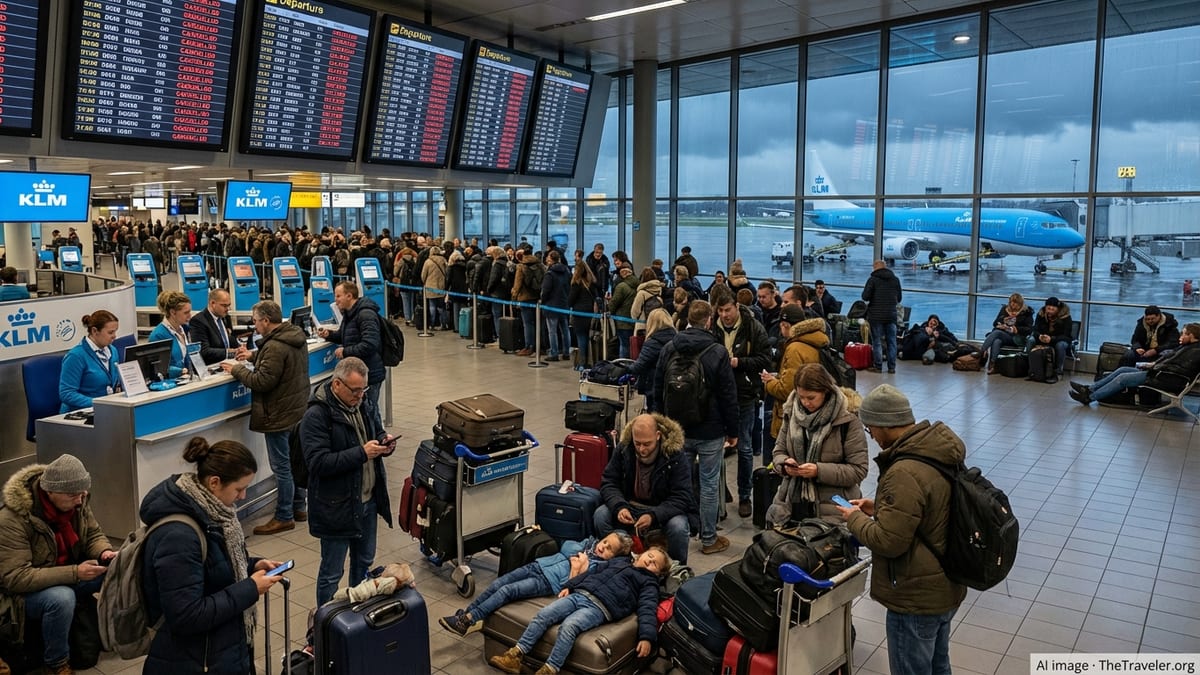
Amsterdam Schiphol Hit Hard As Disruption Spreads
The latest problems centered on Amsterdam Schiphol, KLM’s main hub, where a combination of operational constraints and weather-related bottlenecks left airlines trimming schedules to keep the airport running. Schiphol has already endured a turbulent winter season, with repeated bouts of snow and strong winds forcing KLM and other carriers to cancel large parts of their schedules in January and early February. The newest wave of cancellations added fresh strain just as the airline was working to stabilize operations.
While the exact tally shifts throughout the day, airport monitoring data and industry trackers indicated that roughly fifty KLM-operated flights were withdrawn from the timetable, with more than two dozen others facing extended delays. Those figures sat within a wider pattern of European disruption, as airports from Amsterdam and Paris to Oslo and Copenhagen collectively reported hundreds of delayed flights and scores of cancellations.
Amsterdam once again emerged as one of the worst affected hubs in Europe, with dozens of combined cancellations and a high volume of delays rippling through the day’s departures and arrivals. For KLM, which concentrates much of its European and intercontinental network through Schiphol, any reduction in runway capacity or ground-handling throughput quickly turns into missed connections and stranded customers across the continent.
Nordic Gateways Grapple With Knock-On Chaos
In Scandinavia, the impact of KLM’s schedule cuts and delays was felt most strongly at Oslo Gardermoen and Stockholm Arlanda. Both airports reported widespread timetable disruption on services linking to Amsterdam and other European hubs, a reflection of how heavily Nordic business and leisure travelers rely on Amsterdam for connections to North America, Africa and parts of Asia.
Oslo saw clusters of delayed departures and late-arriving inbound flights, particularly on mid-morning and early evening rotations that feed long-haul banks in Amsterdam. Passengers reported prolonged waits at departure gates, with some flights repeatedly pushed back as crews and aircraft arriving from the Netherlands missed their scheduled slots.
Stockholm, already handling elevated traffic and weather-related challenges this winter, also recorded a series of late-running KLM services. Extended turnaround times and crew duty limits meant that even modest delays quickly translated into missed connections, forcing the airline to rebook passengers overnight or reroute them through alternative hubs operated by alliance partners and competitors.
Hamburg, Copenhagen and German Hubs Feel the Strain
Germany and Denmark also felt the ripple effects, with Hamburg Airport and Copenhagen Airport among the hardest hit outside the Netherlands. In Hamburg, delays on KLM’s Amsterdam link compounded broader congestion as German carriers managed their own weather and capacity constraints. With aircraft arriving late from Schiphol, some Hamburg departures were pushed back repeatedly, leading to crowded gate areas and mounting frustration.
Copenhagen, one of Scandinavia’s busiest transfer points, contended with similar issues. A combination of Amsterdam-related delays and disruptions on other European routes created a patchwork of late departures and tight connections, affecting not only KLM passengers but also travelers booked on codeshare services and itineraries involving multiple airlines. For many, the relatively short hop between Copenhagen and Amsterdam became the weak link in wider international journeys.
Elsewhere in Germany, major hubs such as Frankfurt and Berlin reported scattered delays tied to KLM and other European network carriers. While these airports are less dependent on Amsterdam than Hamburg or Copenhagen, any large-scale disruption at Schiphol inevitably reverberates across the closely intertwined air traffic system in northern Europe.
Thousands of Passengers Face Missed Connections and Overnight Stays
The cancellation of around fifty flights and delays to over twenty five more translated into thousands of disrupted journeys for KLM customers and travelers on partner airlines. At Schiphol, long queues formed at transfer desks and customer service counters as passengers sought new itineraries, meal vouchers and hotel accommodation. Many were already reeling from earlier weeks of winter-weather disruption that have characterized the 2025 to 2026 travel season.
Travelers arriving in Amsterdam from long-haul destinations discovered that their onward European legs to cities like Oslo, Stockholm, Hamburg and Copenhagen had been canceled outright or delayed beyond the last feasible connections of the day. Some were rebooked via alternative hubs operated by Air France in Paris or by SkyTeam partners elsewhere in Europe, while others were offered departures the following morning, effectively turning a short layover into an unplanned overnight stay.
Families with children, elderly travelers and those on tight business schedules were particularly hard hit. Travel agents and online booking platforms reported a spike in calls from stranded customers seeking alternative options, including rail connections where feasible. In several cases, passengers chose to abandon their flights altogether in favor of high-speed trains linking the Netherlands, Germany and Scandinavia, even when it meant longer travel times.
KLM Cites Operational Pressures Amid Difficult Winter
KLM did not immediately detail every factor behind the latest batch of cancellations and delays, but the disruption fits into a season marked by repeated operational challenges. Strong winds, heavy snowfall and de-icing bottlenecks across northwestern Europe have already forced the airline to cancel or reschedule hundreds of flights since early January. At times, pressure on supplies of de-icing fluid and the need to protect ground crews in severe conditions have led to proactive cuts in the schedule to preserve safety.
Earlier in the winter, KLM warned travelers of ongoing uncertainty around Schiphol operations, stressing that extreme weather combined with limited runway capacity and air traffic flow restrictions could continue to trigger large-scale schedule changes. The airline has also acknowledged that recovering from each wave of disruption takes time, as aircraft and crews must be repositioned and maintenance schedules adjusted, leaving limited slack if new problems emerge.
Industry observers note that KLM is not alone in facing a difficult winter. Airlines across Europe have reported elevated levels of cancellations and delays this season, often tied to the same storm systems, snowfall events and capacity constraints that affect the Dutch carrier. However, KLM’s hub-and-spoke model, with a heavy reliance on Amsterdam as a central transfer point, makes it particularly vulnerable to any operational squeeze at Schiphol.
Pressure Mounts on Customer Service and Communication
The latest disruption has also reignited criticism of how airlines communicate with passengers during rolling cancellations and delays. Travelers in Amsterdam and at outstations across Europe reported receiving short-notice notifications via airline apps and text messages, sometimes only after arriving at the airport. Others complained that estimated departure times shifted repeatedly with little explanation, complicating decisions on whether to wait at the gate, seek rebooking or arrange overnight accommodation.
KLM has previously acknowledged that handling large-scale irregular operations involving hundreds of thousands of passengers strains both digital systems and frontline staff. When a high percentage of flights is impacted, automated rebooking often needs manual intervention, customer service queues lengthen and airport information screens quickly fall out of sync with evolving plans. For passengers, the effect can be a sense of confusion and abandonment just when they need clear guidance most.
In response to earlier waves of disruption this winter, KLM executives pledged to improve communication through more frequent app updates, additional staff at information desks and closer coordination with Schiphol’s airport authority. The current episode will serve as a fresh test of those commitments, especially for travelers whose journeys span multiple airlines and countries.
Wider European Context: A Season of Disruption
The turmoil at KLM and Schiphol unfolded against a broader backdrop of disruption across Europe’s air network. In recent days, multiple European countries, including France, Germany, the United Kingdom, the Netherlands, Norway, Denmark and Sweden, have logged thousands of delayed flights and dozens of cancellations in a single day as adverse weather and constrained capacity have strained schedules.
Major carriers such as Air France, Lufthansa, Scandinavian Airlines and various low cost operators have all reported significant punctuality issues, particularly on short haul routes that rely on tight turnarounds. Airports from Paris Charles de Gaulle and Frankfurt to London Heathrow and Madrid have seen operations slow under the combined weight of weather-related restrictions, air traffic control measures and ground handling challenges.
Within this context, KLM’s decision to halt around fifty flights and delay many more reflects a cautious approach to maintaining safety and operational stability in difficult conditions. Yet for passengers in Amsterdam, Oslo, Stockholm, Hamburg, Copenhagen and beyond, the macro-level logic offers little comfort when travel plans unravel.
What Stranded Passengers Can Do Next
For travelers affected by Thursday’s cancellations and delays, airline and consumer advocates emphasize several practical steps. Passengers are urged to monitor their flight status continuously through airline apps and departure boards, as schedules can change at short notice while operations stabilize. Those with flexible itineraries are advised to accept alternative routes or departure times offered by KLM and its partners, even if it means connecting through a different hub or arriving later than planned.
Under European air passenger regulations, travelers whose flights are canceled or significantly delayed may be entitled to assistance such as meals, refreshments and hotel accommodation while they wait for a new flight, particularly when they are stranded away from home. Eligibility for compensation depends on the specific cause of disruption and the length of the delay, which can vary when weather and airport capacity issues are involved. Passengers are therefore encouraged to retain receipts for any out of pocket expenses and to submit claims directly with the airline.
Consumer groups also suggest that, where reasonable alternatives exist, travelers consider rail or coach options for regional journeys, especially between major cities in the Netherlands, Germany, Denmark and Sweden. While such choices may not fully replace a missed flight to Norway or other more distant destinations, they can provide a way to complete parts of a disrupted itinerary while avoiding long waits at crowded airports.