

More news on this day
Passengers across Europe and the Middle East are scrambling to rebook after Dutch flag carrier KLM abruptly grounded all flights to Dubai, Saudi Arabia and Tel Aviv, citing a rapidly deteriorating security situation and fresh airspace restrictions over parts of the region.
Get the latest news straight to your inbox!
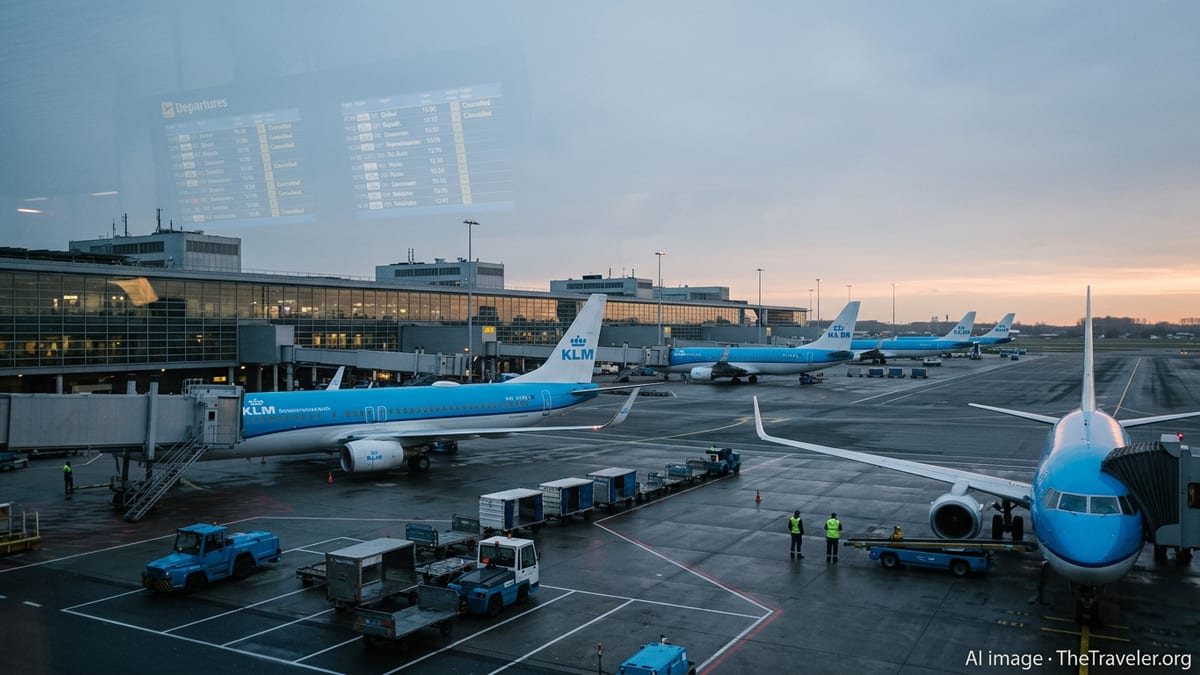
Security Fears and Airspace Closures Force KLM’s Hand
KLM confirmed this week that it has halted services to Dubai, Riyadh and Dammam in Saudi Arabia, and Tel Aviv until further notice, extending and widening a patchwork of previous suspensions as the conflict in the region intensifies. The move comes on top of earlier cancellations linked to the Iran war and retaliatory strikes that have repeatedly disrupted civil aviation across the Gulf and eastern Mediterranean.
In a statement on its website, the carrier said it is avoiding the airspace of Iran, Iraq and Israel, as well as parts of the wider Gulf region, following updated risk assessments and official guidance from European regulators. The rerouting required to steer clear of multiple conflict zones has made several of its core Middle East routes operationally and commercially unviable in the short term, pushing KLM to opt for a full stop rather than ad hoc cancellations.
The decision aligns with a Conflict Zone Information Bulletin issued by the European Union Aviation Safety Agency advising European airlines to avoid Iranian airspace because of the heightened risk from military activity and air defence systems. Dutch officials, already wary after the downing of flight MH17 in 2014, have consistently taken a conservative approach to overflight risks, and KLM’s latest cancellations reflect that risk-averse stance.
While some regional airports have begun limited operations again after temporary closures, shifting missile and drone threats, along with short-notice airspace shutdowns by several states, mean that routing aircraft safely through the region remains a moving target for airline schedulers.
Dubai Hub Disruptions Ripple Through KLM’s Global Network
Dubai has become one of the most affected hubs in this latest phase of the crisis. KLM has cancelled all flights to the emirate until at least March 28, removing a key link in its broader Asia, Africa and Oceania network. The Dutch carrier joins a growing list of European and Asian airlines that have suspended or sharply reduced Dubai operations in recent days as missile interceptions and temporary airspace closures around the United Arab Emirates triggered widespread disruption.
The grounding of KLM’s Dubai services reverberates far beyond the Netherlands. Many passengers from North America and Europe rely on Amsterdam as a transfer point en route to Dubai and onward destinations across the Gulf, Indian subcontinent and Southeast Asia. With Emirates and other Gulf carriers themselves operating on reduced schedules and altered routings, options for rebooking have narrowed sharply, and itineraries that once involved a single change now often require multiple connections or lengthy detours.
Travel agents report that itineraries via alternative hubs such as Istanbul and Cairo are seeing surging demand as travelers look to bypass the most heavily restricted airspace. However, those alternatives are also constrained by the same regional risk calculus and can quickly disappear from schedules when new advisories are issued.
For now, KLM is steering affected customers toward refund or rebooking options on later dates, but with no firm restart timeline for Dubai beyond an indicative late March target, many long-haul travelers are choosing to postpone trips altogether.
Saudi Arabia and Tel Aviv Routes Suspended Indefinitely
Flights to Riyadh and Dammam have also been suspended, with KLM initially setting short-term dates for the Saudi cancellations before extending them as the conflict widened and nearby airspace closures multiplied. Those routes not only served business and government traffic to the kingdom, but also connected religious and labour travelers from Europe and North America to wider destinations in the Gulf and Red Sea region.
Tel Aviv, meanwhile, has been off KLM’s map for much of the past year amid repeated flare ups in the Israel conflict and more recently Iran’s direct strikes on Israeli territory. The airline had signalled plans at various points to cautiously resume services with modified schedules, but the latest wave of missile attacks and retaliatory operations has frozen those efforts. For now, the carrier has stopped selling seats to and from Israel and is treating the suspension as open ended.
Other European airlines, including partners in the wider Air France-KLM group, have taken similar steps, pivoting to daytime-only operations, sporadic repatriation flights or full suspensions depending on their risk assessments and fleet flexibility. The result is a fragmented patchwork of availability that changes day by day, leaving passengers heavily dependent on real-time updates rather than printed timetables.
Industry analysts note that routes to Tel Aviv are often among the first to be cut back during regional escalations because they require flying directly through or adjacent to the most contested airspace, offer fewer diversion options and tend to trigger higher insurance and security costs for carriers.
What Travelers From the Netherlands and Beyond Should Expect
For Dutch travelers, the sudden grounding of KLM services has transformed what were once routine business, family or leisure trips into complex logistical puzzles. The airline is urging passengers not to go to the airport if their flight shows as cancelled and instead to use online tools or contact centres to request refunds or rebook on later dates or alternative destinations.
Passengers connecting through Amsterdam from North America and other parts of Europe face particular uncertainty, as missed onward legs can invalidate entire itineraries. Travel experts advise monitoring booking apps closely, enabling notifications from both airlines and airports, and building in generous layover times if rerouting through less congested hubs that may themselves be operating on reduced schedules.
Those who still need to reach destinations in the Gulf or Israel region are being warned to remain flexible about dates and routing, and in some cases even their final arrival airport. With airspace restrictions and missile alerts changing at short notice, an itinerary that appears confirmed one day can unravel the next. Many corporate travel departments are temporarily blocking non essential trips to impacted countries until there is more clarity on the security outlook.
Insurers are also updating their policies to reflect the elevated risk. Some are treating the suspensions as a known event, limiting coverage for new bookings that include affected airports, while still honouring claims tied to tickets purchased before the latest wave of cancellations. Travelers are being urged to read policy fine print carefully and document all airline communications for future claims.
Outlook: Safety First as the Middle East Aviation Map Shifts
Aviation experts say KLM’s sweeping cancellations underscore how quickly the regional aviation map can change when military conflict intersects with busy commercial corridors. Even when airports remain physically open, overlapping missile trajectories, drone threats and air defence activity can create risk profiles that regulators and airlines are no longer willing to accept for routine passenger flights.
In the short term, the expectation is for continued volatility. Airspace closures can be imposed or lifted with only hours of notice, and airlines must balance operational pressures to restore service with the reputational and safety consequences of a miscalculation. KLM has made clear that its guiding principle will be the safety of passengers and crew, even at the cost of significant disruption.
Longer term, the current crisis may accelerate trends that were already underway, including a shift in preferred routings between Europe and Asia and greater reliance on southern corridors that skirt high risk zones. For Dutch aviation authorities and KLM alike, the episode is likely to reinforce a cautious posture toward conflict zone overflights, shaping route planning well beyond the immediate emergency.
For now, travelers hoping to fly between the Netherlands and key Middle Eastern destinations must brace for an extended period of uncertainty, limited capacity and last minute changes, as one of Europe’s flagship carriers keeps its aircraft away from a region it currently deems too dangerous to serve.