

More news on this day
European group carriers KLM, Transavia and Air France have temporarily halted flights to Dubai as regional airspace tensions escalate, leaving winter holidaymakers and business travelers scrambling to understand whether their upcoming trips will go ahead.
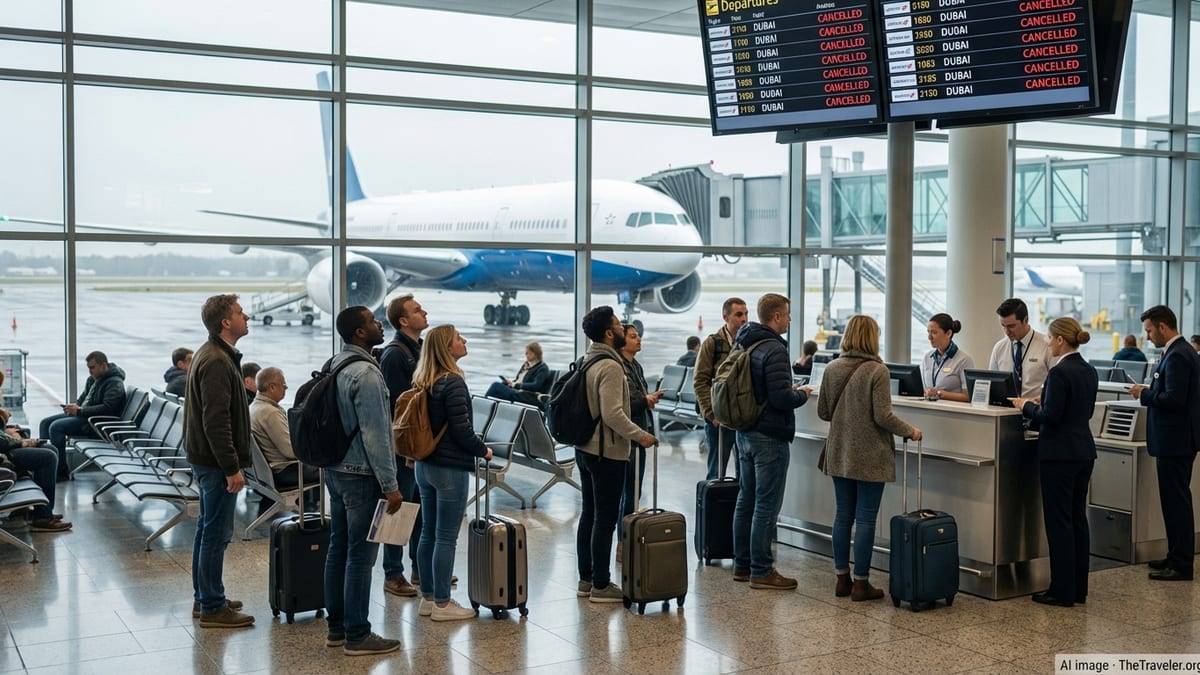
What Is Behind the Sudden Halt to Dubai Flights?
The decisions by KLM, Transavia and Air France to suspend services to Dubai come against a backdrop of mounting concern over the safety of overflying parts of the Middle East. In recent weeks, Western governments and aviation regulators have warned of increased military activity and the potential use of long-range weapons in and around Iranian and Iraqi airspace, which sits astride many of the busiest routes between Europe and the Gulf.
European aviation authorities have issued updated guidance urging airlines to avoid, where possible, certain conflict-adjacent air corridors. That has already prompted carriers such as Lufthansa Group airlines and British Airways to scale back or reroute services to Gulf hubs and to Israel. For the Air France-KLM group, whose Amsterdam and Paris hubs are key gateways to Dubai, the emerging security picture has now tipped the balance in favor of suspending flights rather than relying on costly and time-consuming detours.
The move is not driven by demand. Travel to Dubai remains buoyant, with the city positioned as a major winter-sun destination as well as a crucial connecting hub between Europe, Asia and Africa. Instead, airline executives and safety teams appear to be reacting pre-emptively to a confluence of military build-up, renewed rhetoric between the United States and Iran, and a tightening of European Union safety recommendations.
For passengers, the cancellations are the latest reminder that geopolitics can upend carefully laid travel plans overnight, even when the destination itself is not directly affected by unrest.
How KLM, Transavia and Air France Are Adjusting Their Schedules
While each airline has its own network and strategy, KLM, Transavia and Air France are coordinating closely as part of the wider Air France-KLM group. KLM had already been operating Dubai flights on an adjusted basis, with a focus on daylight operations and routing that avoided the most sensitive airspace wherever practical. That posture has now hardened into a temporary halt, as security assessments pointed to elevated risk and increasingly constrained routing options.
Air France, which serves Dubai from Paris Charles de Gaulle, is taking a similar approach. The airline had trimmed some overnight Gulf operations earlier in the year, in line with steps taken by other European network carriers. The latest suspension of Dubai flights extends that caution, at least in the short term, and concentrates capacity on routes where airspace access is less restricted or where alternative routings are more straightforward.
Transavia, the group’s leisure-focused low-cost carrier, is particularly exposed to shifts in Middle East access because it relies on high-utilization aircraft flying tightly scheduled holiday programs. Any requirement to fly longer, circuitous routings to reach Dubai can rapidly undermine the economics of such flights. As a result, Transavia has opted to withdraw Dubai services for now, redeploying aircraft to European and North African leisure destinations while the airspace situation remains fluid.
Across the group, planners are reassigning aircraft to more predictable routes and using spare capacity to shore up operations elsewhere, including on intra-European services that have seen weather-related disruption this winter. For flyers, that means Dubai flights may disappear from booking systems for upcoming weeks, even as other long-haul destinations remain available.
Who Is Most Likely to Be Affected by the Cancellations?
The immediate impact will be felt by travelers who were due to fly between Europe and Dubai on KLM, Transavia or Air France in late February and early March. This includes both point-to-point passengers beginning or ending their journey in Dubai and those using the city as a connection point to destinations in Asia, Africa or Oceania on partner airlines.
Customers starting their trips in the Netherlands, France, Belgium, Germany, the United Kingdom or the Nordic countries are particularly exposed, since Dubai-bound itineraries from these markets often rely on a first leg to Amsterdam or Paris. With those feeder flights now leading to a dead end for Dubai connections on group metal, travelers may find themselves automatically rebooked via alternative hubs or shifted onto partner airlines that are still operating to the United Arab Emirates.
Business travelers heading to trade fairs, conferences and corporate meetings in Dubai over the coming weeks will face the greatest pressure to secure alternative arrangements at short notice. Many of these trips were booked far in advance to take advantage of lower fares and preferred flight times. Now, replacement options may be limited and more expensive, particularly at peak departure times from major European cities.
Leisure travelers, including families on school-break holidays and long-haul tourists beginning extended trips in Dubai, are also being affected, though they may have slightly more flexibility to bring forward, delay or reroute their itineraries. Travel agents report a surge in calls from customers seeking to understand whether their particular flight is canceled and what new options are available.
What Other Airlines Are Doing in the Gulf Region
The Air France-KLM group is far from alone in curbing operations in and around the Gulf. Lufthansa Group airlines have extended restrictions on overflying Iranian and Iraqi airspace and continue to limit certain overnight services to Gulf and Levant destinations. British Airways has cancelled at least one of its daily Dubai rotations and adjusted its schedules to other regional cities, while several North American carriers have scaled back services to Israel and some Gulf hubs as a precaution.
Middle Eastern airlines are also responding, though the picture varies across the region. Some Gulf carriers, including those based in Dubai and Abu Dhabi, have opted to maintain most scheduled services for now, while quietly adjusting routings and flight times to comply with evolving safety advisories from international regulators and national authorities. Others have trimmed frequencies or temporarily suspended routes where alternative routings would be too complex or fuel-intensive.
For travelers, this patchwork response can be confusing. On certain days, departures to Dubai from European hubs may appear largely unaffected on some foreign carriers while flights on local European airlines are grounded. On other days, a broader wave of changes may ripple through timetables as regulators tighten or extend airspace advisories.
Industry analysts note that any escalation in regional tensions, especially if it involves the deployment or use of long-range weapons, could trigger a much wider retrenchment from the area by global carriers. For now, however, the suspensions by KLM, Transavia and Air France are best understood as targeted, precautionary measures rather than a wholesale retreat from Dubai by the world’s major airlines.
If You Have a Ticket, What Are Your Rights and Options?
Passengers booked on canceled Dubai flights with KLM, Transavia or Air France are generally entitled to be rebooked at no additional cost or to receive a refund. Under European consumer protection rules, airlines must offer travelers a choice between rerouting at the earliest possible opportunity, rerouting at a later date of the passenger’s choosing (subject to seat availability), or a full refund of the unused portion of the ticket. These rights apply whether the traveler booked directly with the airline or through a travel agent, although the process for exercising them can differ.
In practice, the first step is to monitor your booking closely. The airlines are notifying affected customers by email and text message where contact details are on file, and updated information is available in online booking portals and mobile apps. If your flight to or from Dubai shows as canceled, you should be prompted to select a new travel date, accept an automatic rebooking or request your money back.
Those who need to travel on or near their original dates may be offered itineraries via alternative hubs, potentially involving partner airlines or extra connections. For example, a passenger originally booked on a KLM or Air France flight to Dubai could be rebooked via another Gulf or European hub operated by a partner carrier still serving the region, though this will depend on seat availability and the specific commercial agreements in place at the time of travel.
Travelers who decide their trip is no longer viable or safe may opt for a refund instead. In some cases, airlines may also offer vouchers or the possibility to redirect travel to another destination within a similar fare bracket. It is important to read the detailed conditions linked to any voucher offer, including validity periods and whether additional fees might apply for future changes.
Practical Steps to Take Before You Travel
Given the fast-moving nature of the airspace situation, experts advise passengers with upcoming trips to Dubai to treat their bookings as provisional until shortly before departure. That means checking flight status repeatedly in the days leading up to travel, with another check on the morning of departure, as last-minute schedule changes remain possible.
Travelers should also ensure their contact details are up to date with their airline or booking agent, including an email address and mobile phone number that will be reachable while abroad. Many airlines now rely heavily on automated notifications to alert customers to cancellations, delays and rebookings. Without accurate contact information, passengers may miss crucial updates and arrive at the airport only to find their flight has been removed from the departure boards.
Those connecting onward from Dubai to other destinations face additional complexity. If your itinerary includes a separate ticket on a different airline from Dubai, the first carrier may have limited ability to protect your onward journey if schedule changes cause you to miss your connection. Where possible, consider consolidating your bookings with a single airline or alliance, or allow longer connection times to buffer against disruption.
Travel insurance is another key consideration. Policies that include coverage for travel disruption linked to security events or airspace closures can help offset the cost of last-minute accommodation, new flights or other out-of-pocket expenses. However, coverage can vary widely, and some insurers exclude known or ongoing crises, so it is essential to read the fine print or speak directly with your provider.
What This Means for Dubai as a Global Hub
Dubai International Airport has grown into one of the world’s busiest long-haul hubs, with hundreds of daily arrivals and departures connecting Europe, Asia, Africa and the Americas. Any reduction in services from major European airlines therefore reverberates well beyond point-to-point travel between Europe and the United Arab Emirates.
For the moment, the impact on Dubai’s overall connectivity is limited. Gulf-based carriers continue to operate the lion’s share of services to and from the city, and many regional and Asian airlines are still flying through alternative routings that avoid the most sensitive airspace. The temporary withdrawal of KLM, Transavia and Air France primarily affects choice and competition on specific city pairs, particularly between Dubai and Amsterdam, Paris and selected regional European airports.
Nonetheless, the situation underscores the vulnerability of global hub-and-spoke networks to developments far from their home markets. A military build-up in one country, a new safety advisory over another and a shift in regulator guidance at European level can, together, reshape the practical map of global air travel almost overnight. For Dubai, which markets itself as a dependable crossroads between continents, the current episode is a reminder that even the most established hubs are not immune to events beyond their control.
Industry observers will be watching closely to see how quickly European carriers move to restore Dubai flights once the security outlook improves. The longer the suspensions continue, the greater the risk that passengers and corporate travel buyers permanently shift their loyalties to alternative routings and competing hubs.
Will You Be Affected in the Weeks Ahead?
Whether you are personally affected by the Dubai flight suspensions depends on where you are flying from, when you are due to travel and how flexible your plans are. Travelers with imminent departures on KLM, Transavia or Air France are the most exposed, especially those heading to time-sensitive events such as conferences, sporting fixtures or family celebrations.
If you are planning a new trip to Dubai in the coming months, it is worth checking not only current availability but also the broader pattern of advisories from aviation regulators and national authorities. Booking fully flexible or refundable fares, where budget allows, can provide an extra layer of security if the situation deteriorates or if further airlines follow KLM, Transavia and Air France in pausing services.
Passengers whose journeys start outside Europe should also pay close attention if they are ticketed on itineraries that rely on Amsterdam or Paris as connection points to the Gulf. Even if your first leg is on a different carrier, your Dubai-bound segment on one of the group airlines may be disrupted. In such cases, working through your original booking channel, whether that is a travel agent or an online platform, is often the most efficient way to secure alternatives.
For now, the message from airlines and regulators is that safety considerations will continue to take precedence over schedule reliability. While that may mean more uncertainty for travelers in the short term, it also reflects the industry’s determination to avoid exposing passengers and crews to unacceptable risk as tensions in key air corridors ebb and flow.