

More news on this day
As Israel’s airspace remains closed following strikes involving Iran and regional powers, hundreds of thousands of travelers have seen itineraries collapse overnight, raising urgent questions about what airlines and tour operators are actually required to provide when planes cannot take off or land.
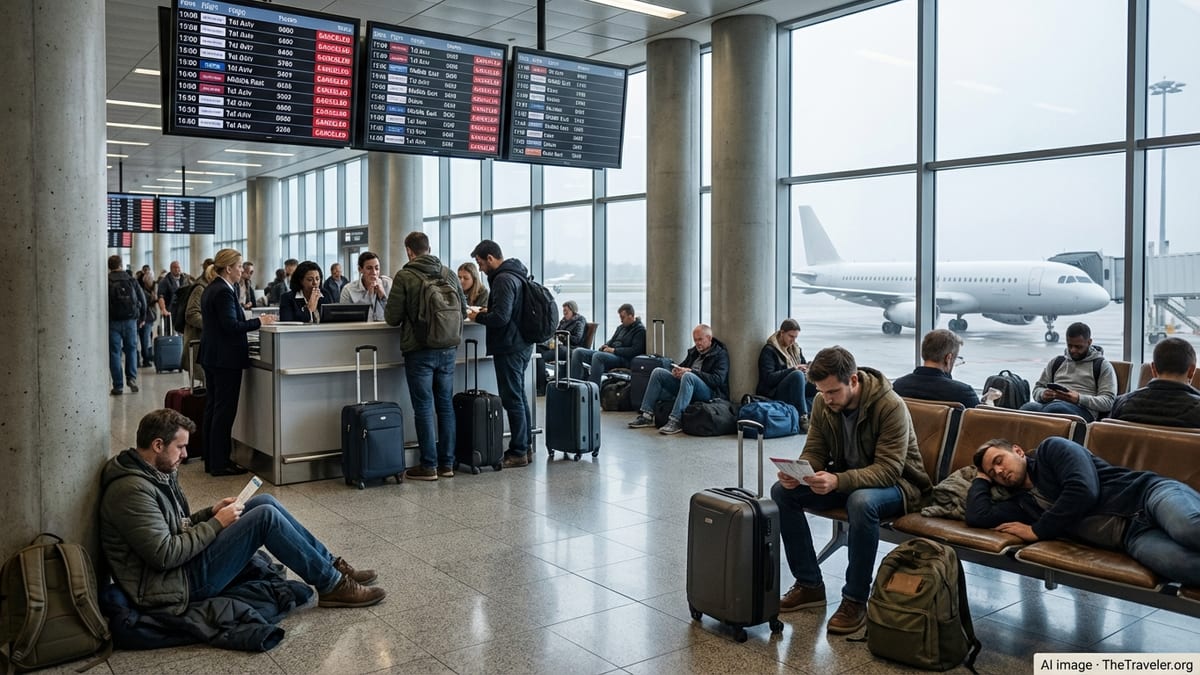
What the Airspace Closure Means for Travelers Right Now
Israel’s civil aviation authority has frozen almost all civilian traffic in and out of the country after security officials ordered a full closure of national airspace. Ben Gurion International Airport, ordinarily one of the region’s busiest hubs, is shut to commercial and even planned rescue flights for at least several days as military operations and missile threats continue.
The shutdown is rippling far beyond Israel’s borders. European and North American carriers have canceled or suspended services to Tel Aviv into next week, while many have also halted flights to nearby hubs such as Amman, Dubai and Doha or are routing around Israeli and Iranian skies, lengthening flight times and straining schedules. Airlines are urging passengers not to go to airports and to monitor carrier apps and text alerts instead.
Estimates from regional media and aviation officials suggest that more than 100,000 travelers with links to Israel are currently stranded overseas or unable to start journeys, with that figure likely to climb as the closure stretches on. With tickets in limbo and hotel reservations ticking away, the practical focus for many is shifting from when they can fly to what they are legally owed while they wait.
Israel’s Aviation Services Law: Refunds, Rerouting and Assistance
For flights touching Israel, the key framework is the country’s Aviation Services Law, which sets out what passengers are entitled to when flights are canceled, delayed or overbooked. In normal times, the law provides fixed cash compensation based on distance when a flight is canceled or severely delayed, alongside a choice between a refund or alternative transport and an obligation to offer meals, accommodation and practical assistance.
In the current crisis, however, the situation is more complex. The same law includes a broad exemption for “special circumstances” beyond an airline’s control, such as war, security directives and airspace closures. When that exemption applies, carriers are generally released from paying automatic monetary compensation, but they are still obliged to provide core assistance services and a choice between a ticket refund or rerouting once flights resume.
That means passengers whose flights to or from Israel have been canceled because the airspace itself is shut can expect to be offered either a full refund for the unused ticket or an alternative flight at the earliest opportunity after operations restart. They should also be offered necessary care while they are stuck, including reasonable meals, refreshments and hotel accommodation if an overnight stay becomes unavoidable.
Authorities have recently amended the law to give the transport minister temporary powers during prolonged emergencies, including the ability to let airlines route passengers only as far as regional hubs such as Greece or Cyprus. In practice, that could mean stranded travelers receive a ticket to a nearby gateway and must then arrange and pay for onward travel themselves, a detail that is angering some passengers but currently sits within the evolving legal framework.
EU and UK Rules: Stronger Care Duties but No Crisis Compensation
Many stranded travelers are covered not only by Israeli rules but also by European Union and United Kingdom passenger regulations. Under EU Regulation 261, which also applies in the UK, passengers departing from an EU, European Economic Area or UK airport are protected regardless of the airline’s nationality. The rules also cover flights into the bloc when operated by an EU or UK carrier.
In principle, these regulations offer three main protections: the right to a refund or rerouting after a cancellation, a duty of care that includes food, drink and hotel stays while waiting for a new flight, and in some cases fixed financial compensation. In the present crisis, legal experts say the last of those is unlikely to apply. War, missile strikes and forced airspace closures are typically treated as “extraordinary circumstances,” which release airlines from the obligation to pay lump-sum compensation even when disruption lasts for days.
The right to a refund or rerouting and the duty of care still stand. Travelers whose flights from Europe to Israel have been canceled can request either a full refund of the unused journey or rerouting at the earliest opportunity or at a later date that suits them, subject to seat availability. If they choose rerouting, airlines must provide meals, refreshments and accommodation as needed until the passenger can be placed on an alternative flight.
Consumer agencies in several European countries are advising passengers to keep receipts for reasonable out-of-pocket expenses such as meals and hotels when airlines fail to provide vouchers on the spot. These may be reclaimable later under the duty of care, although refunds for missed tours, prepaid car hire or nonrefundable hotel nights at the destination are far less likely, since most courts treat those as indirect losses that fall outside airline liability.
Stranded Abroad: Practical Steps to Protect Your Position
For travelers stuck overseas, experts recommend focusing first on establishing clear communication with the airline that issued the ticket. Many carriers serving Israel have temporarily closed ticket sales and are instead building rescue-flight lists from existing reservations so that once airspace reopens, stranded customers can be rebooked automatically. Airline statements indicate that passengers with existing tickets will be prioritized for those flights over new bookings.
Officials and carriers alike are warning against risky self-rerouting via neighboring countries whose airspace may also be restricted or subject to last-minute closures. With several Middle Eastern states limiting commercial overflights, detouring through regional hubs can expose passengers to additional cancellations and complex refund disputes. Travelers who do choose to reroute at their own expense are being told to confirm in writing that their original ticket will remain refundable if the airline later operates a rescue service.
Documentation is critical. Passengers are advised to keep boarding passes, cancellation notices, screenshots of airline messages and itemized receipts for extra accommodation and meals. These records will support later claims under Israeli law, EU or UK regulations or general consumer rules once complaint channels and ombuds services begin processing the inevitable flood of cases.
Those who booked through travel agents or tour operators should contact them as a first step, as they may be able to negotiate group solutions or charter flights and can help navigate overlapping insurance and airline policies. Direct airline bookings, by contrast, leave the traveler solely responsible for pursuing their claims with the carrier.
Insurance Limits and What Airlines Do Not Have to Cover
Even where airlines are obliged to provide basic care, their responsibility has clear limits. Under both Israeli and European frameworks, carriers are generally not required to reimburse so-called indirect damages such as lost workdays, prepaid but unused hotel stays, attraction tickets or nonrefundable rental cars. Courts have repeatedly treated these as consequential losses that fall on the traveler unless an insurance policy explicitly says otherwise.
Standard travel insurance often excludes war, terrorism or known events, and policies taken out after the first public warnings of escalating conflict may not cover any related disruption. Some comprehensive plans and premium credit card protections do offer limited benefits for missed connections, extended delays or enforced extra nights, but they typically cap payouts and demand detailed receipts and proof that the airline has declined further assistance.
Specialists stress that policyholders should not assume their insurance will fill every gap left by airlines. Before incurring major unexpected costs, stranded travelers are urged to check their policy wording carefully, verify coverage with the insurer and, where possible, obtain written confirmation that specific expenses will be reimbursed. Without that, they risk paying for extended hotel stays or rerouting tickets that later turn out to be nonclaimable.
Legal analysts say the combination of broad airline exemptions for extraordinary circumstances and narrow insurance war clauses leaves many travelers exposed. The practical protection that remains lies in enforcing the rights that do still apply: refunds for unused tickets, rerouting when possible, and firm insistence on basic care and accommodation duties while the airspace remains closed and the region waits for skies to reopen.