

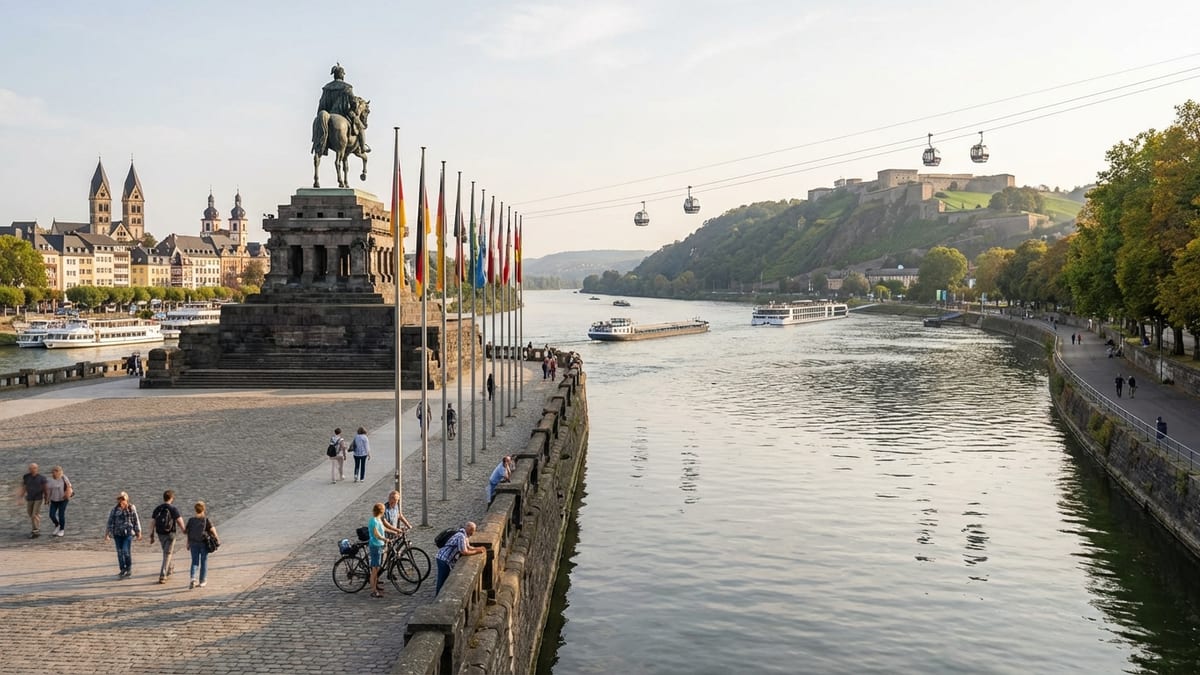
Straddling the point where the Rhine and Moselle rivers meet, Koblenz is one of Germany’s most atmospheric gateways to the Rhine Gorge, blending 2,000 years of history with a fresh, livable city feel. Vine-clad hills and fortress crowns frame waterfront promenades, while cable cars glide overhead and river cruisers slide past medieval towers. This is a city that works equally well as a long-weekend base, a stop on a longer Rhine itinerary, or a laid-back place to settle in and let the wine and water views work their magic.
Understanding Koblenz: City at the Confluence
Koblenz sits in northern Rhineland-Palatinate, roughly midway between Cologne and Frankfurt, at the northern gateway to the UNESCO-listed Upper Middle Rhine Valley. Its very name originates from the Latin “Confluentes,” a reference to the dramatic meeting of the Rhine and Moselle that remains the city’s defining feature. Today, you see that heritage in the layout of the old town, which narrows to a triangular tip at the rivers’ junction, and in the prominent riverside promenades that curve around the confluence.
Despite its age and strategic importance, Koblenz feels more relaxed than many major German cities. The old town is compact and easy to explore on foot, with a lattice of pedestrian lanes, small squares, and courtyards shaded by historic facades. Postwar rebuilding means that the city is an intriguing mix of surviving medieval and Baroque architecture, carefully restored historic monuments, and modern post-1950s structures tucked between them.
For travelers, Koblenz functions as both a destination and a hub. It is a natural staging point for cruises through the Rhine Gorge to towns like Boppard and Bacharach, and upriver along the Moselle to vineyards and storybook villages. Efficient rail links connect the city with Cologne, Frankfurt, and beyond, while ferries, riverboats, and cycle routes spread like capillaries along both valleys, making day trips remarkably simple.
Koblenz is also a regional cultural center. The vast Ehrenbreitstein Fortress across the Rhine hosts museums, festivals, and open-air events, while in town you will find small theaters, galleries, and regular markets. Wine culture is ever-present, with local Rieslings and other varietals served in taverns and seasonal wine festivals animating the streets and riverbanks.
Deutsches Eck and the Riverside Promenades
Every visit to Koblenz orbits around the Deutsches Eck, the “German Corner” where the Moselle flows into the Rhine. Here, a broad headland pushes out between the rivers, crowned by the equestrian statue of Emperor William I and flanked by flags of Germany’s federal states. The panoramic views unfold upriver into the Rhine Gorge, across to the sheer rock and ramparts of Ehrenbreitstein, and back toward the old town and its church spires.
The Deutsches Eck is more than just a vantage point: it is a ceremonial and symbolic site that has hosted national events and memorials, including remembrances of German reunification. For travelers, it is also a place to get your bearings. From here, you can watch tour boats pivot at the confluence, see the cable cars gliding overhead, and trace the curves of both riverfronts as they wrap around the old town.
Along the Rhine, the Konrad-Adenauer-Ufer promenade continues south from Deutsches Eck as a broad, landscaped riverside park. It is a favorite for leisurely walks, jogging, and simply sitting with a coffee to watch the steady procession of freight barges and cruise ships. Benches, lawns, and occasional sculptures punctuate the route, with views across to wooded slopes and castle sites like Schloss Stolzenfels further downriver.
The Moselle promenade, though more modest, has its own quiet charm. Under plane trees and along moorings used by excursion boats, it offers relaxed views back to the old town and the steeple of the Basilica of St. Castor. River cruises to Cochem and other Moselle villages often depart from this side, making it easy to segue from city strolls to vineyard countryside within a single day.
Exploring the Old Town: Squares, Fountains and Lanes
Koblenz’s Altstadt, or old town, lies just behind the riverfront, a walkable mosaic of cobbled lanes and intimate squares. Although much was rebuilt after World War II, the area retains a cohesive historic atmosphere, anchored by surviving monuments and carefully restored facades. This is where you will spend much of your time wandering, eating, and pausing at fountains or churches that suddenly appear at the end of narrow alleys.
One of the best starting points is the Jesuitenplatz, framed by the Town Hall and the Jesuit Church. Here you will find the Schängel fountain, depicting a mischievous local boy who periodically spits a jet of water into the square. The statue has become an emblem of Koblenz, capturing the city’s lightly irreverent streak. Nearby, the “Vier Türme,” or Four Towers, are the ornate oriels of four Baroque houses that mark the crossing of two main streets. Looking up as you pass beneath them, you get a sense of the city’s 17th and 18th century prosperity.
The Basilica of St. Castor is one of Koblenz’s oldest churches, located close to the Deutsches Eck. Its twin towers and Romanesque nave reflect a history stretching back to the 9th century. Inside, you can see later Gothic and Baroque additions layered over the earlier stonework. Just a short walk away stands the Liebfrauenkirche, with onion-domed towers that rise above the rooftops of the old town, a useful landmark as you explore.
Allow time simply to drift through lanes like Münzplatz and Florinsmarkt, which gather cafes, wine taverns, and small shops behind the riverfront. Many buildings display plaques noting their original construction dates and later reconstruction, a reminder of the city’s resilience. In the evenings, the old town glows with soft lighting and the low murmur of diners at outdoor tables, especially in warmer months when many restaurants spill into the squares.
Ehrenbreitstein Fortress and the Koblenz Cable Car
High on the opposite bank of the Rhine, Ehrenbreitstein Fortress is Koblenz’s most commanding landmark. This vast complex, largely shaped in the early 19th century on older fortifications, was once one of Europe’s strongest fortresses. Today it houses museums, exhibition spaces, restaurants, and large open courtyards used for concerts and festivals, alongside sweeping lawns and lookout points over the rivers.
The most memorable way to reach the fortress is via the Koblenz cable car, which carries you across the Rhine between the riverside park and the fortress plateau. The ride lasts only a few minutes but feels like a signature Koblenz experience, hovering over boats and offering a bird’s-eye view of the Deutsches Eck and the old town. According to the operator’s current information, regular daily service resumes each year in mid-March, with gondolas typically running from 10:00 to at least 19:00 in the main season; during scheduled maintenance, usually in winter, service is temporarily suspended, so it is wise to confirm operational dates and times shortly before your visit.
Once on the plateau, you can wander a network of paths along ramparts and bastions, many of which open onto extraordinary viewpoints. Inside the fortress buildings, several museums and exhibitions focus on regional history, photography, and military heritage. Temporary art installations and special events frequently animate the spaces, especially from spring through autumn. Tickets are sold either as cable-car-only or as combined return and fortress admission passes, with adult combined day tickets currently just over 20 euros and reductions for children, students, and families; as with most attractions, these prices are subject to revision, so travelers should verify them close to their travel dates.
Even if you are not planning to delve deeply into the exhibits, Ehrenbreitstein rewards a slower pace. Pack a light picnic or plan a leisurely drink at the on-site beer garden, often praised for its wide terrace and direct views across to Koblenz and down the Rhine valley. At sunset on clear days, the confluence and city resemble a model laid out at your feet, with the cable cars tracing luminous arcs across the darkening water.
Wine, Food and Local Flavors
Koblenz occupies an enviable position at the meeting point of two renowned wine regions: the Middle Rhine and the Moselle. That geography filters directly into its dining and drinking culture. Wine taverns and Weinstuben pour dry and off-dry Rieslings, along with other varietals like Spätburgunder (Pinot Noir), sourced from steep terraced vineyards visible a short cruise or train ride away. Many establishments list the vineyards and villages on their menus, making each glass a small geography lesson.
Typical local dishes reflect hearty Rhineland-Palatinate traditions. Expect plates built around pork, potatoes, and seasonal vegetables: schnitzel, sausages, roasted meats, and stews sit alongside vegetarian options that increasingly highlight regional produce. Flammkuchen, a crisp flatbread topped with cream, onions, and bacon or seasonal toppings, is widely available and pairs well with local whites. In autumn, Federweißer, a partially fermented young wine, appears briefly on menus, usually accompanied by onion tart.
Along the riverfront and within the old town squares, you will find a mixture of classic German restaurants, wine bars, and more contemporary cafes and bistros. Outdoor terraces line the promenades in warmer months, offering front-row seats to river traffic. Many establishments offer multilingual menus and are accustomed to cruise passengers and international visitors, but you will also find plenty of places that feel resolutely local, especially in quieter backstreets slightly removed from the main tourist flows.
For a more structured introduction to regional wine, consider a tasting at a dedicated vinotheque in town or a half-day trip to a nearby winery along the Moselle or Middle Rhine. Regular local trains and riverboats make it easy to visit villages like Winningen on the Moselle or Boppard on the Rhine, where you can walk directly from station or dock into vineyards and tasting rooms, then be back in Koblenz by evening.
Getting To and Around Koblenz
From an access perspective, Koblenz is straightforward. By rail, it lies directly on the main Rhine corridor between Cologne and Mainz, with regular Regional-Express and intercity trains linking it to Cologne in roughly 60 to 80 minutes and to Frankfurt’s main station usually in around 90 minutes, depending on connections. Recent timetable adjustments by Deutsche Bahn have aimed to increase long-distance frequencies through Rhineland-Palatinate and refine some connections, so it is advisable to check current schedules and journey times shortly before travel.
Travelers arriving by air typically route via Frankfurt or Cologne Bonn airports. From Frankfurt Airport, you can take trains via Mainz or directly along the Rhine to Koblenz, with journey times commonly between 1.5 and 2 hours depending on the chosen service. From Cologne Bonn, regional trains run via Cologne and Bonn down the Rhine. Long-distance buses are less central to travel in western Germany than previously, but some intercity coach lines still serve Koblenz, usually from large urban hubs.
Once in Koblenz, the city is pleasantly compact. The main station is about a 15 to 20 minute walk from the old town and riverfront, though local buses shuttle between them regularly. A smaller Stadtmitte (city center) station, opened for the 2011 Federal Garden Show, sits closer to central sights and can be useful for travelers on certain regional routes. Within the city, walking is the primary way to experience the old town and riversides, while buses cover neighborhoods and shopping districts further afield.
Cyclists benefit from extensive riverfront bike paths along both the Rhine and Moselle, forming parts of longer-distance routes that connect Koblenz with Bonn, Mainz, and deep into the Moselle valley. Bike rentals are available in town, and the relatively flat riverside paths are suitable for leisurely rides. For exploring castles and villages along the Rhine or Moselle without a car, combine regional trains, ferries, and scheduled riverboats, many of which allow bicycles on board.
Seasonal Highlights and Events
Koblenz is very much a year-round destination, but the feel of the city shifts distinctly with the seasons. From late spring through early autumn, river travel reaches its peak: cruise ships are frequent, terraces are busy, and the valley’s vineyards are in full leaf. This period is especially appealing if you plan to combine Koblenz with multi-day river cruises or extended cycling and hiking along the valleys.
Summer sees a full calendar of events at Ehrenbreitstein Fortress and on the riverside promenades, including open-air concerts, historical festivals, and family-oriented activities. Combined cable car and fortress tickets often include admission to regular cultural events organized on the plateau, while major festivals may carry separate charges. Evening illuminations and occasional fireworks along the Rhine create dramatic backdrops, particularly on selected weekends when multiple towns coordinate displays.
Autumn brings grape harvest season in the surrounding wine regions, along with wine festivals in Koblenz and neighboring villages. The air cools, forests and vineyards turn gold and red, and menus shift toward heartier seasonal dishes. It is a rewarding time to base yourself in the city for day trips along both valleys, with fewer crowds than at summer’s height.
In winter, Koblenz quiets but does not sleep. Christmas markets typically brighten the old town squares with lights, stalls, and seasonal treats, and temporary attractions such as the Christmas Garden at Ehrenbreitstein Fortress have in recent years added illuminated evening trails and installations. Colder temperatures and shorter days shift the focus inward to cozy taverns and museums, making winter a good choice for travelers who value atmosphere over outdoor activities and can dress for the chill.
Planning Your Stay: Practical Tips
For most visitors, two to three full days in Koblenz provide enough time to explore the old town, ride the cable car to Ehrenbreitstein, and take at least one short excursion along either the Rhine or Moselle. If you plan more extensive day trips to multiple castles and winegrowing villages, consider a four or five night stay to avoid feeling rushed and to build in time for weather-dependent activities such as river cruises.
Accommodation options range from large chain hotels near the station and along the riverfront to smaller family-run inns tucked into old town side streets. Booking ahead is strongly recommended in peak months, especially on weekends and around major events at the fortress or during regional wine festivals. Travelers sensitive to noise may prefer lodging slightly back from the busiest riverfront arteries, where freight traffic on the rails that flank the Rhine can be audible at night.
Language is rarely a major obstacle. German is the everyday language, but staff in hotels, restaurants, and at major attractions are generally accustomed to English-speaking visitors. Menus are often bilingual or at least include English translations for core items. Card payments are increasingly accepted, though carrying some cash remains useful in smaller establishments and for bus tickets or smaller vendors at markets.
As with much of Germany, public safety in Koblenz is generally good, particularly in the central and tourist-focused areas. Normal urban travel precautions apply: keep valuables secure, be aware of your surroundings at night, and follow local advice concerning high water periods on the Rhine and Moselle, when certain riverside paths may be temporarily closed or rerouted. If you plan to drive, note that parking in the compact old town is limited; many visitors instead choose to rely on walking and public transport while based in the city.
FAQ
Q1: How many days should I spend in Koblenz?
Most travelers find that two to three full days are enough to explore the old town, visit Ehrenbreitstein Fortress via the cable car, and take a short cruise or train trip along the Rhine or Moselle. If you plan multiple day trips to wine villages and castles, consider extending your stay to four or five nights.
Q2: When is the best time of year to visit Koblenz?
Late spring through early autumn offers the most pleasant weather and the fullest program of cruises and events, with vineyards in leaf and outdoor terraces in full swing. Autumn is ideal for wine lovers and fall colors, while winter appeals to travelers interested in Christmas markets, illuminated seasonal attractions, and a quieter atmosphere.
Q3: How do I get to Koblenz from Frankfurt or Cologne?
Regular regional and intercity trains run along the Rhine corridor, linking Frankfurt and Cologne with Koblenz in roughly 60 to 100 minutes depending on the service. From Frankfurt Airport, connections via Mainz or the main station are common. It is advisable to check current timetables shortly before traveling, as schedules can change with each timetable update.
Q4: Is the Koblenz cable car open all year?
The cable car typically operates daily from mid-March through much of the main season, often from 10:00 to at least 19:00, with extended hours on some days. In winter, it usually closes for scheduled maintenance for several weeks. Because specific dates and hours can vary each year, always verify the latest operating information close to your travel dates.
Q5: Do I need to book tickets for the cable car and Ehrenbreitstein Fortress in advance?
On ordinary days, it is usually possible to buy tickets on the spot at the lower or upper stations. However, during peak periods, weekends, or special events at the fortress, lines can lengthen and combined tickets may be in higher demand. Checking conditions in advance and allowing extra time on busy days is prudent, especially if you have a fixed schedule.
Q6: Can I visit Koblenz as a day trip from another city?
Yes. Fast and frequent rail connections make Koblenz a feasible day trip from Cologne, Bonn, Frankfurt, or Mainz. A typical day trip could include a walk through the old town, time at the Deutsches Eck, a cable car ride to Ehrenbreitstein, and a short river cruise before returning to your base city in the evening.
Q7: Is Koblenz a good base for exploring the Rhine and Moselle valleys?
Koblenz is particularly well placed for this. Regional trains and boats fan out along both rivers, allowing day trips to Rhine Gorge towns like Boppard, St. Goar, and Bacharach, as well as Moselle destinations such as Cochem and nearby wine villages. Returning each evening to a single base in Koblenz simplifies logistics while still offering variety.
Q8: What types of accommodation are available in Koblenz?
The city offers a spectrum of lodging, including larger modern hotels near the station and riverfront, mid-range chains, boutique properties in historic buildings, and small guesthouses in side streets of the old town. During peak travel periods and major events, advance booking is strongly recommended to secure preferred locations and rates.
Q9: Is Koblenz suitable for families with children?
Koblenz works well for families. Children often enjoy the cable car ride, the open spaces and viewpoints at Ehrenbreitstein Fortress, and riverside parks where they can watch ships. Short cruises, easy riverfront cycling, and relatively car-light old town streets help keep sightseeing manageable and engaging for younger travelers.
Q10: Do I need a car to explore Koblenz and the surrounding region?
You do not need a car to make the most of Koblenz. The old town and main riverside sights are easily walkable, and regional trains, buses, and riverboats provide ample options for reaching nearby towns, castles, and vineyards. A car can be useful for more remote rural excursions, but for most itineraries it is optional and may complicate parking in the compact city center.