

More news on this day
In Arctic Alaska, far beyond the cruise ports and highway viewpoints, Kobuk Valley National Park is emerging as a quiet force reshaping what adventure travel in the United States looks like.
Get the latest news straight to your inbox!
America’s Least-Known National Park Comes Into Focus
Kobuk Valley National Park spans more than 1.7 million roadless acres north of the Arctic Circle, yet it remains one of the least visited of the 63 U.S. national parks. Publicly available National Park Service data and independent tallies indicate that annual visitation has hovered in the tens of thousands at most, a fraction of the millions recorded at marquee destinations in the Lower 48. For travelers willing to make the journey, that rarity translates into an experience defined by solitude rather than crowds.
The park was established in 1980 to protect a landscape where boreal forest gives way to tundra, braided rivers and a sweeping field of Arctic sand. The designation was part of the Alaska National Interest Lands Conservation Act, which locked in protections for a vast tract of the state’s far northwest. Today, federal planning documents describe Kobuk Valley as a living laboratory for climate science and a stronghold for subsistence traditions, rather than an engine for mass tourism.
Recent travel coverage and guidebook updates suggest that this profile is beginning to shift. A small but growing segment of adventure travelers is seeking out Kobuk Valley precisely because it is difficult to reach and largely undeveloped. That change is subtle compared with surges at more accessible parks, but it is pushing outfitters, local communities and land managers to reconsider how remote Arctic landscapes fit into the broader U.S. adventure economy.
A Desert of Sand in the Arctic Circle
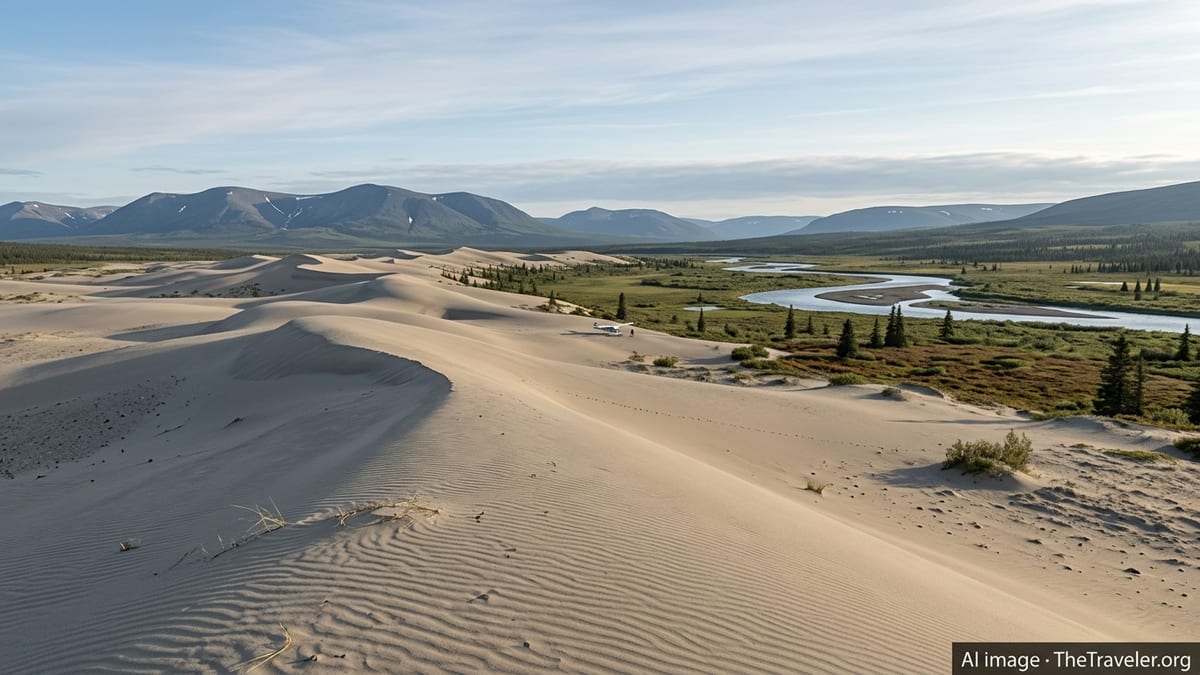
The park’s most striking feature is the Great Kobuk Sand Dunes, a sculpted expanse described by federal researchers as the largest active high-latitude dune field on Earth. Rising up to 100 feet above the surrounding lowlands, the dunes create the improbable impression of a desert ringed by spruce forest, tundra and distant mountains. Historical and scientific accounts portray the area as a relic of Ice Age winds that reworked glacial sediments into today’s shifting hills of sand.
Travel writers note that the dunes have become a powerful draw for photographers and backcountry campers, who often arrange chartered bush flights from the hub communities of Kotzebue or Bettles. From the air, ridges of pale sand cut across the green valley floor; on the ground, visitors encounter a stark quiet broken only by wind and migrating caribou. The setting stands in sharp contrast to the infrastructure-heavy experiences at many popular U.S. parks, where paved overlooks and visitor centers frame the landscape.
Adventure operators and travel planners increasingly highlight the dunes as a symbol of a new kind of U.S. expedition travel, one that values absence as much as access. There are no marked trails in Kobuk Valley, no road network and no in-park campsites in the conventional sense. For some travelers, that remoteness is a deterrent. For others, it is the main reason to go, signaling a shift toward itineraries that prioritize self-reliance and unmediated contact with the environment.
Access by Air, Itineraries Built Around Uncertainty
Unlike more famous Alaska parks where cruise ships or highways deliver visitors to the gate, all travel into Kobuk Valley requires a boat, a small plane or a long overland journey. Federal planning documents and park histories explain that most visitors first fly to Kotzebue or Bettles on scheduled commercial services, then charter an air taxi into the park. Only a handful of authorized air carriers operate regularly in the Western Arctic park units, a reality that keeps overall numbers low but places intense importance on each flight.
Recent backpacking guides and online trip reports describe itineraries that build in multiple weather days to account for fog, high winds and river conditions that can ground planes for long stretches. National Park Service wilderness narratives emphasize that travel here is orchestrated by the valley itself, with river levels, ice breakup and sudden storms dictating when visitors can safely enter or leave. That inherent unpredictability is becoming part of the park’s appeal for travelers looking to step outside tightly scheduled vacations.
The practical challenges of access are also shaping the business model around Kobuk Valley. Reports from regional planning meetings and commercial use summaries show a small cluster of outfitters and air taxi companies providing logistics, from flightseeing day trips to drop-offs for multi-day river floats and dune treks. Rather than building lodges inside the park, most services are based in nearby communities, linking high-end adventure travel directly to local economies along the Chukchi Sea and Kobuk River corridor.
Climate Frontline and Cultural Crossroads
Kobuk Valley’s growing visibility is tied not only to its scenery but also to its role at the meeting point of ecological and cultural shifts. National Park Service research materials describe the park as sitting on an Arctic–subarctic boundary, where warming temperatures, changing snow patterns and shifting permafrost are monitored as indicators of global climate trends. Scientists treat the dunes, wetlands and forests as a long-term observatory, tracking how plant communities, wildlife and river systems respond.
The valley is also a historic route for the Western Arctic caribou herd, one of the largest in North America. Seasonal crossings over the Kobuk River and nearby dunes have sustained Indigenous communities for generations, and contemporary subsistence management plans continue to prioritize that relationship. Publicly available subsistence council documents underscore that any growth in recreational use must be balanced against the needs of local residents who depend on caribou, fish and other resources.
For adventure travelers, this dual identity as climate observatory and cultural landscape is reshaping expectations about what it means to “visit” a park. Increasingly, travel features frame Kobuk Valley not simply as a place to check off a bucket list, but as an environment where recreation, research and traditional livelihoods intersect. That framing is influencing how outfitters market trips, emphasizing low-impact travel, respect for local communities and awareness of ongoing scientific work.
Redefining the Future of U.S. Adventure Travel
The attention turning toward Kobuk Valley comes at a moment when many U.S. national parks are grappling with congestion, infrastructure strain and the search for new models of visitor management. Against that backdrop, this remote northwest Alaska park offers a radically different template. With no roads, limited flights and minimal development, it stands as an example of what adventure tourism can look like when the landscape, rather than amenities, sets the terms.
Industry observers point to a gradual shift toward longer itineraries focused on a single remote destination, instead of fast-paced tours through multiple crowded sites. In this emerging model, travelers accept higher costs and logistical complexity in exchange for time, quiet and a deeper sense of place. Kobuk Valley’s combination of extreme remoteness, scientific significance and living Indigenous cultures aligns closely with that trend.
How far that evolution will go remains uncertain. Growth in visitor numbers is constrained by aircraft capacity, weather and a commitment to preserving wilderness character. Yet even modest increases are enough to ripple through community economies, conservation strategies and the wider imagination of what an American national park experience can be. As more travelers look north to Kobuk Valley, the park’s austere dunes and broad river plains are helping to redefine adventure travel in the United States as a journey into fewer, wilder places.