

More news on this day
Cambodia’s Koh Totung, a small island off the coast of Koh Kong province, is emerging as the latest focus of high-end tourism development, with a planned luxury resort expected to bring new investment and reshape travel patterns in the country’s southwestern Gulf of Thailand.
Get the latest news straight to your inbox!
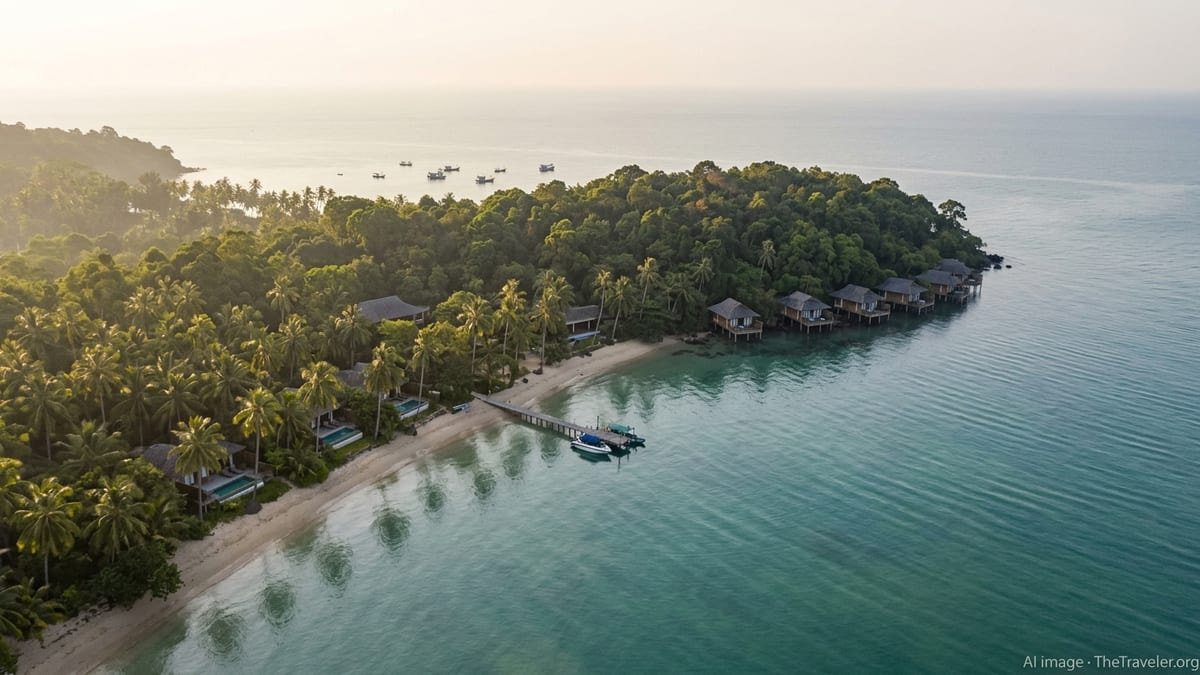
Strategic Island in a Rapidly Changing Coastal Region
Koh Totung, also rendered locally as Koh Toteung or Koh Totang, lies within the Koh Sdach archipelago of Koh Kong province, an area that has seen growing attention from investors as Cambodia promotes its coastal zones as premium tourism corridors. Publicly available information describes the island as largely undeveloped until recent years, known mainly for small-scale, low-impact accommodation and its proximity to relatively untouched marine and forest habitats.
Reports indicate that the island’s appeal has been enhanced by broader infrastructure upgrades in the region. National power utility coverage has been extended to several islands off the Cambodian coast, including Koh Totung, improving reliability for prospective tourism projects and supporting the possibility of year-round, higher-value operations. Observers see these utilities as a prerequisite for attracting investors seeking to build resorts at international luxury standards.
The Gulf of Thailand coastline stretching from Sihanoukville to Koh Kong has already been reshaped by major tourism and real estate schemes, ranging from large integrated resorts to smaller boutique island developments. Within this wider transformation, Koh Totung is now positioned as a new node in an evolving network of higher-end destinations that includes Koh Rong, Koh Russey and other nearby islands.
Den Nokor’s Resort Project Signals High-End Ambitions
According to an investment approval issued by Cambodia’s Council for the Development of Cambodia, Den Nokor (Cambodia) Investment Co., Ltd. has been cleared to develop a tourism resort project on Koh Totung with a reported capital investment of about 30 million US dollars. The project footprint is described as covering an area on Koh Totung within Koh Sdach commune in Kiri Sakor district, indicating a substantial single-operator presence on the island.
Public reporting characterises the planned project as a resort complex aimed at international visitors, aligning with Cambodia’s goal of moving up the tourism value chain through higher-spend segments. The investment scale suggests an intention to introduce more sophisticated infrastructure, premium accommodation and curated guest services rather than budget or mass-market offerings.
The resort approval follows earlier steps in which local authorities clarified that Koh Totung is classified as state land, with land sale and transfer activities restricted. This status effectively channels large-scale development through formal concession and investment frameworks. Analysts note that this approach can concentrate responsibility for environmental management and community interaction in the hands of a single primary operator, heightening expectations on how the project is designed and operated.
Luxury Experiences Framed Around Nature and Seclusion
Regional tourism trends point to strong demand for secluded, nature-focused luxury experiences, a segment that Koh Totung is well placed to serve. Other Cambodian island resorts have promoted private villas, low-rise architecture and direct beachfront access as key selling points, along with spa, wellness and fine-dining concepts tailored to long-haul and regional travelers seeking quiet alternatives to busier beach destinations.
Observers expect any high-end resort on Koh Totung to draw upon similar elements, combining contemporary comfort with views over the Gulf of Thailand and easy access to snorkeling, kayaking and boat excursions. The island’s relatively small size and isolation offer an opportunity to present a curated, all-in-one destination in which guests spend most of their stay within the resort environment, a model well suited to luxury all-inclusive or semi-inclusive formats.
At the same time, Cambodia’s recent tourism promotion efforts have highlighted authentic local culture and low-density coastal landscapes as key differentiators in the global market. By integrating Khmer culinary influences, local building materials and traditional design motifs into a high-end setting, a Koh Totung resort could position itself as both exclusive and distinctly Cambodian, rather than a generic tropical property.
Sustainable Development and Environmental Pressures
Across Koh Kong province, international coverage has drawn attention to the environmental implications of large coastal and island projects, including habitat loss, deforestation and pressure on marine ecosystems. Within this context, Koh Totung has often been cited as an example of an island whose appeal rests on clean waters, intact forest cover and a relatively light tourism footprint, making sustainability a central issue in any future development.
Commentary in regional media and environmental reports has underscored that poorly planned resort construction, such as artificial beach building and unregulated land clearing, can undermine the very assets that draw visitors in the first place. For Koh Totung, which has been known for quiet, small-scale stays and community-linked tourism experiences in the broader archipelago, the transition to a single large resort project raises questions about how natural resources will be managed.
Cambodia’s tourism policy documents increasingly refer to sustainable and responsible tourism as guiding principles, particularly along the coast and in protected areas. For Koh Totung, this implies a focus on measures such as careful waste and wastewater treatment, renewable or low-impact energy use, controlled visitor numbers and preservation of coral, mangrove and forest habitats. Publicly available assessments of luxury island properties in the region suggest that guests in higher price brackets are also paying closer attention to environmental credentials, making sustainability not only an ecological consideration but a commercial one.
Potential Economic Benefits for Koh Sdach and Koh Kong
The Koh Totung resort project is expected to feed into wider economic growth in the Koh Sdach area and the broader Koh Kong province. Large-scale tourism investments typically create construction jobs in the short term and hospitality, maintenance and transport roles over the longer term. In archipelagos where fishing has historically been the primary livelihood, tourism can diversify incomes and reduce vulnerability to fluctuations in marine resources or fuel prices.
Analysts of Cambodia’s coastal tourism note that high-end properties often act as anchors for supplementary services such as private boat transfers, dive operators, craft producers and regional tour companies. For Koh Totung, improved connectivity and regular guest flows could strengthen Koh Sdach’s position as a logistical and commercial hub, with potential spillover benefits for small businesses on nearby islands and the mainland.
However, international reporting on other Cambodian coastal projects has also highlighted risks, including uneven benefit distribution, displacement concerns and rising local prices. Observers suggest that for Koh Totung to deliver genuinely sustainable growth, investment in skills training, inclusive hiring practices and community partnerships will be essential. Transparent communication about land use, access rights and environmental safeguards is also seen as crucial to maintaining public confidence in the island’s transformation.
As Cambodia continues to promote its southern islands as part of a premium tourism corridor, the evolution of Koh Totung will be closely watched. The island’s trajectory toward high-end resort development encapsulates the broader challenge facing the country’s coastal destinations: how to capture the value of luxury tourism while preserving the natural and cultural character that made these islands attractive in the first place.