

When I started planning my last trip to Cologne, I naively assumed the KölnCard would automatically be the cheapest and easiest way to move around the city.
After a week of testing it against regular VRS tickets and passes, I realized the answer is more nuanced. Both KölnCard and individual tickets can save money, but only if you match them carefully to how you actually travel, what you want to see, and how much mental energy you want to spend on fares.
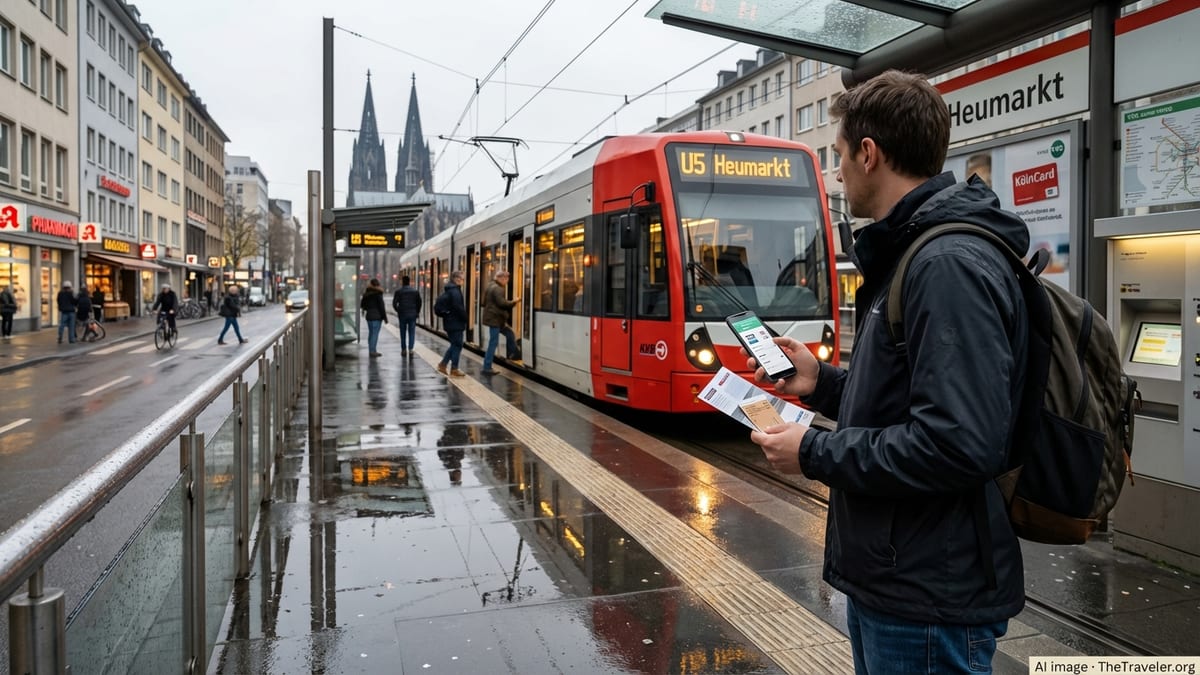
What the KölnCard Really Includes (And What It Does Not)
The KölnCard looks simple on paper. There are two main versions: an individual card and a group card for up to five people. Both come in 24 hour and 48 hour variants. At the moment, the individual KölnCard costs 9 euros for 24 hours or 18 euros for 48 hours, while the group KölnCard costs 19 euros for 24 hours or 38 euros for 48 hours. The card is valid for unlimited rides on local public transport within the city of Cologne, and it adds discounts at museums, attractions, and city tours on top.
In practice, that meant that from the moment I first used the card, I could ride KVB trams, buses, and local trains within Cologne without worrying about zones or price levels. I also got reduced admission at several places I was already planning to visit, including major museums and some guided tours. The advertised discounts of up to 50 percent on city tours and reduced admission at many museums are real, but the exact reduction varies by partner and is rarely that high across the board. I had to check the fine print for each attraction, which was a bit more legwork than I expected.
There are limits that matter. The KölnCard only covers the city of Cologne, not the wider VRS network or the rest of North Rhine Westphalia. When I wanted to go to Bonn for a day trip, the KölnCard suddenly became irrelevant and I had to buy separate tickets. It also does not cover intercity or long distance trains. If you are imagining unlimited train travel across Germany, you will be disappointed. The card is essentially a city card: powerful inside Cologne’s borders, useless once you leave them.
One thing I appreciated was how easy it was to buy. I could purchase it as a mobile ticket in the official regional app, or at tourist information offices and ticket machines. Activation was tied to first use, so I could buy it in advance and only start the 24 hour or 48 hour clock when I hopped on my first tram. That flexibility mattered on my arrival day when my train was delayed and I did not want the clock to start ticking the moment I stepped into the station.
How Individual VRS Tickets Work in Cologne
The alternative to the KölnCard is to behave like a local and rely on the standard VRS ticket system. For Cologne, this essentially means purchasing single tickets, short distance tickets, or day and week passes in the appropriate price level. Cologne itself is in price level 1b for most typical inner city trips, although the full network stretches beyond, with levels ranging from short distance (K) through 1a, 1b, 2a, and upwards.
A regular adult single ticket in price level 1b currently costs 3.80 euros if you buy it from a machine or 3.68 euros in the app. Short distance tickets, which cover boarding plus up to four additional stops and do not allow all transfers, are cheaper, but I found them too restrictive for actual sightseeing. A 24 hour ticket for one person in the same 1b area costs 9.20 euros on paper (slightly cheaper in the app). That is almost exactly the price of a 24 hour individual KölnCard, but without any attraction discounts.
There are also more flexible products like weekly tickets or the nationwide Germany ticket, which from January 2026 costs 63 euros per month and is valid on local and regional public transport across Germany. Weekly tickets for Cologne’s 1b price level currently sit just under 38 euros at vending machines, slightly cheaper in the app. On a per day basis, if you stay a full seven days, that brings your daily travel cost down substantially compared with buying a new 24 hour ticket every day.
The catch is complexity. Individual tickets require that you keep track of zones, ticket types, and validation rules. Some tickets are pre validated and start from the time of purchase, others need to be stamped in validation machines. Tickets bought in the app are usually validated immediately and tied to your phone. I had one awkward moment when I absentmindedly bought a paper ticket at a kiosk and rode two stops before realizing I had not validated it. I fixed it at the next station, but I could easily have been fined during a ticket inspection in that short window.
Cost Comparison in Real Travel Scenarios
On my first full day in Cologne, I set myself a simple test: plan an aggressive sightseeing day and compare what I actually spent with a KölnCard versus what I would have spent with individual tickets. My plan included multiple tram rides, a couple of bus trips, and visits to at least three paid attractions that honored the KölnCard discount.
With the individual KölnCard for 9 euros, I rode trams and buses freely within the city. I made six separate trips on public transport that day. If I had bought individual 1b single tickets for each trip, my transport cost alone would have been 6 times 3.80 euros, which equals 22.80 euros. Even if I had planned carefully and used one 24 hour 1b ticket for 9.20 euros instead of singles, that would have roughly matched the cost of the KölnCard for the transport part. With the KölnCard I also got reduced entry at two museums and a discount on a guided walking tour. In total, those discounts saved me roughly another 7 to 10 euros compared with the standard prices on the day.
On that packed day, the KölnCard was an obvious financial win. I saved money on transport compared with single tickets and ended up ahead compared with a plain 24 hour transport pass once I added attraction discounts. The card also gave me the psychological freedom to jump onto extra trams or buses without hesitating. I am the type who would otherwise overthink whether another quick ride was “worth” it, which can lead to unnecessary walking and fatigue.
However, on my second day I took things slower. I stayed mostly within the old town and walked to most places. I used public transport only twice: once to go out to a slightly more distant neighborhood for dinner and once to come back. In that scenario, two single 1b tickets in the app would have cost me 7.36 euros total, or 7.60 euros on paper. The 9 euro KölnCard would not have paid off for transport, and I only visited one museum that offered a modest discount. When I did the math later that evening, the KölnCard had actually cost me a bit more than just buying single tickets.
Where it gets even more interesting is for group travel. A 24 hour group KölnCard costs 19 euros for up to five people. During one afternoon I tested this with friends who joined me in Cologne. We were four adults and one teenager. Our total outlay for the group KölnCard was 19 euros, which worked out to 3.80 euros per person for a full day of local travel plus attraction discounts. If we had each bought a 24 hour 1b ticket at 9.20 euros, we would have paid 36.80 euros in total. Even if we had all used single rides, we would have broken even after only a couple of trips. For any group larger than two who intends to ride more than once or twice, the group KölnCard is hard to beat purely on transport value within the city.
Convenience, Flexibility, and Mental Load
Beyond raw numbers, I found that the biggest difference between the KölnCard and individual tickets was mental. I enjoy public transport, but the VRS tariff system is not naturally intuitive if you are new. Understanding price levels, city limits, and different ticket types takes time. During my first few rides with individual tickets, I double checked maps at the platform and on my phone to be sure I was buying the right ticket.
With the KölnCard, that calculation disappeared inside Cologne. Once the card was active, I just boarded trams and buses as needed. I did not worry about short distance exceptions or whether a particular ride nudged me into a different price level. Inside the city area covered by the card, it was effectively all or nothing, and “all” felt liberating. I still had to keep track of the 24 hour or 48 hour validity window, but that was relatively simple compared with the day to day tariff logic.
That said, the convenience advantage of the KölnCard vanishes the moment you leave Cologne. When I decided to do a half day trip to Bonn by regional train, I reached the first of several decision moments of the week. Option one was to buy a longer range VRS ticket or a day ticket that covered both Cologne and Bonn in the appropriate price level, ignoring the KölnCard benefits. Option two was to activate a new KölnCard for the time I was staying in Cologne that day and then pay extra for the Bonn trip separately. Option three was to skip the KölnCard altogether and use individual VRS products for both legs of the trip. None of these options integrated cleanly with what the KölnCard was offering me.
In the end, I chose not to use the KölnCard on that Bonn day. Instead, I bought a regional ticket that covered both cities, then walked more within Cologne when I returned in the evening. It felt like a compromise. The KölnCard was great on pure Cologne days, but not flexible enough when my plans crossed city borders. If your trip to Cologne includes multiple regional excursions, you may find the logic of individual VRS tickets or a broader product like the Germany ticket more coherent than layering the KölnCard on top.
When Individual Tickets or Passes Beat the KölnCard
There were several days when individual tickets or longer passes clearly won. The first obvious case was when I was staying in Cologne for an entire week and riding public transport multiple times every day. The weekly ticket for price level 1b landed just under 40 euros. If I had instead bought a 24 hour 1b ticket every day, I would have spent more than 64 euros over seven days. Even alternating between heavy and light days with the KölnCard would not have matched the simplicity and per day price of the weekly pass.
Another scenario where individual tickets are better is when you are a very light user of public transport. On my final day, I mostly lingered in the old town, walked across bridges, and enjoyed the Rhine. I only used the tram once, to reach a dinner reservation that was a little further out. Buying a single 1b ticket for 3.80 euros was the logical choice. A KölnCard would have been a waste, even with a minor museum discount earlier in the day.
The Germany ticket sits in a different category. At 63 euros per month from January 2026, it can be a bargain if you are in Germany for more than a week and plan to travel extensively by local and regional trains across different cities and states. For my particular trip, which was shorter and centered mostly on Cologne with one or two day trips, the monthly pass did not quite justify itself. However, if I were spending a full month in Germany with Cologne as just one of several bases, I would almost certainly lean toward the Germany ticket and skip the KölnCard entirely.
Price sensitivity also matters. If your budget is tight and you are disciplined enough to walk long distances instead of hopping on every tram, buying single tickets only when absolutely necessary can shave off a few euros per day. I tracked my walking versus riding patterns and realized I often used public transport out of convenience rather than necessity when I held a day based product like the KölnCard. Whether that is a plus or minus depends on your priorities and your feet.
Real Decision Moments and What I Would Do Differently
The first real decision moment came on my initial full sightseeing day. I knew I wanted to squeeze in several museums, climb the cathedral towers, and explore neighborhoods beyond the immediate old town. Choosing the individual KölnCard for 24 hours was the right call. It balanced cost and simplicity, and the attraction discounts genuinely pushed it ahead of a standard 24 hour ticket. If I repeated that day, I would make the same choice.
The second decision moment was around the Bonn day trip. That day exposed the biggest weakness of the KölnCard: its strict geographical limit. I had briefly considered stacking a KölnCard onto a regional ticket, but that would have been redundant for the hours I was actually outside Cologne. Next time, if I knew I would be doing multiple day trips in the region over a week, I would seriously weigh a weekly pass covering the necessary zones or even the Germany ticket rather than trying to splice short city cards into a larger itinerary.
The third key decision came when friends joined me for one day. Here the group KölnCard shone. We were five people doing multiple hops across the city, and the cost per person dropped to less than the price of a single standard 1b ticket. Even if we had only used public transport three or four times each, the group card would still have been financially sound. What I would change next time is to plan our attraction visits on that shared day more carefully to maximize the discounts. We ended up visiting one museum that did not participate in the KölnCard scheme and skipped another that did. With better planning, the value would have been even clearer.
My fourth unplanned decision moment happened on a rainy evening. I had originally intended to walk back to my hotel along the river, but the weather turned from drizzle to a steady downpour. Because I had a 24 hour KölnCard active, I did not hesitate to jump on a tram instead. It felt like I had bought myself a layer of weather insurance. With only single tickets on hand, I would have stood on the platform debating whether one extra tram ride was “worth” another 3.80 euros. That small psychological shift is hard to assign a number to, but it does influence how you experience the city.
Who Should Choose the KölnCard vs Individual Tickets
After a full week of trying both approaches, I came away with a fairly clear sense of who benefits most from each option. The KölnCard is strongest for short city focused stays of one to two days where you plan to use public transport several times and visit at least a couple of paid attractions that participate in the discount scheme. It is especially good value for small groups, where the group card quickly undercuts the total cost of individual day tickets. It is also a good choice if you do not want to spend mental energy decoding price levels and zone boundaries.
Individual VRS tickets and passes are better if your stay is longer, your itinerary extends beyond Cologne, or your transport usage is either very high or very low. For a week or more centered in Cologne, a weekly pass in the appropriate price level usually beats stacking daily KölnCards or 24 hour tickets. If you are in Germany for a whole month with heavy regional travel, the Germany ticket becomes the logical center of your strategy, and local city cards like the KölnCard feel redundant.
Light users should almost always stick with single tickets or occasional 24 hour tickets on their heaviest days. If you expect to ride public transport only once or twice per day and you do not care much about attraction discounts, the break even threshold for the KölnCard is hard to reach. In my own budget spreadsheet after the trip, I could clearly see which days the KölnCard had earned its keep and which days it had quietly cost me extra for little tangible benefit.
Personality also plays a role. If you like having everything prepaid and hate standing at ticket machines or fiddling with apps, the KölnCard’s all inclusive feeling within the city may be worth a few euros even on days when it does not strictly pay off mathematically. If you are comfortable with a bit of complexity and enjoy optimizing routes and fares, the standard VRS ticket options give you more granular control and often a lower total cost across a varied itinerary.
The Takeaway
Looking back, the KölnCard did not magically solve all my transport and sightseeing costs in Cologne, but it did deliver solid value on the right days. On one or two museum heavy, tram hopping city days, it easily beat the combination of 24 hour tickets and full price attraction entries. On a group day with friends, the group KölnCard felt like a bargain and simplified our logistics dramatically. On slower days, and especially on those involving regional trips beyond Cologne, individual VRS tickets and longer passes were clearly more sensible.
If I repeated the same trip, I would mix and match rather than commit to just one system. I would use the individual KölnCard for my busiest pure Cologne days and rely on weekly or regional tickets on days when I ventured farther afield. I would skip the KölnCard on very light days where walking and one or two single rides would suffice. That hybrid approach takes a bit of planning but gave me the best overall balance between cost, convenience, and flexibility.
In simple terms, the KölnCard saves more money if you are a short term visitor who plans to stay within Cologne, ride public transport multiple times per day, and visit at least a couple of participating attractions. Individual tickets, day passes, weekly passes, or the Germany ticket can save more in almost every other scenario, particularly for longer or more regionally complex trips. Knowing which camp your own travel style falls into is the key to choosing the right option and avoiding the silent leak of a few unnecessary euros each day.
FAQ
Q1: Is the KölnCard always cheaper than buying individual tickets?
Not always. The KölnCard tends to be cheaper on busy sightseeing days with multiple rides and several paid attractions, especially for groups. On slow days with only one or two rides, or on trips that include regional travel beyond Cologne, individual tickets or passes can cost less.
Q2: How many rides do I need to take in a day for the KölnCard to pay off?
If you compare only transport, the 24 hour KölnCard roughly aligns with the price of a 24 hour 1b ticket. It starts to pull ahead once you factor in even modest attraction discounts. If you were otherwise buying single tickets at around 3.80 euros each, you typically break even after three or more rides plus one discounted attraction in a day.
Q3: Does the KölnCard cover travel to Bonn or other nearby cities?
No. The KölnCard is valid for public transport within the city of Cologne only. For trips to Bonn, other towns in the region, or elsewhere in North Rhine Westphalia, you need separate VRS or NRW tickets, or a broader product like the Germany ticket.
Q4: Is the group KölnCard really worth it for families or friends?
Yes, in many cases. The group KölnCard covers up to five people for a fixed price. If four or five people plan to make several trips in a day inside Cologne, the per person cost often drops below what you would pay for individual 24 hour tickets. It becomes especially attractive if you also visit attractions that offer KölnCard discounts.
Q5: How does the KölnCard compare with a weekly pass cost wise?
For a full seven day stay with regular daily travel, a weekly ticket in the relevant price level usually works out cheaper per day than buying multiple 24 hour KölnCards. The weekly pass also simplifies things if your patterns are consistent and you are not chasing museum discounts every day.
Q6: If I have the Germany ticket, is there any point in buying a KölnCard?
Only if you plan to visit several attractions that offer substantial KölnCard discounts and you are sure those savings will exceed the price of the KölnCard itself. For most travelers with the Germany ticket, the transport portion of the KölnCard becomes redundant, so the card is only about attraction discounts. For occasional museum visits, that usually does not justify the extra expense.
Q7: Do I need to validate the KölnCard before each ride?
No. The KölnCard works as a time based pass. Once it is activated from the first use, it is valid for 24 or 48 hours depending on the version you bought. You do not validate it before each ride, but you should carry it or have it ready on your phone for inspections.
Q8: What if I mostly walk and use public transport only in bad weather or late at night?
In that case, single tickets or the occasional 24 hour ticket are probably better value. If your usage is very light and unpredictable, the KölnCard often will not recoup its cost through the few rides you make, unless you deliberately stack several discounted attractions into the same card period.
Q9: Can I buy the KölnCard on arrival, or do I need to order it in advance?
You can do either. It is available as a mobile ticket through the regional app and can also be purchased at tourist information centers and ticket machines in Cologne. I found buying it on arrival easy and appreciated that I could activate the card when I actually boarded my first service, not at the moment of purchase.
Q10: If I am unsure which option to choose, what is the safest approach?
For a first visit, I would start with a single 24 hour KölnCard on your busiest sightseeing day and use individual 24 hour or single tickets on lighter or regional days. After a day or two, you will see your own patterns clearly and can decide whether to lean more on city cards, weekly passes, or single tickets for the rest of your stay.