

More news on this day
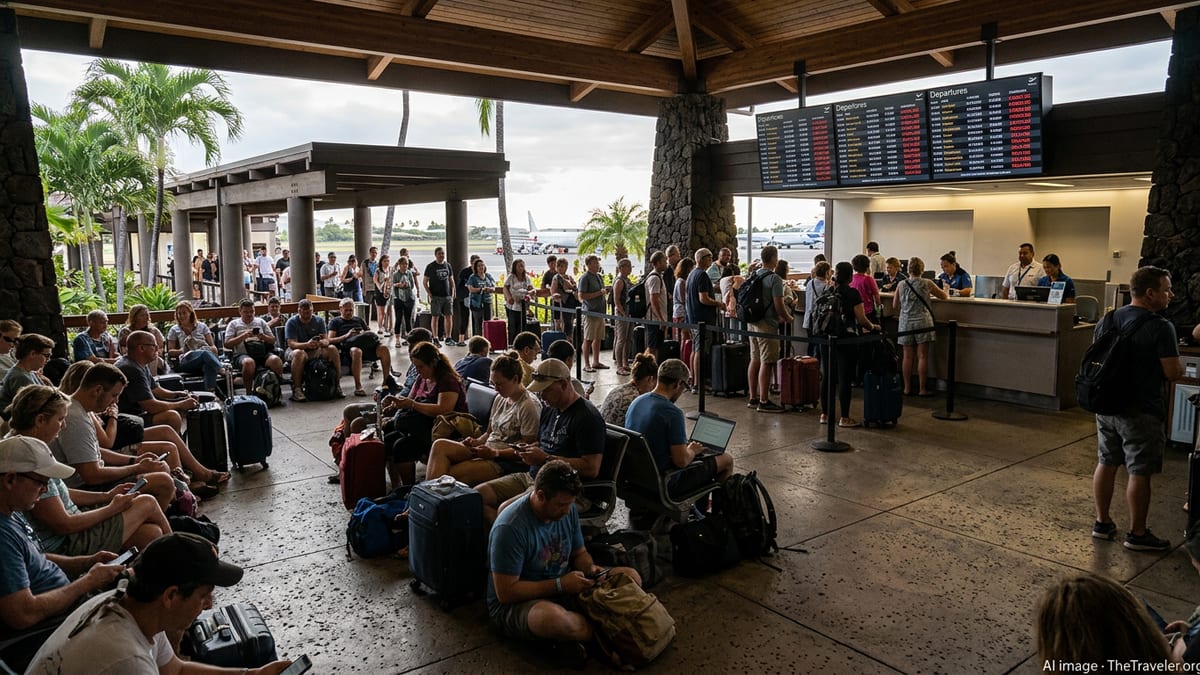
Travelers passing through Ellison Onizuka Kona International Airport on Hawaii Island are facing extensive disruption after a wave of more than forty flight cancellations left passengers stranded and sent shock waves across a network of major U.S. and international routes.
Get the latest news straight to your inbox!
Widespread Disruption at a Key Hawaii Gateway
The disruption at Kona, a critical gateway for visitors to Hawaii’s west side, has unfolded over a short period, with publicly available flight-tracking data and local coverage indicating a rapid escalation from scattered delays to large-scale cancellations. The affected flights include services linking Kona with major mainland hubs such as Los Angeles, San Francisco, Seattle, Denver, and Phoenix, as well as connections that feed into longer-haul international itineraries.
Reports indicate that the cancellations began with early departures on the mainland that never left their origin airports, creating a cascade of so-called “downline” disruptions. Aircraft that would typically cycle through multiple island and mainland legs became unavailable, leaving inbound and outbound Kona rotations unable to operate as scheduled.
By late in the day, more than forty flights touching Kona’s schedule had been canceled, ranging from early-morning departures to late-night red-eyes. Travelers already on the island found themselves without confirmed seats home, while those connecting through mainland hubs encountered broken itineraries and unexpected overnight stays far from their intended destinations.
The scene inside the open-air terminal, usually marked by a steady flow of resort-bound visitors, has instead been characterized by long lines at check-in counters and service desks, with many travelers attempting to rebook using mobile apps while also seeking assistance in person.
Major U.S. and International Cities Caught in the Ripple Effect
The impact of the Kona cancellations reaches far beyond Hawaii’s shorelines, affecting passengers traveling to and from some of the busiest airports in North America and connections onward to Asia and Oceania. Disrupted itineraries involve carriers that rely on hubs such as Los Angeles International, San Francisco International, Seattle-Tacoma International, and other large U.S. airports to funnel traffic to and from Hawaii.
Many itineraries between Kona and cities like New York, Chicago, Dallas, and Vancouver depend on tight connections at these hubs. When one or more Kona legs are removed from the schedule, entire multi-segment journeys can unravel. Travelers have reported missed onward flights to destinations in Europe and Asia after their initial Kona or mainland segment was canceled, forcing them to seek alternative routings or overnight accommodations.
Because Hawaii itineraries often involve peak-season demand and limited daily frequencies, the ability to re-accommodate stranded travelers can be constrained. Publicly available booking data shows remaining seats on alternative flights selling out quickly or becoming significantly more expensive, leaving some passengers with days-long delays before the next available departure.
For visitors who planned cruise departures, tour start dates, or fixed resort stays based on specific arrival times, the knock-on effect of missed connections can extend well beyond air travel, with disrupted vacation packages and added costs for last-minute changes.
Possible Drivers: Weather, Operational Strain and Network Fragility
Published coverage of recent airline performance trends highlights just how vulnerable island routes can be to operational shocks. Even a modest bout of adverse weather at a mainland hub or along a key corridor can trigger schedule reductions, equipment reassignments, and crew timing issues that disproportionately affect long-haul leisure markets such as Hawaii.
In recent years, large-scale airline disruptions elsewhere have illustrated how quickly staffing constraints, aircraft positioning problems, and tight schedules can combine to ground hundreds of flights in a matter of hours. While every event has its own mix of causes, analysts often point to highly optimized, high-utilization schedules that leave little margin for recovery when conditions deteriorate.
For Kona, which sees a mix of domestic narrow-body jets and longer-range wide-body or extended-range aircraft on peak routes, even a single aircraft taken out of service can impact multiple rotations. If the same plane is slated to operate a Kona turn followed by an international leg from a mainland hub, a cancellation at one point in the chain can remove capacity from multiple city pairs.
Weather-related congestion at busy hubs, lingering effects from earlier storms, and logistical challenges in shuttling aircraft and crews into position can all contribute to sudden schedule pullbacks. When that happens on dates with heavy leisure travel demand, the number of travelers affected can quickly climb into the thousands, even if the raw number of canceled flights remains in the dozens.
Stranded Passengers Face Limited Options and Mounting Costs
Travelers stuck in Kona and at mainland hubs connected to the island are confronting a familiar but stressful reality: rebooking is possible in many cases, but not always on the same day or even within a 24-hour window. With more than forty flights removed from the schedule, remaining services are heavily booked, and same-day standby lists are reported to be long.
Some passengers have opted to purchase entirely new tickets on other carriers in order to reach time-sensitive events or return to work, absorbing out-of-pocket expenses and hoping to seek partial reimbursement later. Others are relying on travel insurance policies that may cover missed connections, extra hotel nights, and additional meals, depending on the policy terms and the documented cause of the disruption.
For visitors on Hawaii Island, extended stays can also be challenging. Resort availability may be limited during peak periods, and nightly rates can be high at short notice. Those traveling in family groups or on fixed budgets are finding it especially difficult to secure affordable accommodations while they wait for new departure options.
At mainland hubs, passengers arriving from Kona or attempting to depart to the island are dealing with crowded customer service lines and dynamic schedule changes. Some are being rerouted through alternate gateways within the airline’s network, such as connecting via different West Coast cities or even other islands in Hawaii before continuing on long-haul legs.
What Travelers Can Do if Their Kona Flight Is Canceled
Travel experts generally recommend that passengers impacted by widespread disruptions take a multi-pronged approach: use airline mobile apps and websites to search for alternative flights while also speaking with agents at the airport when possible. Same-day options may involve inconvenient routings or red-eye departures, but acting quickly can be crucial when seats are limited.
Those with flexible travel dates may find better availability by shifting their trip by a day or two, particularly when cancellations are clustered on a single date or over a short window. Passengers who booked through online travel agencies or bundled vacation packages should also contact those providers, as they may have additional rebooking tools or contracted rates for hotels.
Publicly available consumer guidance on U.S. air travel emphasizes that, if a flight is canceled, travelers are typically entitled to a refund if they choose not to travel, even on non-refundable tickets, when they decline a rebooking offer. Separate rules can apply to weather-related and operational cancellations, and any compensation beyond a refund generally depends on the airline’s published policies and the specific circumstances.
In the wake of the Kona disruption, travelers planning upcoming trips to Hawaii are being encouraged by travel advisers to monitor their itineraries closely in the days leading up to departure, keep airline apps updated with push notifications enabled, and build extra time into tight connections through major mainland hubs. While mass cancellations of this scale remain relatively rare, the current situation at Kona shows how quickly a localized disruption can ripple across some of the busiest air corridors linking Hawaii with the rest of the world.