

More news on this day
Hawaii is grappling with its worst flooding in more than two decades as a powerful Kona low weather system drenches Oahu, Maui, Hawaii Island and Molokaʻi, triggering evacuations, widespread power outages and major disruptions to transport and tourism just as spring travel peaks.
Get the latest news straight to your inbox!
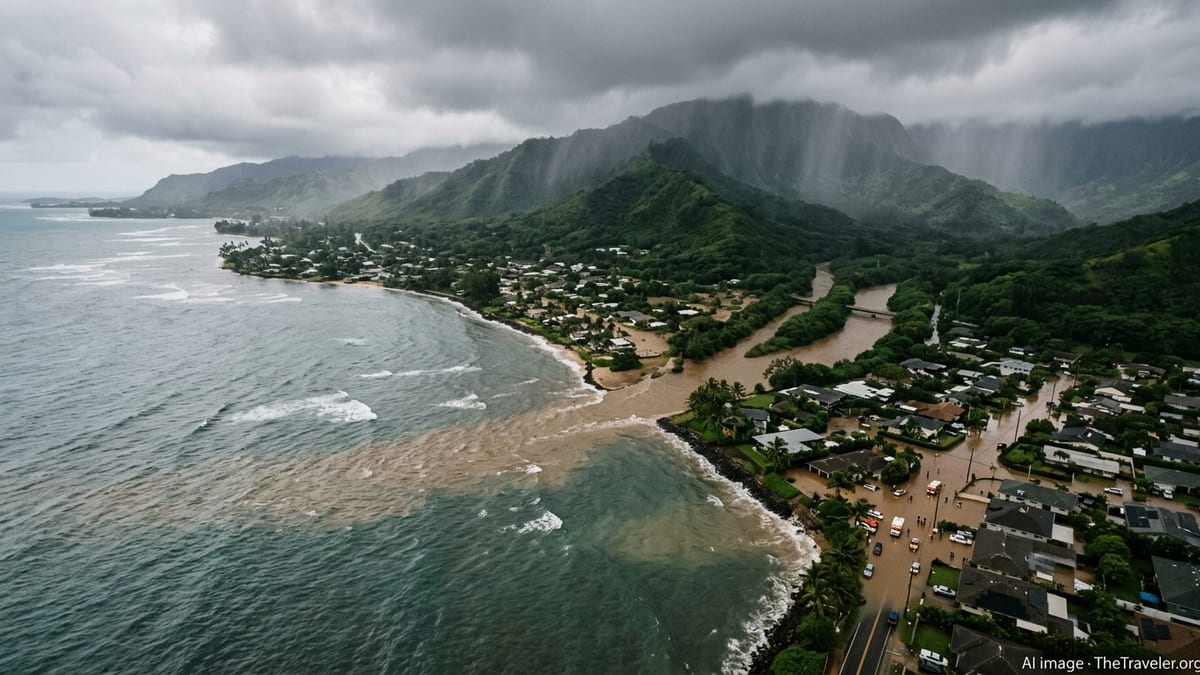
Storm System Soaks Multiple Islands Over Consecutive Weekends
Publicly available information from state and federal agencies shows that a Kona low that developed in mid-March intensified over the weekend of March 20 to 22, following an earlier round of heavy rain that had already saturated much of the state. The sluggish storm system pulled deep tropical moisture over the islands with southerly winds, a pattern associated with some of Hawaii’s most damaging rain events.
Across Oahu, gauges recorded many inches of rain in just a few hours, with particularly intense downpours on the North Shore and in central and eastern valleys. Reports indicate that muddy floodwaters swept through residential areas, inundated streets and pushed some homes off their foundations. On Monday, localized flooding was still being reported in urban Honolulu neighborhoods after days of almost continuous rainfall.
According to published coverage, the same system spread heavy showers and thunderstorms across Maui County and the Big Island, with runoff spilling into low-lying communities from Hilo to Kona and along parts of the leeward Maui coast. Smaller and more isolated communities on Molokaʻi also experienced flooding and road washouts as the Kona low’s rain bands pivoted over the island chain.
The March event follows a pattern of increasingly intense rain episodes in recent years, with climate researchers noting that slow-moving Kona lows are capable of producing extreme rainfall totals, especially when soils are already saturated from earlier storms as they were this month.
Evacuations, Rescues and Emergency Declarations
In the hardest-hit parts of Oahu, reports indicate that more than 200 people were rescued from floodwaters over several days as creeks and drainage channels overflowed into neighborhoods. North Shore communities saw some of the most dramatic conditions, with roads into and out of Haleiwa and nearby areas temporarily cut off by fast-rising water.
State documents show that the governor issued an emergency proclamation in early March in anticipation of the Kona low, enabling counties to mobilize additional resources for flood response and cleanup. The order covered all islands, citing the threat of heavy rain, road closures and damaging winds. That authorization has remained a key legal framework as the impacts have escalated.
On Maui, evacuation advisories in flood-prone zones, including portions of Lahaina and South Maui, were upgraded at times as retention basins and streams neared capacity. Local reports describe residents moving vehicles and belongings to higher ground and, in some cases, leaving low-lying homes when water began to encroach.
On Hawaii Island, county notices in recent days announced the opening of emergency shelters for both residents and visitors affected by flooding and potential landslides. These facilities have served as refuges for people whose homes were inundated or cut off, as well as for travelers stranded by closures on key highway links.
Travel Disruptions on Roads, in the Air and Along the Coast
The flooding has severely tested Hawaii’s transportation network just as spring break traffic surges. Reports from local media and travelers describe major road closures on Oahu’s North Shore, including choke points near Haleiwa where high water covered sections of the only through-arteries. In urban Honolulu, ponding and debris have slowed traffic, with some secondary roads temporarily impassable.
On the Big Island, runoff and landslide risk have caused intermittent closures or lane restrictions on stretches of Highway 11 between Kona and Hilo and on smaller coastal and uphill roads. Drivers have reported long delays and detours as crews work to clear mud, rocks and fallen trees from pavement slick with red-brown floodwater.
Aviation has also been affected. While Hawaii’s major airports have largely remained open, publicly available information and social media reports indicate waves of delays and a handful of cancellations as thunderstorms, low clouds and gusty winds associated with the Kona low disrupted flight schedules. Inter-island services have been particularly vulnerable, with aircraft forced to hold or divert around the heaviest cells.
Along the coast, high surf and powerful runoff plumes have combined to degrade nearshore conditions, complicating operations for small boat harbors and tour operators. Harbor users on several islands have reported strong currents and reduced visibility in waters turned murky by sediment-laden flood discharges.
Power Outages, Water Quality Advisories and Visitor Impacts
Beyond immediate flooding, the storm has left a long tail of disruptions across daily life. According to coverage from local outlets, more than 2,000 customers remained without electricity at one point on Sunday as utilities worked to restore lines damaged by inundation, downed poles and landslides. On Oahu’s North Shore, power cuts were used preemptively in some districts to reduce safety risks while crews assessed damage.
At the shoreline, health concerns are mounting. The heavy rains have overwhelmed drainage and wastewater systems on parts of Oahu and other islands, sending polluted runoff and, in some cases, partially treated sewage into the ocean. State health alerts and local advisories have warned of “brown water” conditions across large stretches of coastline, cautioning people to avoid swimming or surfing in discolored seas until testing shows contaminant levels have fallen.
For visitors, the combination of road closures, hazardous surf and poor water quality has reshaped vacation plans. Travelers have described canceled excursions, closed beach parks and difficulty moving between popular resort areas and airports. Tourism businesses have responded by shifting activities inland where possible and emphasizing safety guidance around flash flooding and contaminated water.
Industry observers note that while Hawaii’s tourism sector is experienced in handling weather-related disruptions, the geographic breadth and duration of this multi-island Kona low event are posing particular challenges, especially in communities still recovering from past disasters such as the 2023 Maui wildfires.
What Travelers Need to Know in the Coming Days
Forecast discussions from the National Weather Service indicate that while the worst of the widespread deluge is beginning to ease, showers and isolated thunderstorms are expected to linger as the Kona low gradually weakens and drifts away from the state. That means additional localized flooding remains possible, especially in areas where drainage systems are still clogged or where slopes have been destabilized by earlier downpours.
Travelers currently in Hawaii, or planning imminent arrivals, are being encouraged in public messaging to monitor airline notifications closely, allow extra time for drives to and from airports, and remain flexible with itineraries. Conditions can vary significantly over short distances, and a sunny resort neighborhood may be separated by only a few miles from a valley still dealing with high stream levels and blocked roads.
Health and emergency management agencies continue to highlight the importance of heeding brown water and flood advisories, staying away from fast-moving streams and drainage canals, and avoiding attempts to drive through standing water. Even as skies brighten, hidden damage to roadbeds and culverts can persist, and currents within flooded sections can remain deceptively strong.
As cleanup begins in the most affected neighborhoods on Oahu, Maui, the Big Island and Molokaʻi, attention is turning to longer-term questions about infrastructure resilience and land-use in flood-prone zones. For now, however, communities and visitors across the islands remain focused on navigating a slow and uneven return to normal amid one of Hawaii’s most disruptive Kona low events in recent memory.