

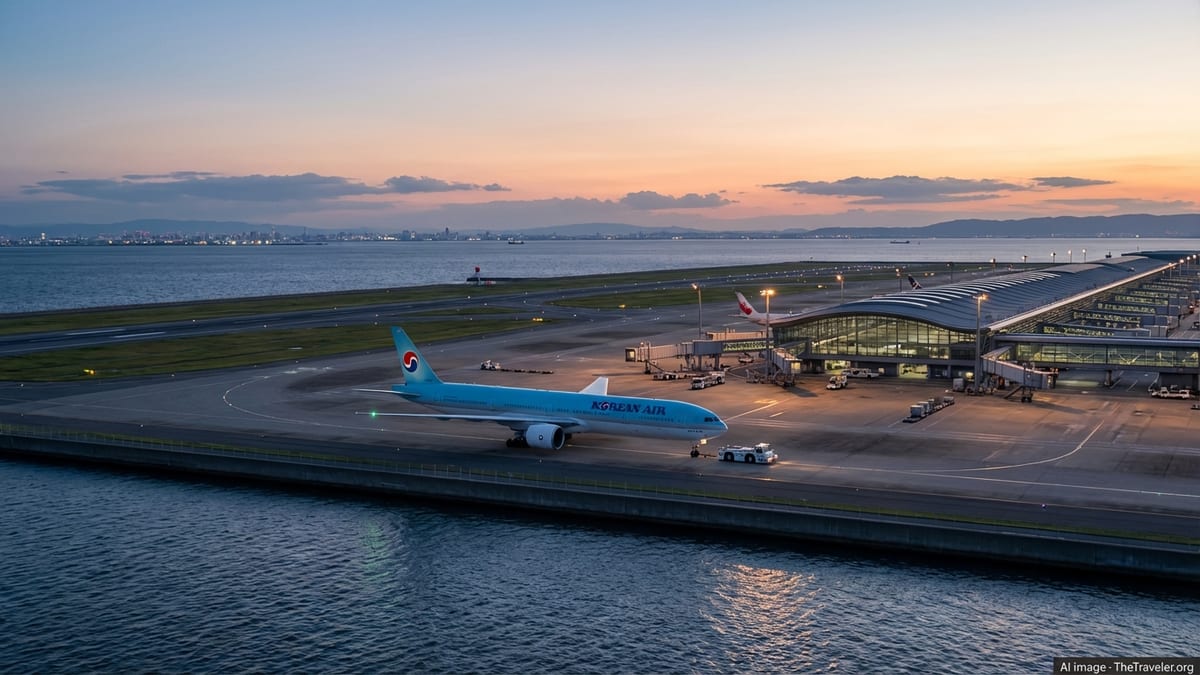
Korean Air is ramping up capacity on its key Incheon–Osaka route to Kansai International Airport, underscoring a broader push by South Korean and Japanese carriers to deepen air links amid surging leisure and business travel between the two countries.
Expanded Services on a Flagship Korea–Japan Corridor
The Incheon–Osaka market, centered on Kansai International Airport, has long been one of Korean Air’s busiest short-haul corridors. Industry officials in Seoul say the airline’s latest schedule adjustments for the summer 2026 season add seats and refine timings on Incheon–Kansai services, positioning the route to capture peak demand during Japan’s school holidays and major events in the Kansai region.
The changes come as Korean Air continues to fine-tune its Japan network. Recent schedule filings and industry reports show a pattern of increased frequencies and upgauged aircraft on Japanese routes, particularly to regional cities, with Osaka ranked among the carrier’s top-performing destinations by passenger numbers.
Osaka already stands as one of the most popular cities for Korean travelers, trailing only Tokyo in some recent traffic rankings. With the yen remaining relatively weak and Japan maintaining its status as a short-haul, value-focused getaway for Korean and regional tourists, the airline sees room for further growth on Incheon–Kansai as part of a diversified Japan portfolio.
For Kansai International Airport, additional Korean Air capacity on the Seoul route strengthens its role as western Japan’s main international gateway and reinforces the airport’s recovery trajectory after the pandemic and subsequent capacity constraints.
Strengthening Bilateral Air Links Amid Political Thaw
The ramp-up in Korean Air’s Osaka services reflects a wider alignment between aviation trends and political priorities in Seoul and Tokyo. In January 2026, South Korean President Lee Jae Myung and Japanese Prime Minister Sanae Takaichi met in Nara and pledged to deepen cooperation across economic security, technology and people-to-people exchanges, signaling continued commitment to more stable bilateral ties after several years of strain.
Air connectivity is emerging as one of the most visible expressions of that thaw. Government data from Seoul show that passenger traffic between South Korea and Japan climbed strongly in 2025, with more than 27 million travelers flying between the two countries and Japan ranking as South Korea’s largest outbound market by passenger volume.
Executives at Korean carriers say that improved political atmospherics reduce the risk of sudden travel boycotts or capacity cuts that previously disrupted Korea–Japan routes. Instead, airlines are now investing in schedule certainty, product upgrades and new city pairs, betting that business cooperation and tourism flows will remain resilient.
Osaka and the Kansai region, home to major manufacturers, technology firms and a thriving tourism sector, sit at the center of this strategy. Expanded Seoul–Kansai flights offer more options for corporate travelers, small and medium-size exporters and university exchange programs, which in turn supports the broader diplomatic aim of closer cross-border integration.
Hub Strategy: Using Incheon to Connect Regional Japan
Korean Air’s growth on the Incheon–Osaka route is closely tied to its broader strategy of positioning Incheon International Airport as a premier transfer hub for travelers from across Japan heading to North America, Europe and Southeast Asia. By pairing more Incheon–Kansai frequencies with added services to regional Japanese airports, the airline is building a web of connections that channel Japanese demand through Seoul.
Over the past year, Korean Air has announced or implemented capacity increases on routes such as Incheon–Aomori, Niigata and Okayama, in several cases upgrading aircraft types and boosting frequencies to near-daily service. Industry schedules for summer 2026 show more weekly flights from Incheon to Niigata and additional service to Okayama, even as the airline trims frequencies on a handful of lower-yield Japanese routes to rebalance the network.
For Kansai, this hub strategy means that flights are not only carrying leisure travelers on short breaks, but also connecting passengers transiting through Seoul to long-haul destinations. Korean Air reports that a significant portion of Japan-origin passengers now use Incheon as a one-stop gateway to cities in North America and Europe, attracted by through-ticketing, coordinated schedules and competitive fares.
The airline’s focus on regional Japan also helps diversify risk away from the highly competitive Tokyo and Osaka trunk routes, where multiple Korean and Japanese carriers operate dense schedules. By linking Kansai with secondary Japanese cities through Incheon connections, Korean Air seeks to lock in customer loyalty and create itineraries that are difficult for rivals to replicate.
Competitive Landscape: Korean and Japanese Carriers Crowd the Osaka Skies
The decision to expand Incheon–Osaka capacity comes in an increasingly crowded market. Low-cost carrier Aero K recently doubled its own Incheon–Osaka frequencies to twice daily, adding an early-morning flight that enables same-day trips for budget-conscious travelers. Other South Korean low-cost airlines and Japanese carriers also operate multiple daily flights between the Seoul area and Kansai.
Industry analysts note that Korean Air, as a full-service network carrier, is seeking to differentiate itself through schedule breadth, premium cabins, loyalty perks and seamless onward connections, rather than competing purely on price. Enhanced frequencies on the flagship Incheon–Kansai route allow the airline to offer more departure-time choices for both origin-and-destination passengers and transfer customers connecting at Incheon.
On the Japanese side, carriers based at Kansai are also rebuilding and expanding their international networks, with a particular focus on capturing inbound demand from South Korea and the wider Asia-Pacific region. This has led to a proliferation of fare promotions on Seoul–Osaka flights, with travelers benefiting from lower prices and more flexible travel dates.
The competitive dynamic is expected to intensify as new entrants such as Parata Air and other regional operators establish or expand routes linking Korean and Japanese secondary cities. Yet Korean Air’s longstanding presence in the Osaka market, combined with its strong brand recognition among Korean travelers, gives it a solid base from which to grow.
Record Passenger Demand and the Osaka Effect
South Korea’s aviation rebound has provided fertile ground for route expansion. Government figures for 2025 show that total air passenger traffic at South Korean airports reached an all-time high of nearly 125 million travelers, surpassing pre-pandemic records. International traffic led the growth, rising more than six percent year on year, while routes to and from Japan posted an even stronger increase.
Korean Air has been a major beneficiary of this demand. The carrier transported more than 16 million passengers between January and early November 2025, with internal data highlighting Japan as the most favored overseas destination among its customers. Tokyo was the single most popular route, closely followed by Osaka and Fukuoka, reflecting a sustained boom in short-haul leisure trips.
Analysts attribute Osaka’s strong performance to a combination of factors: the city’s status as a gateway to Kyoto, Nara and the wider Kansai region; the draw of popular theme parks and shopping districts; and the relatively low cost of travel for Korean visitors, amplified by favorable exchange rates. These elements have helped keep load factors on Seoul–Kansai services high, even outside peak holiday periods.
The rising share of foreign nationals on Korean Air flights, including many Japanese travelers flying to or through Seoul, further supports the business case for additional capacity. For Kansai International Airport, increased arrivals from South Korea bolster tourism revenue and help offset fluctuations in other inbound markets.
Infrastructure and Lounge Upgrades at Incheon
To support growing international traffic, Korean Air is investing heavily in its home base at Incheon International Airport. The airline has embarked on a multi-year overhaul of its lounge network, with new Prestige Garden lounges planned for Incheon’s expanded terminal areas and upgrades underway at existing facilities used by premium and frequent travelers.
According to company statements, the total lounge footprint at Incheon is set to expand by roughly two and a half times once renovations are complete, with seating capacity nearly doubling. The phased opening of these new spaces, scheduled to begin in August 2025, is designed to coincide with expected increases in connecting traffic from routes such as Incheon–Osaka and additional Japanese cities.
The pending full integration of Asiana Airlines into Korean Air, targeted for completion in late 2025, will further consolidate premium services and transfer flows at Incheon. As Asiana-branded lounges are phased out, Korean Air plans to channel more passengers through its own upgraded facilities, creating a unified ground product for travelers connecting from Kansai and other Japanese gateways.
Airport officials say that enhanced lounges, streamlined transfer procedures and improved retail offerings are critical to maintaining Incheon’s competitiveness against rival hubs in Tokyo, Hong Kong and Singapore. For passengers originating in Osaka or elsewhere in Japan, a smoother connection experience in Seoul can be a deciding factor when choosing itineraries to Europe or North America.
Sustainability and Innovation on Japan Routes
Korean Air’s expansion on the Incheon–Osaka corridor is also a platform for testing new sustainability measures on short-haul routes. The airline has begun using domestically produced sustainable aviation fuel on selected flights between Incheon and Kobe and on services linking Seoul’s secondary airport, Gimpo, with Osaka. The program, which involves a small blend of sustainable fuel with conventional jet fuel, is part of a government-backed effort to lower lifecycle emissions from aviation.
Industry reports indicate that Korean refiners are supplying the sustainable fuel, which is produced from non-fossil feedstocks and can reduce carbon emissions significantly compared with traditional kerosene. While the initial blend ratio remains modest, Korean Air and policymakers portray the initiative as an important step toward meeting future mandates that will require airlines to use a minimum share of sustainable fuel on outbound flights.
The Osaka market, where Korean Air already enjoys high load factors and frequent services, provides an ideal test bed for scaling up such initiatives. By combining increased capacity on Incheon–Kansai flights with incremental sustainability improvements, the airline can gather operational data while signaling to environmentally conscious travelers that it is working to reduce its carbon footprint.
In parallel, Korean Air is advancing other environmental projects, including fleet renewal and lighter in-flight service materials, which together are expected to yield substantial fuel-efficiency gains over the coming decade. Many of these improvements will be most visible on high-frequency routes such as Incheon–Osaka and other Japan services, where small per-flight savings add up quickly.
Economic and Tourism Impact for Kansai and Beyond
The expansion of Incheon–Osaka services is expected to deliver tangible economic benefits on both sides of the Korea Strait. For the Kansai region, additional flights from Seoul bring more weekend tourists, longer-stay visitors and business delegations, supporting hotels, restaurants, retailers and cultural attractions in Osaka, Kyoto, Nara and surrounding areas.
Local tourism officials note that Korean visitors are among the most frequent repeat travelers to Kansai, often returning multiple times a year for shopping, concerts or seasonal festivals. More flexible Korean Air schedules, combined with increased capacity from competing carriers, make it easier for these travelers to book last-minute trips or align itineraries with regional events.
On the Korean side, Osaka’s popularity reinforces outbound tourism and supports the travel agency ecosystem, which relies heavily on package tours and dynamic pricing tied to airline capacity. The expanded link through Kansai also strengthens trade ties, as small and medium-size enterprises in both countries use the route for frequent, short-notice travel related to manufacturing, logistics and technology partnerships.
As South Korea and Japan continue to prioritize cooperation in economic security and supply chains, policymakers and business leaders see robust air connectivity as a prerequisite. Korean Air’s decision to add capacity and refine service on the Incheon–Osaka corridor, centered on Kansai International Airport, underscores how commercial aviation has become both a beneficiary and an enabler of the two countries’ cautiously improving relationship.