

More news on this day
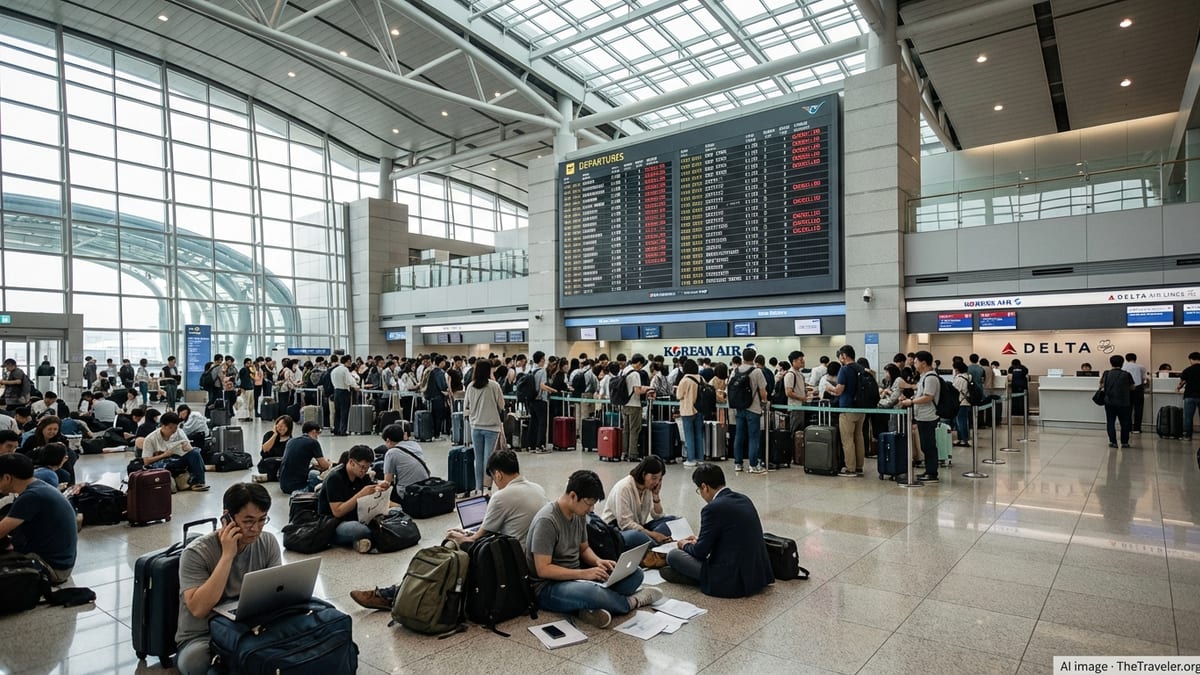
Travelers moving between South Korea and the United States faced fresh disruption this week as Korean Air and Delta Air Lines cancelled two key long haul departures from Seoul Incheon, affecting transpacific routes to New York and Seattle and leaving hundreds of passengers scrambling to rebook.
Key Incheon Departures Scrubbed as Operational Pressures Mount
The latest disruption centers on two high profile departures from Incheon International Airport, South Korea’s main global hub. One was due to serve New York, a flagship Korea–US business and leisure corridor, while the other connected Seoul with Seattle, a vital gateway for both technology and cruise traffic to North America. The cancellations came with only limited advance warning, forcing many passengers to discover the changes when attempting to check in.
Korean Air and its US joint venture partner Delta Air Lines have not publicly detailed a single underlying cause, pointing instead to a mix of operational constraints. Industry observers in Seoul note that staffing constraints, aircraft rotations affected by earlier delays, and the lingering aftershocks of last year’s large scale IT disruption at Delta have together left little margin for irregular operations. In such a tight environment, a single late arriving aircraft or crew timing issue can trigger knock on cancellations on long haul routes.
According to schedule data reviewed by local aviation analysts, affected passengers on the New York and Seattle routes were offered a combination of same day rerouting through alternative US gateways and next day departures from Incheon. However, heavy loads driven by peak winter travel and Lunar New Year related itineraries meant that many flights were already close to full, limiting the options for seamless rebooking.
The cancellations also underscore how dependent Korean outbound and inbound travel has become on a relatively small number of daily widebody departures linking Incheon with major US cities. When even one or two of these flights are pulled, the ripple effects extend across connecting services to Southeast Asia, Japan, and domestic Korean destinations, as itineraries are built around long haul transpacific legs.
Hundreds of Passengers Face Missed Connections and Overnight Stays
For travelers, the immediate impact at Incheon was visible in growing queues at airline service counters, as passengers attempted to salvage complex itineraries. Many were relying on the cancelled New York and Seattle flights to connect onward to secondary US destinations, or to reach tightly scheduled cruises, tours, or corporate events. With aircraft across the network already operating at high load factors, agents reported difficulty finding seats for entire families on the same replacement flights.
Some passengers accepted rerouting via alternative hubs such as Atlanta, Detroit, or Minneapolis, while others were rebooked to fly first to West Coast gateways and then connect domestically across the United States. For those whose original travel plans were built around same day arrivals, these changes translated into lost nights of hotel reservations, missed meetings, and in some cases the need to entirely rework vacation itineraries.
Airport hotels around Incheon saw a sharp uptick in last minute bookings as travelers accepted overnight stays when same day onward options were not available. While Korean Air and Delta provided accommodation and meal vouchers in many cases, passengers still faced the cost of rearranging plans on the ground in the United States, including changes to nonrefundable rail tickets, event bookings, and prepaid local tours.
Those traveling with tight US visa validity windows or with onward international sectors expressed particular concern. Travel agents in Seoul said they were fielding urgent requests from customers worried that delayed arrivals might affect prebooked entry slots, cruise embarkations, and package tours with fixed start dates, especially in New York where theater and holiday travel demand remains consistently strong.
Incheon’s Role as a Regional Hub Magnifies the Fallout
The disruption highlighted just how central Incheon has become to both South Korea’s outbound market and wider Northeast Asian connectivity. The airport functions as the primary long haul hub for Korean Air and a crucial node for Delta’s transpacific partnership, funnelling passengers from cities across Asia into a relatively small set of daily flights to major US gateways. When those flights are cancelled, the consequences extend far beyond the immediate origin and destination pair.
Passengers originating in cities such as Busan, Daegu, and Jeju often rely on timed connections through Incheon to reach long haul services to North America. With the New York and Seattle flights removed from the schedule, some travelers found that their carefully coordinated domestic feed flights no longer aligned with viable alternatives. That left them facing long layovers in Seoul or, in some cases, the need to return home and attempt the journey again the following day.
Incheon’s status as a transfer hub for regional passengers from Japan, China, and Southeast Asia also came into play. Some international travelers who had already flown into Incheon from cities such as Tokyo, Bangkok, or Manila discovered that their onward US legs no longer existed. Airlines worked to reaccommodate these passengers across competing carriers, but interline capacity was constrained, particularly to New York, which remains one of the most competitive and busiest long haul city pairs out of Seoul.
Airport authorities at Incheon monitored the situation closely but stressed that air traffic control, security screening, and core airport infrastructure were functioning normally. The bottleneck, they noted, lay in available aircraft and crew hours on specific long haul routes rather than any systemic airport or airspace issue. Nevertheless, from the perspective of passengers holding now defunct reservations, the distinction offered little comfort.
Joint Venture Dynamics Tested on Transpacific Corridor
The cancellations also served as a real time test of the joint venture framework between Korean Air and Delta Air Lines on the transpacific corridor. Under their deep commercial partnership, the two carriers coordinate schedules, share revenue on many routes, and sell seats on one another’s flights. In theory, this cooperation should provide flexibility in the face of irregular operations, allowing passengers to move between carriers with relatively little friction.
In practice, the surge in demand on Seoul–US traffic following the full reopening of international travel has reduced slack in the system. Seats that once might have been held in reserve to handle disruptions are now routinely sold, particularly on premium heavy routes to New York, where business traffic remains robust, and to Seattle, which serves both technology travelers and a growing cohort of Korean leisure visitors exploring the Pacific Northwest.
When the Incheon departures were cancelled, Korean Air and Delta attempted to lean on their joint schedules to relocate passengers onto alternative departures. However, observers reported that some customers faced fragmented itineraries involving both carriers, with changes to ticketing responsibility and baggage handling that added complexity. The episode may fuel calls for clearer joint venture protocols on disruption management, especially for itineraries that cross between Korean and US domestic sectors.
From a competitive standpoint, rival airlines connecting Seoul with North America could see a short term benefit if dissatisfied travelers shift loyalty. Yet capacity across the Pacific remains carefully managed, and most carriers report strong load factors. For passengers, that means fewer empty seats to absorb sudden surges in demand when another airline cancels a high capacity flight.
Consumer Rights, Refunds, and Rebooking Options
The episode is also refocusing attention on what rights travelers have when long haul flights are cancelled at short notice. South Korean consumer regulations require airlines to provide refunds or alternative transport in cases of cancellations attributable to the carrier, but the exact level of support can vary depending on cause and applicable international agreements. For joint venture services, responsibilities may also be split between marketing and operating carriers, adding a layer of complexity.
Travel advisors in Seoul and Busan encouraged passengers to document all out of pocket expenses incurred as a result of the cancellations, including hotel stays, meals, and ground transport, and to keep boarding passes, cancellation notices, and receipts together for potential claims. They also urged travelers to proactively check flight status through airline apps and airport information systems in the days leading up to departure, rather than relying solely on original booking confirmations.
Many passengers affected by the cancelled Incheon–New York and Incheon–Seattle services discovered that standard rebooking channels were overwhelmed during the peak of the disruption. Airline call centers experienced long wait times, and airport service desks quickly accumulated long lines. Those who were able to use mobile self service tools to accept rebooked itineraries, select alternative routings, or request refunds generally moved more quickly through the disruption than travelers who depended solely on in person assistance.
Insurance providers in South Korea note a growing interest in policies that explicitly cover missed connections and schedule changes, not only for classic causes like severe weather but also for operational disruptions. As transpacific airfares have risen and trips have become more complex, the financial stakes associated with a single cancelled flight have increased accordingly.
Knock On Effects Across Domestic and Regional Networks
Although the most visible impact of the cancellations was felt on the long haul routes from Incheon to New York and Seattle, the shockwaves also hit domestic and regional services. Aircraft and crews that were originally scheduled to operate feeder legs into Incheon for the transpacific departures had to be reassigned, leading to a scattering of delays and minor cancellations within South Korea and nearby markets.
Passengers flying from Jeju, Busan, and smaller Korean cities into Incheon for onward US connections found that some of their domestic flights were retimed or replaced with different equipment. In a few cases, tight minimum connection times could no longer be guaranteed, prompting airlines to proactively move passengers to earlier departures or, where that was not possible, to push their entire journey back by a day.
Regional routes to neighboring countries, particularly those served by the same widebody aircraft that cycle between short haul and long haul missions, also saw schedule shuffles. While most of these changes were absorbed without high profile cancellations, the cumulative effect was a day of irregular operations that left airline operations control centers juggling aircraft positioning and crew duty limits across multiple time zones.
Tour operators catering to inbound visitors to South Korea expressed concern that repeated disruptions of this sort could undermine confidence in using Incheon as a connecting hub. While the airport itself retains a strong reputation for efficiency and passenger amenities, tour planners say they are increasingly building additional buffer time into itineraries that rely on specific long haul arrivals.
Lessons for Travelers Planning Transpacific Trips via Seoul
For future travelers, the events around the cancelled Korean Air and Delta flights provide several practical lessons. First, flexibility in travel dates and routings is more valuable than ever. Passengers whose itineraries allowed them to accept alternative gateways or travel a day earlier or later generally had a smoother experience than those tied to fixed arrival times. Booking with some built in buffer before cruises, tours, or business events can mitigate the risk of missing immovable commitments.
Second, having airline mobile apps installed and notifications enabled can significantly reduce the stress of last minute changes. In many cases, carriers now push rebooking options directly to passengers’ phones when cancellations occur, allowing them to confirm new flights with a few taps instead of waiting in line at an airport desk. Checking flight status the evening before travel and again on the morning of departure has become a necessary habit on busy transpacific routes.
Third, travelers connecting through Incheon to North America may wish to consider travel insurance that covers not only cancellation but also additional accommodation and transport costs arising from operational disruptions. Policies that specify coverage for missed connections on separate tickets are particularly valuable for independent travelers who piece together their own itineraries across multiple airlines.
Finally, as Korean Air and Delta continue to refine their joint venture, passengers may benefit from clearer communication on who is responsible for assistance, vouchers, and compensation when a codeshare route is disrupted. Understanding whether a booking is ticketed by Korean Air or Delta, and which carrier is operating each leg, can help travelers know where to turn first when problems arise at the airport.