

More news on this day
Passengers across South Korea are facing schedule turmoil this week after Korean Air canceled three key services from Seoul, Incheon and Jeju, disrupting air links to Hong Kong, Yeosu, Cheongju and other major Asian hubs at the start of a busy spring travel period.
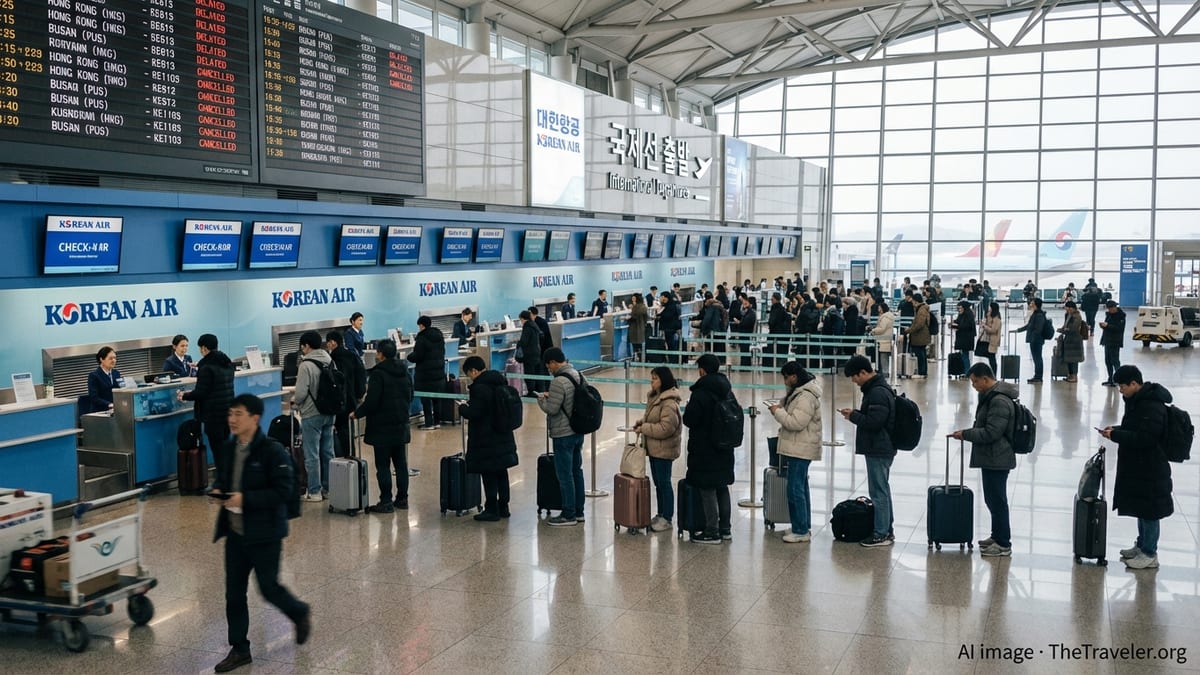
Three Flight Cancellations Ripple Across Major Hubs
The latest disruption centers on a cluster of cancellations affecting both domestic and international routes, with flights withdrawn from Seoul, Incheon International Airport and Jeju International Airport. Among the affected services are connections to Hong Kong and key regional cities that act as feeder gateways for onward travel into China, Japan and Southeast Asia.
Industry trackers and airport operations data indicate that three Korean Air flights were pulled from schedules within a short window, catching many passengers as they were preparing to travel. At Jeju, services to Yeosu and Cheongju were canceled, severing two high-demand domestic corridors and complicating plans for travelers relying on those sectors for same-day connections through larger mainland airports.
At Incheon, the main international gateway for South Korea, passengers bound for Hong Kong and other Asian hubs reported last-minute notifications of schedule changes and cancellations. While some travelers were rebooked on later departures or rerouted through alternative hubs, others faced overnight stays or were forced to abandon tightly timed itineraries.
Although Korean Air has not announced a broad schedule reduction, the targeted cancellations underscore how even a handful of withdrawn flights can cascade through the region’s aviation network, particularly when they involve trunk routes linking South Korea’s coastal and island gateways with primary Asian cities.
Travelers Face Missed Connections and Overnight Delays
The immediate impact has been keenly felt by passengers traveling for business, family visits and leisure trips at the tail end of February, a period that typically sees elevated demand as travelers take advantage of off-peak fares and milder weather across Northeast Asia. Many had arranged onward flights from Hong Kong and domestic Korean hubs, only to find that missed connections left them stranded mid-journey.
At Incheon, check-in queues lengthened as airline staff worked to rebook affected travelers on alternative departures, in some cases via Tokyo, Taipei or other secondary hubs. Those with nonflexible tickets or tight schedules were hit hardest, with some corporate travelers forced to cancel same-day meetings across the region as they waited for new departure options.
On Jeju Island, a vital leisure and convention destination, the cancellation of services to Yeosu and Cheongju disrupted weekend city breaks and domestic tourism flows. Travelers who had planned circular itineraries combining Jeju with mainland coastal cities reported scrambling to secure replacement seats on remaining flights or pivoting to high-speed rail and ferry services where available.
Airports and ground handlers have been advising passengers to arrive earlier than usual to allow more time for rebooking and documentation, particularly for those with separate tickets on different carriers. Travel agents in Seoul and Busan noted a spike in calls from clients seeking clarification on their rights to refunds, hotel vouchers and alternative transport after last-minute changes.
Operational Strains Behind the Cancellations
Aviation analysts point to a combination of operational pressures that may be sitting behind the latest cancellations, even as Korean Air continues to expand its overall flying program following its merger with Asiana Airlines and a strong rebound in regional travel demand. Airlines across Asia have been working to balance tight aircraft availability, intensive maintenance schedules and crew rostering constraints.
Fleet utilization at Korean Air has been rising, with the carrier operating significantly more flights than during the pandemic and early recovery period. Recent corporate disclosures from the airline highlight efforts to modernize the fleet, optimize fuel burn and streamline route structures, but they also underline the delicate balance between maximizing aircraft use and preserving spare capacity to absorb unexpected technical or weather-related disruptions.
Industry observers note that crew scheduling remains another pressure point, particularly on networks that mix long-haul intercontinental flights with dense short-haul rotations around Northeast Asia. Delays or aircraft swaps on overnight services can easily spill into the following day’s domestic and regional departures, forcing planners to make hard choices about which routes to protect and which to cancel when resources are stretched.
While Korean Air has not detailed exact causes for each affected flight, the pattern fits a wider regional trend of airlines trimming individual rotations to maintain overall network stability. By canceling select services from Seoul, Incheon and Jeju, carriers can concentrate aircraft and crews on routes with the heaviest loads or most critical connectivity, albeit at the cost of short-term disruption for passengers on the dropped flights.
Advice for Passengers Caught in the Disruption
Given the knock-on effects across domestic and international connections, travel advisers are urging passengers booked on Korean Air services from South Korea in the coming days to double-check their itineraries well ahead of departure. Airline mobile apps, call centers and airport information displays remain the primary channels for up-to-the-minute schedule changes, although response times can lengthen during disruption spikes.
Passengers holding separate tickets on different carriers, or those planning tight layovers in Hong Kong, Yeosu, Cheongju or other connecting points, are being encouraged to build in longer buffers between flights where possible. Travel management companies say that even an extra hour or two between scheduled arrivals and onward departures can be the difference between a straightforward rebooking and an overnight stay during periods of irregular operations.
Consumer advocates also stress the importance of understanding fare conditions before travel. Flexible or semi-flexible tickets can offer more generous rebooking and refund options when cancellations occur, while basic economy and promotional fares may come with stricter rules. Travel insurance with clear coverage for missed connections and cancellations can provide an additional layer of protection, especially for multi-stop journeys across Asia.
For now, passengers affected by the latest Korean Air disruptions are being processed on a case-by-case basis, with many being accommodated on the next available services or offered rerouting via alternative hubs. As airports and airlines continue to fine-tune their schedules heading into the spring travel season, travelers in and out of South Korea are likely to keep a close eye on their flight status up until the moment they head to the airport.