

More news on this day
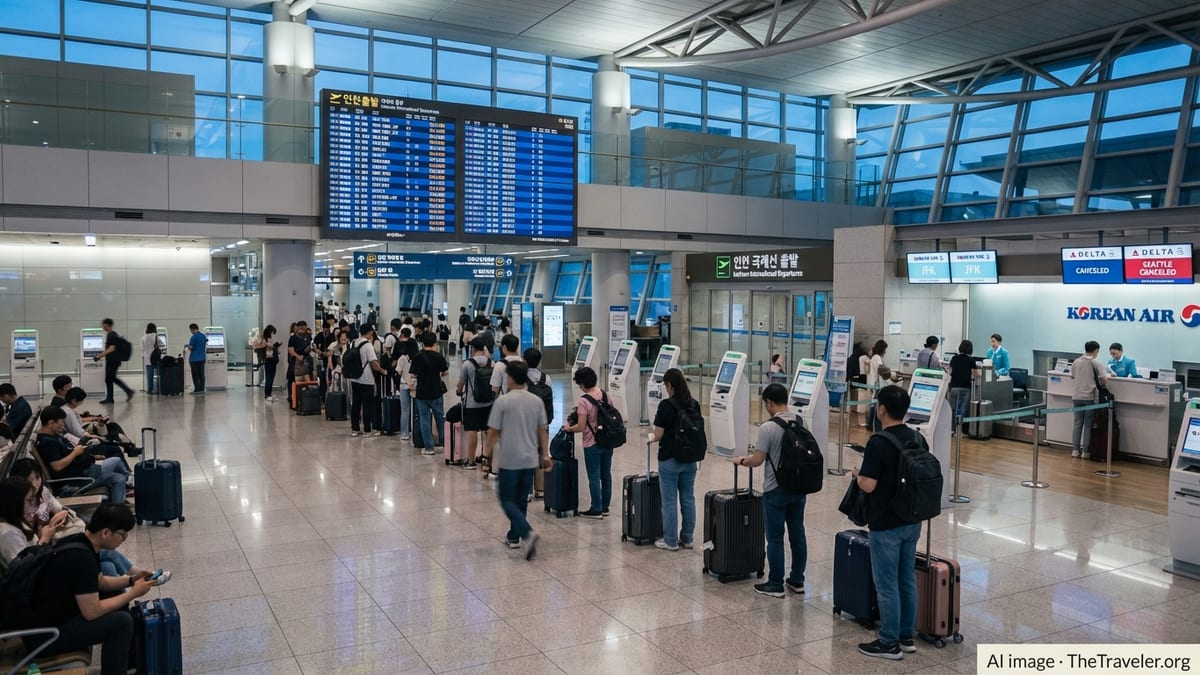
Unexpected flight cancellations by Korean Air and Delta Air Lines at Seoul’s Incheon International Airport have triggered a ripple of travel disruption across South Korea, interrupting key transpacific links to New York and Seattle and forcing hundreds of passengers to hastily rebook or reroute their journeys.
What Happened at Incheon and Which Flights Were Hit
The latest disruption unfolded when two departures from Incheon were pulled from the schedule within hours of takeoff, one operated by Korean Air on the busy Seoul Incheon to New York John F. Kennedy route and the other a codeshare service with Delta Air Lines serving Seattle. Both flights form part of a tightly integrated transpacific network and are heavily used by business travelers, students, and connecting passengers heading onward across North America.
According to operational updates from industry trackers and local aviation sources, the Korean Air New York flight was withdrawn shortly before boarding was due to begin, while the Delta-linked service to Seattle, marketed under a Korean Air codeshare, was also canceled after an initial delay. The decisions came as aircraft and crew resources were stretched by a combination of weather challenges affecting the US East Coast and knock-on operational pressures within the joint venture network.
The cancellations immediately raised concerns for passengers with onward connections, particularly those booked on same-day domestic links from New York to other US cities or from Seattle to destinations in the Pacific Northwest. With both routes typically running close to capacity, re-accommodating ticket holders has proven complex, especially for those needing to arrive in North America within tight time windows for work, study, or family commitments.
While day-to-day disruptions are not unusual in global aviation, the simultaneous loss of two long-haul departures from Incheon to major US gateways has underscored how vulnerable even mature, high-frequency routes can be when a hub experiences sudden constraints.
Operational Pressures Behind the Disruption
The cancellations have occurred against a backdrop of mounting operational pressures on both sides of the Pacific. Delta recently activated a travel waiver for the US East Coast due to forecast winter weather, covering airports including New York JFK and LaGuardia. Those conditions have limited arrival and departure slots and contributed to a cascade of schedule adjustments, equipment swaps, and crew repositioning challenges that can reverberate as far afield as Seoul.
For Korean Air, which now leads a consolidated South Korean market following its merger with Asiana Airlines, the task of balancing fleet deployment has become more complex as it integrates aircraft, staff, and routes from the former rival. The carrier has been working to rationalize overlapping services while maintaining strong transpacific capacity to New York and the US West Coast. A sudden schedule disruption at a major partner hub like New York can therefore have outsized consequences at Incheon, particularly when aircraft are tightly scheduled.
Industry analysts note that the joint venture between Korean Air and Delta allows the two airlines to share revenue, coordinate schedules, and market services jointly across the Pacific. That tight integration delivers benefits in normal times, including more convenient departure times and easier connections. However, it also means that irregular operations at one end of the network can quickly spill over, forcing coordinated cancellations and rebookings rather than isolated adjustments by a single carrier.
In this latest instance, Delta’s weather-driven constraints in the United States, combined with Korean Air’s own fleet and crew positioning, appear to have converged at an unfortunate moment, leaving Incheon with fewer options to absorb the disruption without cutting entire flights.
Impact on Passengers Bound for New York and Seattle
The most immediate fallout has been felt by travelers holding tickets on the affected New York and Seattle services. Passengers bound for New York JFK, a key entry point for South Korean travelers heading to the East Coast and beyond, faced the prospect of extended delays or overnight stays in Seoul as they queued at service counters to secure alternatives on later departures or different routings.
For many, alternative options included rebooking onto Korean Air’s other daily New York services where seats were available, or connecting through partner hubs in cities such as Tokyo or Vancouver on competing carriers. However, seats on those routes are already heavily booked, and some travelers reported being offered itineraries with travel times extended by many hours or even an extra day.
On the Seattle side, passengers encountered a similar scramble. Seattle is a strategic West Coast gateway for both Delta and Korean Air, used heavily by travelers connecting to domestic US flights and to destinations in Canada and Alaska. With the canceled flight removing a significant block of capacity from Incheon, travelers had to be shifted onto later departures, alternative West Coast gateways such as Los Angeles or San Francisco, or indirect routings that added connections in other Asian hubs.
Families, students, and business travelers interviewed at Incheon described a mix of frustration and resignation, noting that they were informed of the cancellations relatively late and sometimes received conflicting information from call centers, airport staff, and mobile apps as airlines worked to update their systems in real time.
Rebooking Options, Waivers, and Passenger Rights
Both Korean Air and Delta are now leaning on their joint customer service structures and alliance relationships to manage the backlog of disrupted travelers. Agents at Incheon have been authorized to rebook affected passengers on the next available services to New York or Seattle without additional fees, subject to seat availability, and in many cases to reroute travelers via alternative gateways in the United States when direct options are not possible.
Delta’s ongoing East Coast winter weather waiver, which allows customers to change itineraries to and from impacted airports without standard penalties, is expected to provide additional flexibility for those whose plans involved onward connections from New York. Although the waiver is focused on US domestic and transatlantic traffic, Incheon-originating passengers connecting through JFK are typically able to benefit if their downstream segments fall under the advisory.
For Korean Air customers, standard irregular operations policies apply, including entitlement to rebooking at no extra charge in the same cabin and, where necessary, hotel accommodation and meal vouchers when overnight delays are unavoidable. However, implementation can vary depending on whether tickets were purchased directly from the airline, via online travel agencies, or as part of group or tour packages, complicating the process for some travelers.
Travel experts advise affected passengers to document all communications with the airlines, retain receipts for any out-of-pocket expenses such as taxis or meals, and check the specific terms attached to their tickets and travel insurance policies. While South Korean and US regulations do not mandate cash compensation for weather-related disruptions, passengers may be entitled to refunds when a flight is canceled and they choose not to travel.
Broader Effects Across the South Korean Aviation Network
The loss of two long-haul departures from Incheon has also had a knock-on effect across South Korea’s domestic and regional network. Incheon, together with Seoul’s Gimpo Airport and the tourism-focused Jeju Airport, forms the backbone of the country’s air transport system. When a major long-haul service is canceled, aircraft positioning, crew schedules, and gate availability can all shift, sometimes leading to delays or minor schedule changes on shorter routes as airlines reshuffle resources.
Travel monitoring services have reported scattered delays on feeder flights bringing passengers from regional cities such as Busan, Daegu, and Gwangju into Seoul for onward connections to North America. Some travelers arriving from those cities have found that their connecting flights no longer exist, forcing last-minute overnights in the capital or complete changes to their plans.
The timing of the disruption is particularly sensitive for South Korea’s tourism and business travel sectors. Late February is a busy period for outbound travelers lining up early spring trips and for inbound visitors catching the end of the winter season. Hotels near Incheon and in central Seoul have already reported an uptick in same-day bookings from stranded passengers seeking a bed for the night while they wait for alternative flights.
Local transport providers, including airport limousine buses, express trains, and taxis, have also been affected as passenger flows shift from late-evening departures to early-morning rebooked flights, putting pressure on services during certain hours while leaving others unexpectedly quiet.
What This Means for the Korean Air–Delta Partnership
The disruptions will inevitably raise questions about resilience within the Korean Air and Delta joint venture, which has been a cornerstone of transpacific connectivity between North America and South Korea. The partnership has been widely viewed as a success, offering travelers a dense network of connecting itineraries through Incheon and US hubs like Atlanta, Seattle, Detroit, and New York. However, it also creates a high degree of interdependence.
When Delta is constrained by weather or air traffic control measures at key US hubs, Korean Air’s ability to operate its own long-haul flights may be indirectly affected, particularly if those flights rely on shared aircraft rotations or if crew schedules are synchronized to support codeshare operations. Conversely, disruptions on the Korean side, such as severe weather in Seoul or operational issues at Incheon, can complicate Delta’s efforts to maintain reliable schedules across its domestic and transborder network.
Aviation analysts say that this incident is unlikely to fundamentally alter the partnership but could prompt both carriers to revisit their contingency planning, especially around peak travel periods and during predictable weather seasons. Options could include maintaining a slightly larger buffer of spare aircraft on key routes, increasing interline agreements with other SkyTeam members, or adjusting schedules to reduce tight turnarounds at congested hubs.
For travelers, the episode serves as a reminder that joint ventures, while beneficial for connectivity and loyalty perks, do not eliminate the risk of disruption. Instead, they require robust communication and coordinated recovery strategies to ensure that passengers receive clear, consistent information and realistic alternatives when things go wrong.
Advice for Travelers With Upcoming Flights via Incheon
For those scheduled to travel between South Korea and the United States in the coming days, especially on routes touching New York or Seattle, the disruption offers several practical lessons. First, travelers are encouraged to monitor their bookings closely using both the airline’s mobile app and official communications, rather than relying solely on third-party booking platforms. Flight status can change rapidly in response to weather forecasts and operational shifts, and the most accurate information typically comes from the operating carrier.
Second, passengers with tight connections, such as same-day domestic links beyond New York or Seattle, may wish to proactively inquire about moving to earlier departures or more robust routings, even if their current flights are still showing as on time. While changes may incur fees in normal circumstances, existing waivers or goodwill policies can sometimes be applied when there is a clear risk of misconnection due to ongoing schedule volatility.
Third, travelers should review their travel insurance coverage and credit card benefits, many of which include trip interruption or delay protections that can help cover hotel stays, meals, or alternative transport when flights are disrupted. Ensuring that key receipts are kept and that policy conditions are understood in advance can make the claims process smoother if things do go wrong.
Finally, flexible planning remains one of the most powerful tools for mitigating stress. Allowing additional buffer time before important events, opting for routings with slightly longer connections at major hubs, and avoiding last-flight-of-the-day options when possible can all reduce the risk that a single cancellation will derail an entire itinerary.
Outlook for Transpacific Travel From South Korea
Despite the immediate disruption, demand for travel between South Korea and North America remains strong, underpinned by deep business ties, a large Korean diaspora, and growing tourism flows in both directions. Airlines serving Incheon, including Korean Air, Delta, and other international carriers, have been steadily rebuilding and expanding their transpacific schedules, adding new frequencies and restoring widebody aircraft on key routes.
Korean Air in particular has been reshaping its long-haul network as it integrates Asiana’s operations, reintroducing high-capacity aircraft such as the Airbus A380 on select transpacific routes and adjusting frequencies to match demand. Delta, for its part, has signaled a renewed focus on Asia, with new services planned to regional hubs and strengthened cooperation with its partners in the region.
Industry observers expect that, once the current weather systems affecting North America subside and airlines have had time to work through the backlog of disrupted travelers, operations between Incheon, New York, and Seattle will normalize. For now, however, the canceled flights stand as a reminder that even in a maturing post-pandemic recovery, the global air travel system remains susceptible to sudden shocks that can ripple across continents.
For passengers, the key takeaway is not to avoid these routes, which remain among the most efficient and comfortable ways to cross the Pacific, but to approach travel with an informed, flexible mindset and a clear understanding of their options should plans unexpectedly change.