

More news on this day
Korean Air has moved to extend the suspension of its Incheon–Dubai service through March 15, citing continued airspace restrictions and security concerns following recent military strikes involving Iran, a decision that is unsettling passengers and complicating travel between Korea and the Middle East’s busiest hub.
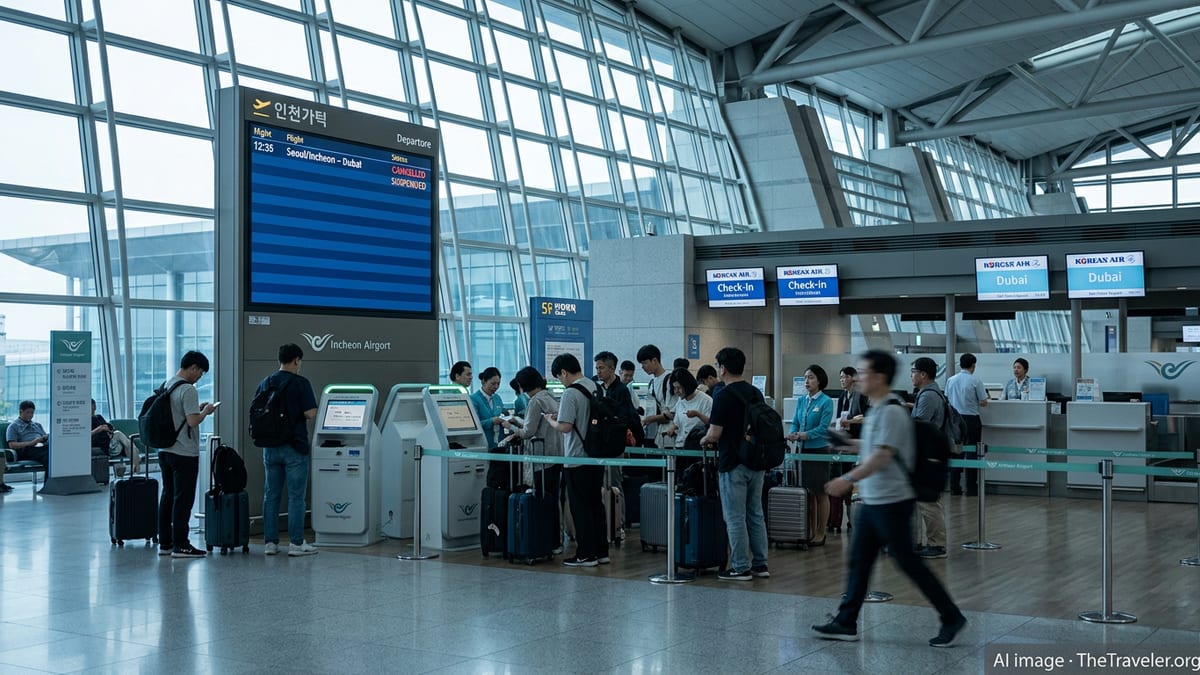
Route Suspension Extended as Conflict Ripples Through Aviation
Korean Air confirmed on Friday that flights KE951 and KE952, the carrier’s only nonstop services linking Incheon and Dubai, will remain suspended until at least March 15. The decision follows repeated cancellations and diversions after U.S. and Israeli strikes on Iran triggered retaliatory attacks and a cascade of airspace closures across the region.
The airline had initially halted the route at the end of February, framing the move as a short-term response to operational uncertainty. However, the latest extension underscores how deeply the evolving security situation is affecting carriers that rely on Gulf hubs for both point-to-point traffic and onward connections to Europe, Africa, and the broader Middle East.
Industry officials in Seoul say Korean Air’s options are constrained by restrictions imposed by authorities in the United Arab Emirates and neighboring states, as well as by insurers closely monitoring overflight risks. With the situation in flux and further military developments possible, airlines are being forced to reassess route viability on an almost daily basis.
Dubai authorities have reportedly informed airlines, including Korean Air, that commercial operations on certain routes will remain curtailed through mid March. That guidance effectively rules out an immediate restart of normal Incheon–Dubai flights, despite the gradual resumption of limited services by some foreign carriers.
Stranded Travelers Face Uncertainty and Patchwork Alternatives
The suspension has left Korean nationals and foreign travelers who rely on the Incheon–Dubai corridor scrambling for alternatives. Dubai serves as a major transit point for Koreans heading to destinations across the Middle East, North Africa, and Europe, meaning that the loss of the direct link reverberates far beyond the UAE.
Reports from Dubai International Airport describe long lines at airline desks and anxious passengers seeking rebooking options. Some travelers have been rerouted through alternative hubs such as Istanbul, Doha, and European gateways where airspace remains open, but capacity is tight and fares have spiked sharply in recent days.
The Korean government has prioritized bringing home citizens stranded in the UAE and other parts of the Middle East. Officials in Seoul have coordinated closely with Gulf carriers operating repatriation and limited commercial flights, including services from Dubai to Incheon run by Emirates, to clear backlogs of Korean nationals waiting to depart.
Korean Air, which does not currently have the green light to fly its regular Dubai service, is instead working with authorities on special operations and exploring charter options once conditions allow. Travelers holding tickets on suspended flights are being urged to monitor airline notifications closely and to consider rerouting via safer corridors where seats are available.
Safety, Insurance and Airspace Restrictions Drive Decisions
Behind the scenes, the extended suspension reflects a complex risk calculus shared by airlines, regulators, and insurers. The recent strikes and missile attacks involving Iran have heightened concerns about potential threats to civil aviation, particularly in and around key Gulf hubs and overflight corridors traditionally used for Asia–Europe traffic.
Airspace closures announced by countries across the region have forced wide detours for some long-haul routes and made others temporarily unviable. For airlines like Korean Air, which depend on predictable, high-altitude corridors over the Middle East, the combination of airspace restrictions and safety advisories can quickly tip a route from profitable to impossible overnight.
Insurance underwriters are also playing a pivotal role. War-risk premiums for flights operating into or over conflict-adjacent areas can climb rapidly when tensions spike, adding significant costs and in some cases making scheduled services financially or operationally untenable. Carriers must weigh these factors against their duty of care to passengers and crew.
Korean Air’s extended pause on Incheon–Dubai services highlights how even major, well-capitalized airlines can be constrained when geopolitical risk and regulatory decisions align. For now, safety considerations are trumping commercial ambitions, with the airline signaling it will only restore the route once it is confident in the stability of the operating environment.
What Affected Passengers Need to Know Right Now
Travelers booked on Korean Air’s Incheon–Dubai flights through March 15 are being offered a range of options, including fee waivers for itinerary changes, refunds, or rebooking on alternative routes where space permits. Exact conditions vary by ticket type and booking channel, but the airline is generally allowing date and routing changes without the usual penalties for those directly impacted by the suspension.
Passengers whose journeys involve onward connections beyond Dubai are being advised to contact their airline or travel agent as soon as possible to avoid last-minute disruptions. With alternative hubs under pressure and many flights already heavily booked, acting early can significantly improve the chances of securing a workable new itinerary.
Travel advisories from Korean authorities continue to urge against nonessential travel to affected parts of the Middle East. Those who must travel are encouraged to register with consular services, keep close track of airline notifications, and build extra time and flexibility into their plans in case of sudden schedule changes.
For travelers still in the UAE or nearby countries, official channels remain the safest and most reliable way to arrange departure. Officials have warned against using unofficial intermediaries or private operators advertising evacuation services on social media and messaging platforms, noting the risk of scams and unsafe arrangements.
Prospects for Resumption and the Wider Travel Outlook
While some direct flights between Dubai and Incheon operated by foreign carriers are beginning to resume under tight coordination with aviation authorities, Korean Air is signaling a more cautious approach. The carrier’s extended suspension through March 15 suggests it expects at least short-term instability to persist, even if the most intense phase of the crisis eases.
Aviation analysts say much will depend on whether airspace restrictions are relaxed in the coming days and whether the current round of hostilities remains contained. A rapid de-escalation could see Korean Air move to restore the route on a limited basis, possibly with adjusted schedules or alternative routings that avoid the most sensitive areas.
In the meantime, the disruption is a stark reminder of how quickly geopolitical shocks can reshape global travel patterns. Korean tourists and business travelers who once took the Incheon–Dubai link for granted are now rethinking itineraries, considering non-Middle East routing to Europe and Africa, and weighing the potential for further volatility in the region.
For Korean Air and other carriers, the priority remains safety and regulatory compliance, even as they face pressure from customers eager for normal service to resume. Until there is greater clarity on both the security situation and the status of regional airspace, passengers can expect schedules to remain fluid and contingency planning to be an essential part of any trip touching the Middle East.