

More news on this day
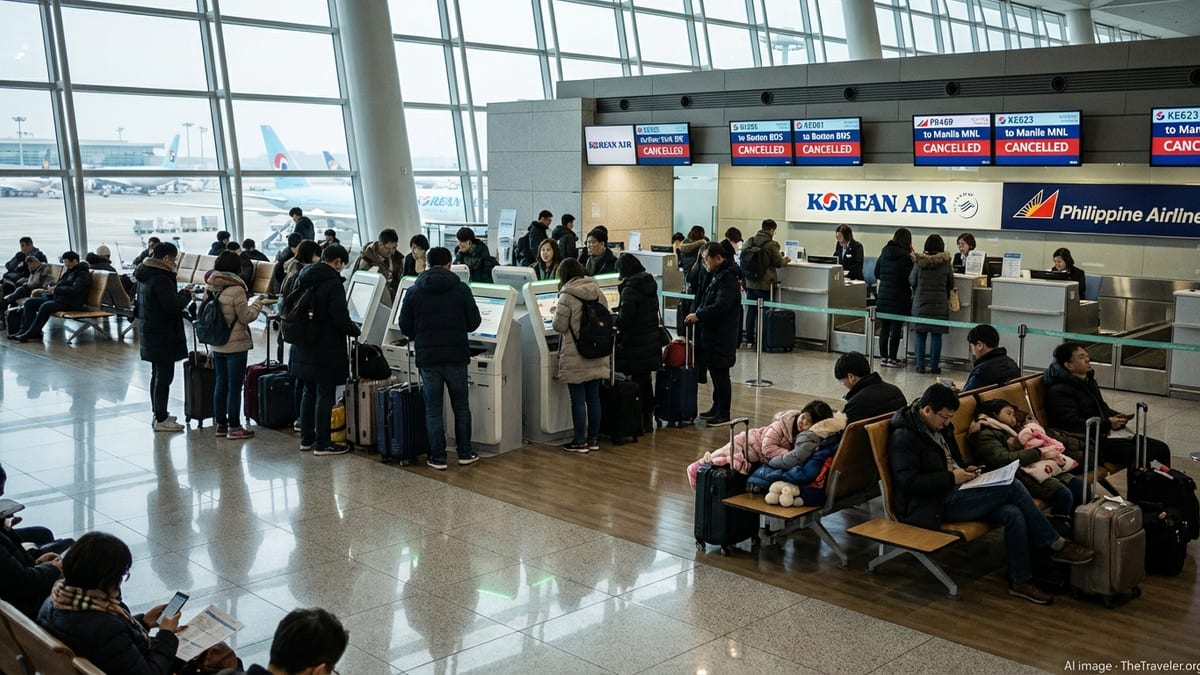
Travelers moving through South Korea this week have faced fresh disruption after Korean Air and Philippine Airlines cancelled five key international departures from Seoul Incheon, temporarily severing links to New York, Boston, Manila and other major hubs and forcing hundreds of passengers to rebook or reroute at short notice.
Five High-Profile Cancellations Hit Incheon Schedules
The latest data from Incheon International Airport shows that a total of five long-haul and regional flights operated by Korean Air and Philippine Airlines were withdrawn from the departure boards over a single operating window, concentrating disruption at one of Asia’s busiest hubs. The affected services included Korean Air’s flagship transpacific routes to New York John F. Kennedy and Boston, as well as an important Southeast Asia connection to Manila operated by Philippine Airlines.
Airport movement logs indicate that Korean Air accounted for the majority of cancellations, scrubbing several widebody departures bound for the United States and other long-haul markets. Philippine Airlines’ cancelled departure to Manila further tightened capacity on a corridor that links South Korea’s capital region with one of its most important outbound leisure and labor markets.
Although overall traffic at Incheon has continued to recover, the sudden loss of these five flights compressed demand into remaining services on the same corridors. Aviation analysts note that even a small cluster of cancellations on widebody aircraft can temporarily remove hundreds of seats from the market, amplifying knock-on effects for both local passengers and those using Seoul as a connecting hub.
While carriers did not immediately release detailed passenger counts, the combination of peak-season bookings and long-haul aircraft types suggests that several thousand itineraries may have been disrupted, either through outright cancellations or significant schedule changes.
New York, Boston and Manila Among Worst-Affected Destinations
The cancellations have been particularly sensitive on routes linking Seoul with New York and Boston, two of Korean Air’s marquee North American gateways. These flights are linchpins for business travelers, students and family visitors moving between the northeastern United States and Northeast Asia, and they also serve as crucial feeders into broader transpacific and intra-Asian networks.
With at least one scheduled departure to each city removed from service, passengers faced narrower options and higher pressure on remaining seats operated not only by Korean Air but also by alliance and codeshare partners. Same-day rebooking on alternative flights was described as challenging by travel agents, especially for those traveling in groups or on fixed-date itineraries.
On the Manila corridor, the Philippine Airlines cancellation compounded strain on a route that already operates with high load factors. Manila–Seoul services cater to a mix of Filipino workers transiting through Korea, South Korean tourists headed to Philippine beach destinations and connecting passengers bound for North America via Incheon. Even a single cancelled leg can fragment onward journeys, forcing some travelers to overnight in Seoul or reconfigure entire multi-stop trips.
Domestic South Korean connectivity also felt indirect effects. With long-haul passengers missing onward connections, seats on popular shuttle services between Seoul and secondary cities were reallocated at short notice, occasionally displacing local travelers who had booked those domestic legs weeks in advance.
Airlines Cite Operational Pressures as Passengers Scramble
Neither Korean Air nor Philippine Airlines cited a single overarching cause for the five Incheon cancellations, but industry experts point to a familiar mix of operational pressures. These include tighter maintenance windows, ongoing staffing imbalances across cabin and technical crews, and aircraft rotations that leave little margin when earlier flights arrive late or require additional checks.
South Korea’s aviation sector has also been navigating the longer-term effects of fleet realignments and safety-driven inspections, particularly on older aircraft types and high-utilization long-haul jets. When a single aircraft is pulled from service for unscheduled maintenance, carriers sometimes opt to consolidate or cancel individual sectors to avoid cascading delays across their networks.
For affected passengers, the immediate focus has been on rebooking and, where necessary, compensation. Travel agencies in Seoul and Manila reported a spike in calls from customers seeking clarification on their rights, especially those holding nonrefundable or highly restricted fares. Many travelers were offered rerouting via alternative Asian hubs or later departures from Incheon, though some faced significant arrival delays at their final destinations.
Industry observers note that while such disruptions remain relatively limited in scale compared with the mass cancellations seen during the pandemic, they underscore how vulnerable interconnected long-haul networks can be to sudden operational shocks, particularly during busy travel periods when spare capacity is minimal.
Guidance for Travelers Connecting Through Seoul
The latest wave of cancellations serves as a reminder for passengers planning itineraries through Seoul to build additional flexibility into their trips. Travel advisers recommend leaving longer layover windows when connecting from long-haul transpacific flights to regional services, and, where possible, avoiding last flights of the day on critical sectors such as New York, Boston or Manila.
Airlines have been encouraging customers to register contact details and opt into real-time notifications so they can receive prompt updates on any schedule changes. In many cases, early alerts can expand rebooking options, allowing travelers to shift to alternative departures or even adjust travel dates before flights fill up.
Passengers are also being urged to review the conditions of carriage and applicable passenger rights before departure. While South Korea does not mirror the European Union’s exact compensation framework, carriers operating from Incheon typically outline rebooking, refund and accommodation policies in cases of significant delay or cancellation. Being familiar with these terms can help travelers negotiate solutions at airport counters when time is tight.
For now, airport authorities in Seoul maintain that overall operations at Incheon remain stable and that the five cancellations, while highly visible due to the prominence of the affected routes, represent a small fraction of daily movements. However, with long-haul demand remaining strong and airlines operating close to capacity on some days, even isolated cancellations are likely to continue producing outsized disruption for those caught in the middle.