

More news on this day
Transpacific and regional travelers faced fresh disruption this weekend after Korean Air and Philippine Airlines scrubbed five key services linking South Korea with New York, Boston, Manila and other major hubs, as a powerful winter storm battering the US Northeast and tight aircraft availability combined to upend carefully planned journeys.
Key Routes Hit as Airlines Trim Schedules
Operational data and airport notices on Saturday indicated that Korean Air removed at least three long haul departures from its schedule, including services from Seoul Incheon to New York and Boston, while Philippine Airlines canceled two Korea linked rotations touching Manila and another Southeast Asian connection. The cuts came during what was expected to be a busy late February travel weekend, leaving aircraft stands unexpectedly empty at Incheon and Gimhae airports.
Although neither carrier immediately released a full public list of affected flights, industry tracking sites and airport displays showed a pattern of long haul and high demand regional routes being targeted. Korean Air’s nonstop links to the US East Coast, particularly John F. Kennedy Airport in New York and Boston Logan, bore the brunt of the adjustments, while Philippine Airlines trimmed departures connecting Manila with South Korean gateways that act as onward springboards to North America.
The disruptions unfolded against the backdrop of a historic blizzard in the northeastern United States, which has already triggered thousands of cancellations at New York and Boston airports this week. With arrival slots constrained, turnaround times unpredictable and crew duty hours under pressure, Korean Air’s decision to pre emptively cancel select departures limited the risk of aircraft and staff becoming stranded out of position for subsequent rotations.
For Philippine Airlines, which relies heavily on narrow body and mid haul wide body aircraft to feed its Manila hub, any extended ground time caused by weather or airspace restrictions quickly ripples across the network. Pulling two Korea services from the roster gave the flag carrier room to protect higher density transpacific segments while it reassessed aircraft utilization in light of the developing storm system.
Travelers Stranded Between East Asia and the US Northeast
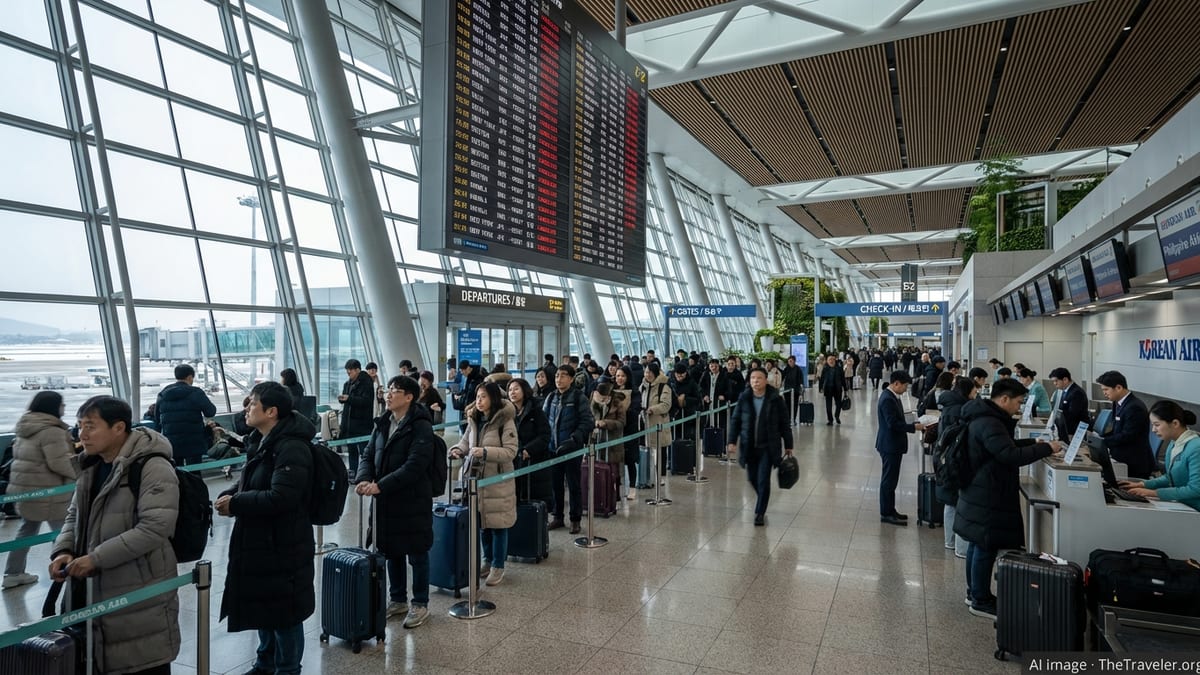
Passengers heading to and from New York and Boston were among the hardest hit. At Incheon International Airport, check in lines formed early as travelers learned that their overnight flights to the United States had been pulled, in some cases after they had already cleared security. Airline staff worked to reroute customers via West Coast gateways such as Los Angeles, or through alternative Asian hubs in Tokyo and Taipei, but available seats quickly became scarce.
For many, the cancellations meant losing critical time on short business trips or family visits. Corporate travelers bound for Monday morning meetings in Manhattan and Boston’s financial district faced rebookings that would not land them until well into the work week, forcing some to shift to virtual participation or postpone engagements altogether. Others on tight vacation schedules found that even a 24 hour delay would cut deeply into already short itineraries.
On the return side, East Coast based Koreans and Filipinos attempting to get back to Seoul or Manila encountered a maze of disrupted connections. With New York’s major airports and Boston Logan already operating at reduced capacity due to snow and high winds, options to fly westward via Europe or the West Coast were heavily oversubscribed. Several travelers interviewed at Incheon described overnight stays in transit hotels after misaligned connections left them stranded mid journey.
Those with separate tickets or nonchangeable fares faced the additional challenge of coordinating between multiple airlines, often with differing waivers and rebooking rules. In some instances, passengers who had pieced together self connecting itineraries saw one leg canceled while another remained scheduled, leaving them to shoulder the cost of last minute changes out of pocket.
Knock On Effects Across Manila and Regional Asian Hubs
The decision by Philippine Airlines to pull two South Korea linked services reverberated quickly through its Manila hub. Travelers using Seoul and Busan as convenient gateways between North America and Southeast Asia found themselves funneled into already busy direct transpacific flights or asked to reroute via Japan, where carriers have also been grappling with knock on effects from US weather disruptions.
In Manila, terminal departure boards showed a smattering of cancellations and extended delays on routes tied to US bound connections, as ground handlers and airline operations teams worked to match aircraft, crew and passengers in a constantly shifting puzzle. Some travelers reported being offered rebookings several days out, a reflection of how little slack remains in late February schedules following a string of earlier winter storms.
Regional hubs such as Hong Kong and Taipei also felt the ripple, with seats on flights bridging Northeast Asia and the Philippines suddenly at a premium. Korean leisure travelers heading for beach holidays in Palawan or Cebu via Manila, as well as overseas Filipino workers transiting through Incheon on their way to contracts in North America and the Middle East, were among those forced to redraw their travel plans with little notice.
Industry analysts noted that while the absolute number of canceled flights remains modest, the specific routes involved are strategically important. Direct links between South Korea, Manila and the US East Coast tend to carry a mix of high yielding corporate traffic, VFR travelers visiting friends and relatives, and connecting passengers feeding into broader networks, amplifying the commercial and human impact of each scrubbed departure.
Airlines Roll Out Waivers as Pressure Builds on Operations
In response to the growing disruption, both Korean Air and Philippine Airlines introduced flexible rebooking policies for affected travelers. Passengers holding tickets on the canceled services were generally offered the option to move to alternative flights within a defined travel window without additional change fees, though fare differences still applied in some cases where only higher cabin classes remained available.
Travelers with itineraries touching storm hit US cities reported mixed experiences when it came to securing new seats. Those who booked directly with the airlines and monitored their reservations closely often received proactive notifications and were switched onto new routings before the most popular alternatives sold out. Others who purchased tickets through third party agents or online platforms sometimes learned of the changes only upon arrival at the airport, leaving fewer options on the table.
Operational teams at both carriers faced difficult trade offs as they juggled safety considerations, airport slot constraints and crew duty limits. With winter storms continuing to affect departure banks across the North Pacific, planners have little incentive to operate flights that are unlikely to secure timely access to congested arrival airports. At the same time, canceling creates a backlog of displaced travelers, requiring extra capacity in the days ahead to clear the queues.
Observers say that as severe weather events become more frequent and intense, airlines operating long haul networks between Asia and North America will increasingly rely on dynamic schedule management, pulling flights early when conditions deteriorate and building more buffer into crew and aircraft rotations. For passengers, that means continued volatility, but also the possibility of more transparent and timely communication when plans must change.
What Impacted Passengers Should Do Next
Travel planners advise that anyone booked on Korean Air or Philippine Airlines services from South Korea in the coming days, particularly on routes touching New York, Boston or Manila, should monitor their reservations closely and keep an eye on departure boards before heading to the airport. With schedules still in flux, even flights that appear confirmed now could be subject to last minute timing changes or aircraft swaps.
Experts recommend that travelers confirm their contact details with airlines so they can receive push notifications and text alerts, and that they download carrier mobile apps where possible. Those with flexible schedules may wish to volunteer for rerouting or later departures in exchange for travel credits, freeing up seats for passengers with urgent needs or immovable commitments.
For disrupted passengers still in transit, maintaining documentation is key. Keeping boarding passes, cancellation notices and any receipts for meals, hotels or ground transport will make it easier to submit reimbursement claims where they are permitted under airline policies. Travelers connecting across multiple tickets should pay particular attention to the terms of each booking, as protections and entitlements can vary widely between carriers and fare types.
With North Pacific travel demand set to remain strong into the spring and summer, the latest wave of cancellations serves as a reminder that even marquee routes between South Korea, the United States and the Philippines are vulnerable to sudden disruption. For many global travelers, building in buffers, choosing through tickets where possible and staying informed will be essential tools for navigating an increasingly unpredictable skies.