

More news on this day
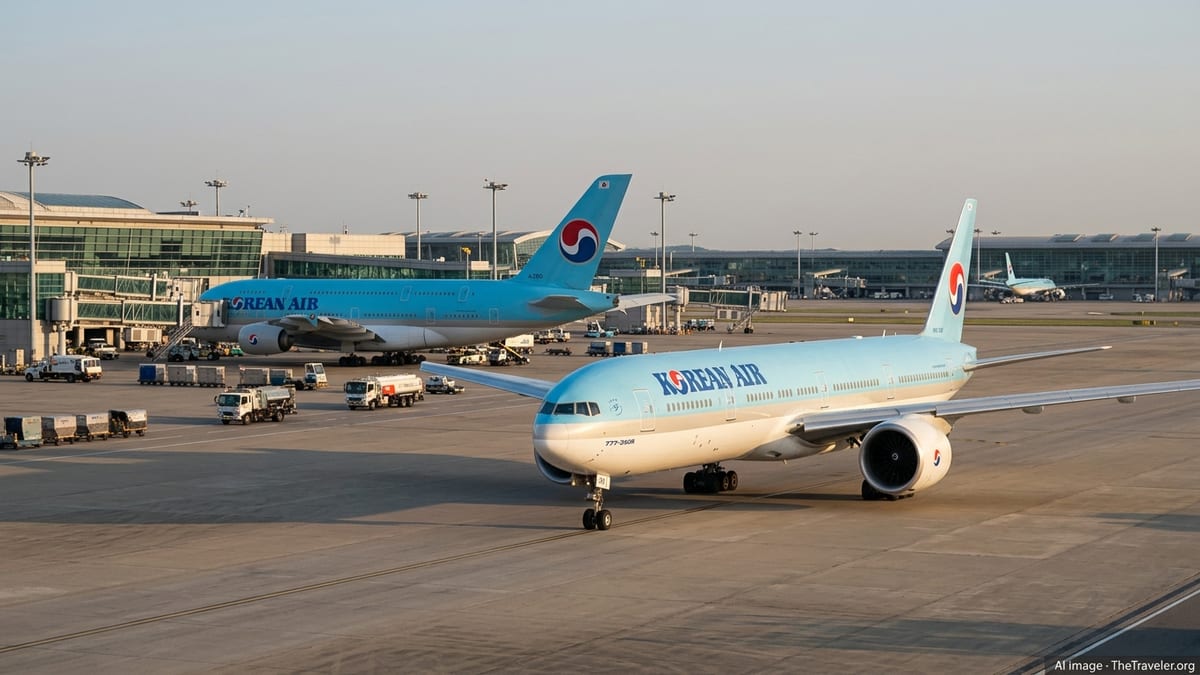
Korean Air is reshaping its long-haul network by withdrawing the Airbus A380 from several flagship intercontinental routes and relying more heavily on the Boeing 777-300ER, a shift that reflects evolving fleet strategy, demand patterns and regulatory pressures following its merger with Asiana Airlines.
Get the latest news straight to your inbox!
What Is Changing on Korean Air’s Global Network
Published schedules and route analyses for the northern summer 2025 season show Korean Air systematically phasing out A380 operations on some of its biggest long-haul city pairs, particularly in North America. On the Seoul Incheon to New York JFK route, which has long been a showcase for the double-decker, filings indicate that from March 30, 2025, Korean Air plans to operate two daily flights with Boeing 777-300ER aircraft instead of the previously scheduled A380 service.
Similar adjustments are taking place on the carrier’s broader North American network. Route data for the same season highlights the 777-300ER replacing larger widebodies on multiple trunk routes, including the Atlanta service where the type will step in for the Boeing 747-8I. Capacity to Los Angeles, another historically important A380 market, is also being reshaped through a mix of 747-8I and 777-300ER operations, reducing the superjumbo’s presence on one of Korean Air’s busiest corridors.
Across the Atlantic, Korean Air has used the 777-300ER as the default long-haul workhorse on many European routes, with the A380 now appearing only intermittently in schedule filings. Even where the superjumbo is reintroduced for limited periods, as on certain Frankfurt services, updates suggest that the 777-300ER is increasingly the baseline aircraft, underscoring a structural move away from quad-engine types on most intercontinental flights.
In Asia-Pacific, the pattern is similar. Schedules for Sydney, San Francisco and Vancouver over the next two northern summer seasons point to a progressive shift from 777-300ER to newer twinjets such as the Boeing 787-10 and Airbus A350-900, while A380 deployments are concentrated on shorter, high-density regional sectors like Hong Kong and Taipei rather than global flagship routes.
Why Korean Air Is Pulling Back the A380
The retreat of the A380 from major long-haul routes at Korean Air is part of a broader industry trend away from very large, four-engine aircraft. Publicly available fleet data indicates that the airline originally planned to retire its A380s around 2026, only to delay that timeline due to aircraft delivery bottlenecks affecting both Airbus and Boeing. With new twin-engine widebodies arriving more slowly than expected, Korean Air continued to operate both A380s and Boeing 747-8Is longer than first intended.
Pressure linked to the Asiana Airlines merger has added another layer of complexity. Competition remedies in key markets, particularly Europe, have required adjustments in capacity and slot usage, encouraging a move toward more flexible, lower-risk aircraft such as the 777-300ER. Analysts note that replacing the A380 with 777-300ERs on routes like New York and Los Angeles allows Korean Air to better match capacity to demand while maintaining frequency and connectivity through its Seoul hub.
Fuel efficiency and operating cost are also central to the shift. The 777-300ER, while not the newest design in the fleet, is significantly more economical per seat than the A380 on many stage lengths, especially when premium cabins are not consistently full. With long-haul yields under pressure and competition intensifying from Gulf, European and Japanese carriers, Korean Air is prioritizing flexibility and cost control over the prestige associated with operating the world’s largest passenger aircraft.
Finally, the evolving role of the A380 within the combined Korean Air–Asiana group is influencing network decisions. Reports indicate that while Asiana continues to operate A380s on select routes, Korean Air’s own schedules increasingly treat the type as a niche, supplementary capacity tool rather than a flagship aircraft, making the 777-300ER the backbone of the merged long-haul operation.
How the 777-300ER Will Change the Onboard Experience
For passengers accustomed to the spacious upper deck and large lounge areas of the A380, the shift to the 777-300ER will feel different, but not necessarily like a downgrade. Korean Air’s 777-300ERs feature competitive premium cabins, and the airline has been revising its retrofit plans to balance capacity with comfort. Industry coverage in late 2025 detailed how Korean Air backed away from a widespread move to denser 3-4-3 seating in economy on most refurbished 777-300ERs, instead preserving a roomier 3-3-3 layout on the majority of aircraft.
In business class, the 777-300ER fleet offers fully flat seats with direct aisle access on many long-haul configured jets, along with updated inflight entertainment systems. While the A380’s first class suites and distinctive onboard ambiance have been a draw for aviation enthusiasts, seat maps and cabin plans show that Korean Air has focused its most recent product investments on twinjets such as the 777-300ER and 787 family, where passenger volumes are highest.
From an operational standpoint, travelers are likely to see more consistent cabin products across the long-haul network as the 777-300ER assumes a larger role. This should reduce the variability that came with mixing A380s, 747-8Is and multiple generations of 777s and A330s on similar routes. For frequent flyers, that consistency can translate into more predictable seat selection, service patterns and upgrade opportunities, even if the aircraft itself is smaller than the A380.
However, some experiential aspects will inevitably change. The A380’s quieter cabin, particularly on the upper deck, and the sense of space created by its wide fuselage are difficult to replicate on a twin-engine jet. Travelers who prioritize those qualities may seek out the remaining A380 flights within the Korean Air and Asiana networks while they are still available.
Where the A380 Still Flies and What Comes Next
Despite its withdrawal from several marquee routes, the A380 is not disappearing overnight from Korean Air’s schedules. Recent timetable filings for 2025 and 2026 show the aircraft continuing to operate select regional and long-haul services on a limited basis, including seasonal deployments to Frankfurt and high-demand Asian hubs. These appearances are often short-lived and subject to change, underlining the transitional nature of the current fleet plan.
For now, Korean Air is using the A380 where it can reliably fill the extra capacity or where slot constraints make larger aircraft more attractive. At the same time, it is steadily expanding the role of newer, more efficient types such as the Airbus A350-900 and Boeing 787-10. On routes like San Francisco, Sydney and Vancouver, schedule comparisons between the 2025 and 2026 northern summer seasons highlight a pivot from the 777-300ER to these next-generation twinjets, suggesting the 777 itself will gradually shift from growth aircraft to a bridge between the A380 era and a younger widebody fleet.
Looking ahead, the long-term direction is clear even if the exact retirement dates are not. Statements from Korean Air leadership and fleet plans disclosed in industry reports indicate that both the A380 and remaining four-engine aircraft are intended to leave the fleet before the end of the decade, contingent on the timely delivery of replacement jets. Until that happens, travelers can expect further fine-tuning of aircraft assignments, with the 777-300ER maintaining a central role on Korean Air’s most important intercontinental routes.
For passengers planning trips over the next two years, the key takeaway is that aircraft types on Korean Air itineraries may continue to shift as the airline adapts to market conditions and integration with Asiana. Checking current schedules close to departure will be essential for those specifically seeking, or seeking to avoid, flights operated by the A380, while the reliable presence of the 777-300ER will increasingly define the long-haul Korean Air experience.