

More news on this day
Korean Air is sharpening its competitive edge in the resurgent China–South Korea travel market by expanding recruitment of bilingual cabin crew in key Chinese hubs, positioning itself to capture rising demand on routes linking Beijing, Shanghai and Guangzhou with Korean cities.
Get the latest news straight to your inbox!
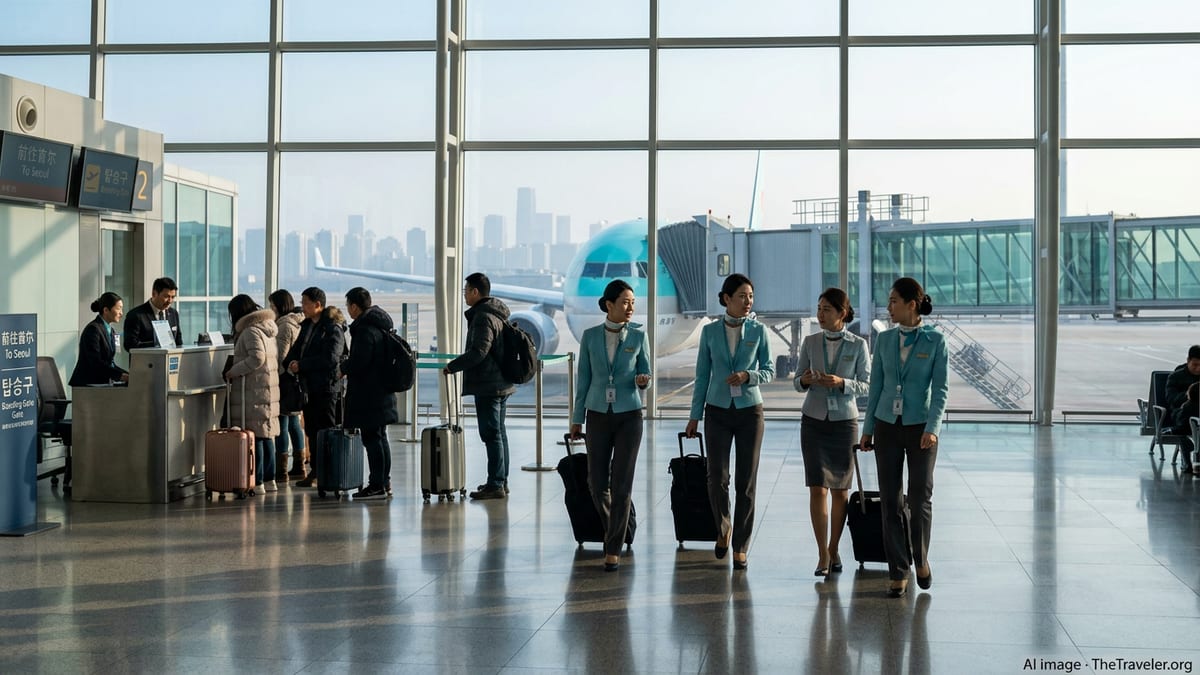
New Hiring Push in China’s Largest Gateway Cities
Publicly available recruitment materials and industry coverage indicate that Korean Air has resumed and widened hiring of foreign cabin crew, with a particular focus on candidates proficient in Chinese and Korean, alongside English. This latest phase places special emphasis on China’s three primary gateway cities of Beijing, Shanghai and Guangzhou, where the airline already operates dense schedules and sees some of its strongest regional demand.
The airline’s broader hiring drive follows a sector-wide rebound in air travel, as Korean carriers add capacity and prepare for a structurally larger combined network after Korean Air’s acquisition of Asiana Airlines. Market reports describe a clear shift from pandemic-era cuts to proactive recruitment, especially for front-line roles that directly influence passenger experience, such as flight attendants.
Bilingual and trilingual applicants are being prioritized to staff routes where passenger mixes are increasingly diverse. For Chinese markets, that typically means cabin crew who can handle service and safety communication in Mandarin or Cantonese, in addition to Korean and English, reflecting the realities of multinational tour groups, business travelers and transit passengers.
While detailed headcounts are not disclosed, information from aviation hiring platforms and training organizations suggests that Korean Air has been steadily increasing the number of foreign flight attendants since 2023 and aims to build on that momentum in 2025 and 2026. The renewed focus on China-specific language skills fits into this wider pattern.
Visa-Free Travel and Surging China–Korea Demand
The recruitment push in Beijing, Shanghai and Guangzhou comes at a time of notable recovery in travel between China and South Korea. After China introduced temporary visa-free entry for South Korean visitors from November 2024, traffic on China–Korea routes accelerated, particularly to coastal and southern Chinese cities that are popular with Korean leisure travelers.
According to recent coverage from Chinese and Korean media, Korean Air’s operations in China expanded markedly through 2024 and early 2025, with capacity growth concentrated on major economic centers such as Beijing and Shanghai, as well as warmer southern gateways including Guangzhou and Shenzhen. The airline’s China regional leadership has publicly highlighted double-digit growth in passenger volumes compared with the previous year.
On the Chinese side, simplified entry rules have encouraged more short-stay trips for shopping, business meetings and family visits, often booked at short notice. Airlines are adapting by adding early-morning and late-night departures and by tightening turnaround times. In this environment, onboard communication becomes more complex, as crews must manage a mix of first-time international flyers, package tourists and seasoned business travelers, often within a single cabin.
Industry observers note that this combination of policy tailwinds and pent-up demand has made language-savvy cabin crew a strategic asset. The ability to communicate fluently with both Korean and Chinese passengers can reduce misunderstandings, speed up service and help manage irregular operations, which in turn supports on-time performance and customer satisfaction metrics.
Why Bilingual Cabin Crew Matter on China Routes
Korean Air’s emphasis on recruiting bilingual cabin crew in Beijing, Shanghai and Guangzhou aligns with long-standing practices in Asian aviation, where carriers often tailor hiring to specific language markets. Safety briefings, medical assistance, special meal coordination and disruption handling are all more effective when delivered in a passenger’s native tongue, particularly on routes with high proportions of local travelers.
On busy China–Korea sectors, cabin crew typically juggle Korean, Chinese and English throughout a flight. Bilingual flight attendants can bridge cultural as well as linguistic gaps, helping explain cabin procedures, duty-free regulations or customs forms, and smoothing potential points of friction such as baggage rules or seat changes. For families traveling with children or elderly relatives, being able to speak directly with crew in Chinese can be especially valuable.
Language skills are also closely tied to commercial performance. Airlines routinely rely on cabin crew to support onboard sales of ancillary products, from duty-free items to seat upgrades. In markets like China, where brand preferences and consumer expectations may differ from those in Korea, crews who understand local norms and can converse fluently can help personalize recommendations and build repeat business.
From an operational perspective, deploying multilingual crews reduces the need for ad hoc translation by ground staff and enables more flexible rostering. As Korean Air fine-tunes its merged network with Asiana, a deeper bench of Chinese-speaking attendants should make it easier to adjust capacity on short notice across different Chinese gateways.
What Applicants in Beijing, Shanghai and Guangzhou Can Expect
For would-be cabin crew based in China, Korean Air’s current strategy translates into new entry points into a traditionally competitive career track. Application information shared through airline job boards and specialist recruitment portals indicates that candidates are generally expected to hold at least a college-level education, meet prescribed height and health standards, and possess strong proficiency in required languages, often evidenced by standardized test scores.
In practice, this means Chinese nationals who grew up bilingual in Mandarin and Korean, or who have studied in South Korea, are particularly well positioned. English remains a core requirement for international aviation operations, so candidates with verifiable English proficiency, in addition to Chinese and Korean, are likely to stand out. Training institutes that prepare applicants for Korean cabin crew roles report a growing share of students from mainland China’s major cities.
Once selected, new hires typically undergo several months of intensive training covering safety procedures, emergency response, service protocols and cultural orientation. For those recruited in Beijing, Shanghai or Guangzhou, the curriculum places special weight on cross-cultural communication between Chinese and Korean passengers, as well as on handling common service situations on short- to medium-haul regional flights.
While posting patterns can vary, aspiring crew should expect to operate not only on China–Korea routes but also on broader regional and long-haul services over time, especially as Korean Air integrates Asiana’s network and fleet. Experience gained in China’s largest aviation markets may therefore serve as a springboard to a global flying roster.
Strategic Implications for the China–Korea Travel Corridor
Korean Air’s targeted recruitment in Beijing, Shanghai and Guangzhou underscores how crucial the China–Korea corridor has become to the airline’s long-term strategy. China already ranks among Korean Air’s most important international markets by number of destinations served, and the merger with Asiana consolidates that presence by combining overlapping networks and aircraft types.
As competitive pressure intensifies from Chinese carriers and other low-cost airlines, service quality and reliability are likely to become decisive differentiators. By investing in bilingual cabin crew and tailoring staffing to the linguistic needs of Chinese travelers, Korean Air is effectively betting that higher-touch service and smoother onboard communication will justify premium fares and strengthen its appeal to both leisure and corporate clients.
The focus on language skills also dovetails with broader workforce trends in aviation, where airlines are seeking more diverse and internationally minded teams. Foreign cabin crew recruitment, including in China, is one way to reflect the passenger base onboard and to signal commitment to key markets.
For travelers, the immediate impact is likely to be felt in small but meaningful ways: clearer announcements in Chinese, more nuanced assistance with connections or irregularities, and a greater sense of comfort for passengers who may be flying internationally for the first time. For Korean Air, those incremental improvements could add up to a stronger foothold in China just as travel flows between the two countries move back toward pre-pandemic levels and beyond.