

Kos Town blends ancient history, medieval intrigue and relaxed island living into one walkable waterfront capital.
At its heart lies Kos Old Town, a dense tangle of lanes where Greek, Ottoman and Italian eras layer over a much older classical city.
From the palm-lined harbor to Hellenistic mosaics, from the fabled plane tree of Hippocrates to contemporary café culture, this compact town rewards travelers who slow down, wander on foot and look closely at the stones beneath their feet.
This guide explores the story of Kos Town, highlights key sights, and suggests walking routes that bring its past and present to life.
The Story of Kos Town Across the Centuries
The history of Kos Town begins in classical antiquity, when the island emerged as a Dorian colony and later a key member of the Athenian-led Delian League.
In the 4th century BC the capital was relocated and laid out on a rational grid plan, a reflection of the island’s prosperity and its importance as a maritime and trading hub in the southeastern Aegean.
This was also the era when the sanctuary of Asklepieion on the hills above town developed into a celebrated healing center linked with the physician Hippocrates.
In the Hellenistic and Roman periods Kos Town grew into a refined provincial city known for its medical and philosophical schools.
Benefiting from strategic alliances with the Ptolemaic rulers of Egypt, it functioned as both a naval outpost and a place of learning where royal heirs were educated.
Archaeological remains scattered through modern Kos Town hint at that sophistication, from fragments of colonnaded streets to elaborate floor mosaics and public baths.
From the medieval era onward, layers of new powers reshaped the town. Genoese interests, then the Knights Hospitaller of St John, transformed the harbor area into a fortified maritime bastion.
Repeated Ottoman attacks culminated in the conquest of Kos in the 16th century, ushering in centuries of Ottoman influence that left mosques, fountains and houses around the Old Town.
In 1912, Italian rule brought a new urban vision, especially after a devastating earthquake in 1933 prompted wide-scale reconstruction and archaeological clearance.
Modern Kos Town was largely built in the 20th century but still traces the outlines of its ancient street grid. Public buildings from the Italian period display rationalist and eclectic architectural styles, while postwar tourism has added hotels, cafes and beach infrastructure.
Earthquakes in 2017 damaged some monuments, including parts of the medieval castle and several churches and mosques, but ongoing restoration continues to shape the townscape.
Today visitors experience this long chronology in a single walk, moving within minutes from ancient temples to Ottoman squares and lively modern promenades.
Orientation: Harbor, Old Town and Archaeological Zone
Kos Town is compact and easily explored on foot. The waterfront curves gently around a natural harbor, with ferries and excursion boats moored along the quayside.
From here, palm-lined Akti Kountouriotou and Akti Miaouli form a busy seafront strip with cafes, tavernas and bike rental shops, while the skyline is dominated by the robust stone walls of the medieval Castle of the Knights at the harbor entrance.
Just behind the waterfront lies the Old Town: a maze of narrow streets centered roughly around Eleftherias Square and the nearby market hall.
This area mixes low-rise traditional houses, Italian-era public buildings and Ottoman-era monuments. Lanes are packed with small shops, cafes and bars that stay lively well into the night in summer.
Although highly commercial in places, it still offers pockets of local life, including family-run bakeries and neighborhood grocery stores away from the main shopping streets.
North and east of the Old Town spreads the main archaeological zone. Here, modern traffic yields to open excavations where the ancient agora, Roman houses and early Christian basilicas lie exposed among pine and eucalyptus trees.
The area functions almost like an open-air museum threaded by quiet paths. To the south and west, modern Kos Town extends into residential streets, hotels and beaches, including the popular town beach running west from the harbor and the tree-lined avenue leading toward the Asklepieion in the hills above.
Most visitors will find that staying within or near the Old Town and harbor area allows for easy exploration on foot. Distances are modest: crossing from the waterfront to the far side of the main archaeological park typically takes less than 20 minutes.
Bicycles are a favored local mode of transport, and several dedicated cycling lanes make it convenient to pedal between town, nearby beaches and outlying neighborhoods.
Highlights of Kos Old Town
Eleftherias Square forms a natural starting point for exploring Kos Old Town. Created and reshaped during the Italian administration, it is framed by the former Italian market hall, an archaeological museum housed in an imposing neoclassical building, and a former mosque that reflects the Ottoman heritage of the island.
Cafes spill onto the paving stones, and in the evening locals mingle with visitors for a promenade and people-watching.
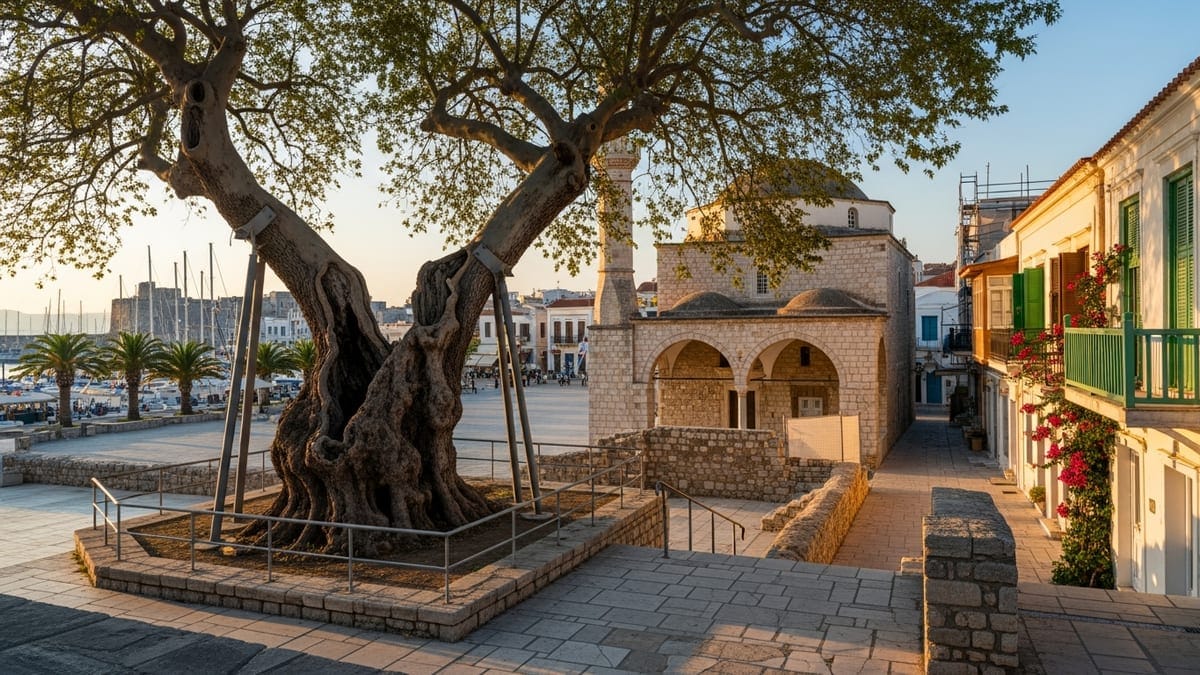
A short walk from the square brings visitors to Plateia Platanou, the square of the plane tree. Here stands the celebrated Plane Tree of Hippocrates, a centuries-old oriental plane whose hollow trunk and massive branches are propped by metal supports.
Local tradition holds that Hippocrates taught his students medicine beneath an earlier tree on this site.
Whether or not the legend is literally true, the spot captures the enduring association of Kos with medical learning, and many visiting physicians and students consider it a minor pilgrimage.
Adjacent to the tree is the Gazi Hasan Pasha Mosque, also known as the Loggia Mosque, an 18th-century Ottoman structure that speaks to the island’s multicultural past.
Though no longer functioning as a mosque, its stone and marble details and elegant arcade evoke the centuries when Kos lay within the Ottoman realm.
Nearby, small lanes lead into residential quarters where traditional island houses, some with wooden balconies and enclosed courtyards, retain a quieter, more local atmosphere.
South of Eleftherias Square and running through the Old Town are narrow commercial streets that form the heart of Kos Town’s retail scene. Here modern boutiques share space with shops selling local products such as honey, herbs, olive oil and wine.
Despite the holiday atmosphere, it is worth pausing to notice architectural details: lintels that reuse ancient stones, Italian-era facades with geometric decoration, and occasional surviving Ottoman houses with carved doorframes and shaded verandas.
Ancient Agora and the Roman Quarter
Just east of the harbor and a few steps from the Plane Tree of Hippocrates lies the archaeological site of the ancient agora, once one of the largest marketplaces in the Greek world. Today it presents a patchwork of foundations, partial columns and mosaic fragments that reward unhurried exploration.
The agora originally stretched along a vast rectangular space that served as the commercial and civic heart of classical Kos, linking the harbor with the inner city.
Wandering the site, visitors can trace outlines of stoas, shrines and workshops that lined the central open area. The proximity to the harbor highlights the agora’s dual role as both trading hub and ceremonial gateway to the city.
Scattered blocks bearing inscriptions and carved motifs, along with re-used architectural elements in later structures, show how the city’s stone fabric was repeatedly recycled across the centuries.
To the south and west of the agora, the archaeological zone merges into the Roman quarter, where well-preserved mosaics and building plans offer a vivid glimpse of urban life in imperial times.
Among the most notable remains are the Casa Romana, an excavated Roman villa with elegant peristyle courtyards and polychrome floor mosaics depicting marine scenes and mythological figures.
Another nearby site, often referred to as the Roman Odeon, preserves the semi-circular seating of a small roofed theater used for performances and civic gatherings.
Together, the agora and Roman quarter convey the scale and sophistication of ancient Kos. Unlike some more heavily reconstructed sites, much of this area retains a slightly wild character, with grass and trees weaving through the ruins.
This makes it particularly atmospheric in the early morning or late afternoon, when the light is soft and the tour groups thin out, allowing travelers to imagine colonnades, porticoes and crowds where now only stone fragments remain.
The Medieval Harbor and Castle of the Knights
Guarding the entrance to Kos Town’s harbor is the impressive Castle of the Knights, also known as Nerantzia Castle.
Constructed by the Knights Hospitaller beginning in the 15th century, it stands on a low promontory separated from the town by a former moat, now crossed by a broad causeway lined with palm trees.
The fortress was part of a wider defensive network across the Dodecanese, intended to secure Christian maritime routes against Ottoman expansion.
The castle’s massive basalt and limestone walls incorporate many spolia, or reused blocks, from the ancient city and the Asklepieion. Carved column drums, inscriptions and decorative fragments are clearly visible in the masonry, creating a startling collage of classical, medieval and later eras.
Within the outer and inner enceinte, traces of barracks, storage rooms and gun emplacements recall the site’s military function through the late Middle Ages and into early modern times.
In recent years, seismic activity has affected the structural stability of parts of the castle, prompting ongoing restoration and conservation projects.
During certain periods, including recent seasons, access to the interior has been restricted or fully closed for safety and repair work, though visitors can still appreciate the bulk of the walls from the harbor and stroll along the outer perimeter.
Checking current local information on arrival is advisable to confirm whether the interior is open during a particular visit.
Even when the main fortress is closed, the harbor area around it remains a highlight of Kos Town. Fishing boats, excursion craft and yachts cluster along the quays, while cafes and tavernas enjoy views across to the Turkish coast and nearby islets.
Evening is especially atmospheric as the sun sets behind masts and the stone of the castle takes on warm tones. For many travelers, this waterfront, with the fortress looming above, forms the defining image of Kos Town.
Walking Routes Through History
Kos Town is best understood on foot, and a few simple walking routes help structure exploration. A classic introductory walk begins at the harbor, crosses the palm-lined causeway beside the castle, then curves around Plateia Platanou to pause at the Plane Tree of Hippocrates.
From there, the route continues into Eleftherias Square, where visitors can step inside the archaeological museum before drifting into the adjoining lanes of the Old Town for a leisurely circuit of shops, cafes and side streets.
A second walk focuses on the ancient city. Starting again at Plateia Platanou, one can enter the archaeological zone of the ancient agora, tracing paths among the low walls and colonnades.
Continuing south and west, this route reaches the Roman Odeon and Casa Romana, where tickets may allow combined or separate entry depending on current arrangements.
The path then loops back toward the Old Town via quiet residential streets that reveal more of everyday island life away from the busiest tourist corridors.
For those with energy to spare, a longer excursion links Kos Town with the Asklepieion, the ancient healing sanctuary associated with the cult of Asklepios.
Although many visitors take a taxi or organized tour, it is also feasible to walk, especially in cooler months, following roads that gradually climb above the town to reach the wooded archaeological site.
From the sanctuary terraces, views stretch back over Kos Town, the harbor and the Turkish coastline, tying together geography and history in a single panorama.
Even without set itineraries, travelers should allow time simply to wander. Some of the most memorable scenes appear unexpectedly: a fragment of mosaic beside a modern house, a quiet courtyard chapel open for a local feast day, or an elderly resident tending potted plants on a sunlit balcony.
The scale of Kos Town invites repeated rambles at different times of day, each revealing a slightly different mood.
Beaches, Cafes and Everyday Life in Kos Town
Beyond its historical landmarks, Kos Town serves as a living island capital, and part of its charm lies in the blend of daily routines and holiday relaxation. West of the harbor, the town beach offers an easily accessible stretch of sand and pebbles backed by cafes and snack bars.
While not as secluded or dramatic as some beaches elsewhere on the island, it is convenient for a quick swim between sightseeing stops or an evening stroll when the heat of the day has faded.
Cafes and bakeries throughout the Old Town and along the waterfront provide opportunities to sample local flavors. Traditional sweets, savory pies and coffee culture coexist with modern international offerings.
Early mornings find residents shopping at local markets or sharing conversation over thick Greek coffee, while evenings bring a more international crowd to cocktail bars and waterfront tavernas. Despite the tourist focus, there remain corners where the pace is slower and local rhythms dominate.
Markets and small grocery shops stock island products that make thoughtful souvenirs or provisions for day trips.
Honey from Kos and neighboring islands, oregano and mountain teas, local cheeses and regional wines reflect the agricultural backbone that complements the tourism economy.
Spotting labels from small producers and asking shopkeepers for recommendations can lead to discoveries that reach beyond standard resort fare.
Seasonality shapes life in Kos Town. In the high summer months of July and August, the waterfront throngs with visitors arriving on ferries and excursion boats, and nightlife stretches late into the night.
Shoulder seasons in late spring and early autumn can be particularly rewarding for travelers who prefer milder temperatures and a more relaxed atmosphere, with enough activity to keep the town lively but not overwhelming.
Practical Tips for Visiting Kos Town
Most international visitors arrive in Kos via the island’s airport, which sits southwest of Kos Town, or by ferry from other Aegean islands and the Greek mainland.
From the port, it is a short walk into the heart of town, and taxis and local buses connect to outlying resorts. Given the compact size of the center, visitors who stay in or near the Old Town can comfortably explore without a car, using public transport or rented bicycles to access beaches and villages further afield.
Kos experiences a classic Mediterranean climate, with hot, dry summers and mild winters. Peak heat generally arrives in July and August, when afternoon temperatures can be intense in exposed archaeological sites.
In these months, early morning and late afternoon are the most comfortable times for walking tours, with midday reserved for swimming or shaded cafes. Spring and autumn bring more temperate conditions ideal for extended urban walks and excursions to the Asklepieion and inland villages.
Many of Kos Town’s key monuments are part of managed archaeological zones or heritage properties that may be affected by ongoing restoration work, particularly following seismic events.
As a result, opening hours and levels of access can change from season to season. On arrival, checking at local information offices, museums or visitor centers provides the most accurate picture of which sites are fully open, which are partially accessible and which remain closed for safety or conservation.
Respect for local customs and religious sites enhances any visit. Churches and former mosques, even when used mainly as historic landmarks, may occasionally host services or events.
Modest dress is advisable when entering such spaces, and photography rules vary by location. As in many popular destinations, visitors should also remain mindful of residents’ privacy in residential lanes and courtyards, keeping noise and intrusive photography to a minimum.
The Takeaway
Kos Town and its Old Town core offer far more than a convenient base for beach days and boat trips. Within a relatively small area, the town encapsulates the long story of the eastern Aegean, from classical grids and Roman villas to crusader fortresses, Ottoman squares and Italian-era urban planning.
Its archaeological sites invite reflection on medicine, trade and daily life in antiquity, while its modern waterfront and cafe culture illustrate how the island continues to adapt to changing times and visitors.
For travelers willing to walk slowly, look closely and move beyond the main shopping streets, Kos Old Town reveals layers of subtle detail.
An inscription reused in a medieval wall, a mosaic half-hidden by trees, or a quiet square where children play under centuries-old stones all contribute to an experience that feels both historical and human-scale.
Combined with easy access to beaches, island-wide excursions and a well-developed visitor infrastructure, Kos Town becomes not just a transit point, but a rewarding destination in its own right.
FAQ
Q1: How much time should I allow to explore Kos Old Town and the main sights on foot?
Most visitors find that a full day is enough to see the principal highlights at a relaxed pace, including the Plane Tree of Hippocrates, Eleftherias Square, the ancient agora and parts of the Roman quarter. However, adding an extra half day or more allows time to revisit favorite areas, enjoy museum visits and include a swim or extended cafe stop without rushing.
Q2: Is Kos Town suitable for travelers who prefer walking and do not want to rent a car?
Yes, Kos Town is particularly well suited to car-free travel. The historic center, harbor and main archaeological sites are all within comfortable walking distance of one another, and local buses or taxis can be used for excursions to beaches, villages and the Asklepieion. Many visitors choose to rent bicycles instead of cars for additional flexibility.
Q3: Can I visit the Castle of the Knights inside, and what should I know about access?
Access to the interior of the Castle of the Knights can vary depending on ongoing restoration and safety assessments. At times the fortress has been closed for conservation, while at other times certain sections are open to visitors. Even when the interior is closed, the exterior walls and harbor views remain accessible. On arrival, it is advisable to inquire locally about current conditions and any visiting hours.
Q4: What is special about the Plane Tree of Hippocrates, and is it really that old?
The Plane Tree of Hippocrates is significant because local tradition associates it with Hippocrates teaching his students in antiquity. The current tree itself is several centuries old rather than dating from classical times, but it is likely a descendant of earlier trees on the same site. Its great age, hollow trunk and symbolic connection with the history of medicine make it a popular and evocative landmark.
Q5: Are the archaeological sites in Kos Town suitable for children and casual visitors, or mainly for specialists?
The archaeological sites in and around Kos Old Town are accessible and engaging for a broad audience. Children often enjoy the open spaces, ruins and mosaics, while casual visitors can appreciate the scale and atmosphere even without detailed prior knowledge. Information panels at key locations help explain the significance of different structures, and combining site visits with breaks in nearby parks or cafes makes exploration manageable for families.
Q6: When is the best season to explore Kos Old Town and its walking routes?
Late spring and early autumn are particularly pleasant times for walking in Kos Town, offering warm but not extreme temperatures and generally lighter crowds than peak summer. In July and August, early morning and late afternoon provide the most comfortable conditions for exploring on foot, with midday better suited to swimming or shaded rest. Winter brings cooler, sometimes unsettled weather but far fewer visitors, offering a quieter experience for those who do not mind variable conditions.
Q7: How easy is it to combine cultural sightseeing in Kos Town with beach time?
It is very easy to combine culture and relaxation in Kos Town. The town beach begins a short walk west of the harbor, so visitors can move quickly between archaeological sites, Old Town streets and the seafront. Many travelers structure their day with a morning dedicated to history and walking, followed by afternoon swimming or sunbathing, then a return to the Old Town or harbor area for dinner and evening strolls.
Q8: Are guided walking tours available, or is it better to explore independently?
Both options work well, depending on individual preference. Guided walking tours, when available, can provide valuable context, stories and orientation, especially for first-time visitors with limited time. However, the town’s layout is straightforward and many travelers enjoy exploring independently using basic maps or self-guided routes. A combination is often ideal: an initial guided tour followed by independent wandering on subsequent days.
Q9: What should I wear and bring for a day of walking in Kos Town?
Comfortable walking shoes or sandals with good grip are important, as some lanes and archaeological areas have uneven surfaces. Light, breathable clothing, a hat and sun protection are essential in warmer months. A reusable water bottle helps maintain hydration, and a small daypack can hold essentials such as a camera, a light cover-up for visiting churches and any items purchased along the way.
Q10: Is Kos Old Town accessible for travelers with limited mobility?
Accessibility varies across Kos Old Town. Main streets, the harbor promenade and central squares are relatively level and paved, making them more manageable for travelers with mobility challenges. However, some archaeological zones, narrow lanes and older structures involve uneven ground, steps or slopes. Those with specific mobility needs may wish to research particular sites in advance and consider guided visits or assistance to make the most of what the town can offer.