

More news on this day
Hundreds of passengers were stranded at Kuwait International Airport today as 38 flights were canceled amid widening airspace closures linked to the Iran war, disrupting services by IndiGo, Qatar Airways, Egypt Air, Gulf Air, FlyDubai and other major carriers across key hubs in Kuwait, Qatar, Bahrain, Egypt, the United Arab Emirates and beyond.
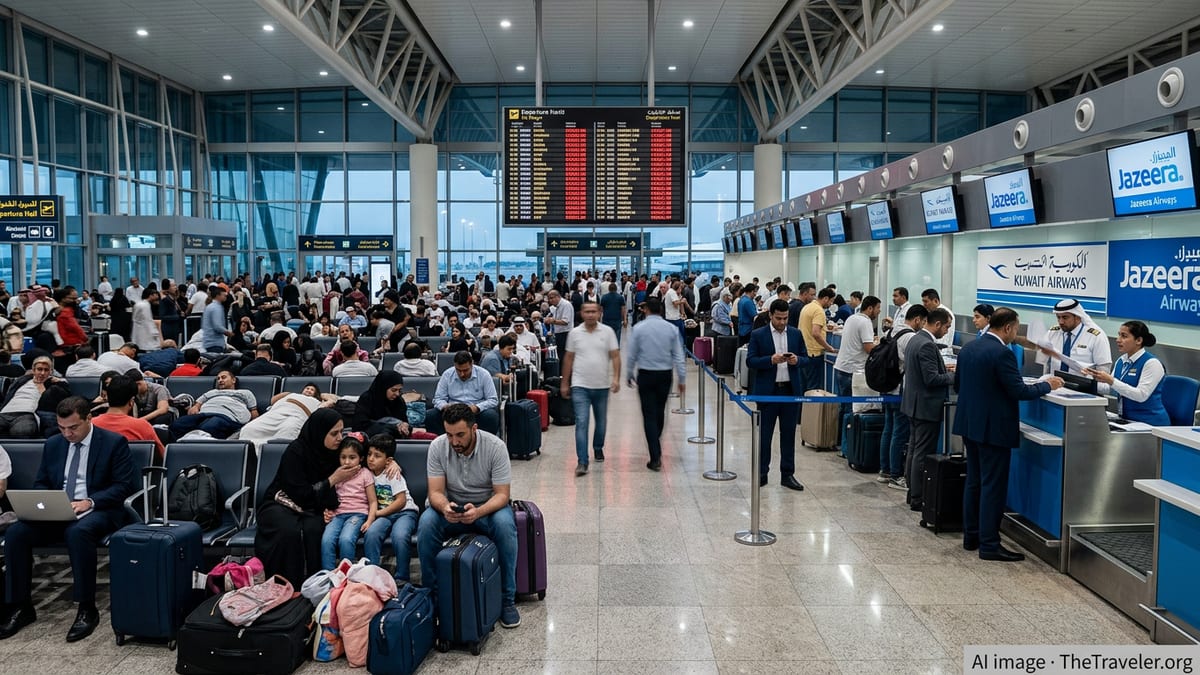
Wave of Cancellations Hits Kuwait International Airport
Kuwait International Airport, a critical gateway for Gulf and South Asian traffic, saw 38 flights scrubbed from schedules today, according to airport and aviation industry sources. The sudden wave of cancellations left departure halls crowded with anxious travelers, many of whom had already endured days of uncertainty as the regional crisis deepened.
Ground staff reported long queues at airline counters from early morning, with passengers seeking rebooking options or refunds as information boards filled with red "canceled" notices. Several flights operated by Gulf-based carriers, including Kuwait Airways, Jazeera Airways, Gulf Air and FlyDubai, were among those grounded, while services by IndiGo and other South Asian airlines were also affected on Kuwait routes.
The cancellations at Kuwait International are part of a broader pattern of disruption sweeping the Middle East’s aviation network since late February, as militarized tensions and airspace closures have forced airlines to suspend, reroute or dramatically curtail operations.
Airport officials said priority was being given to essential and emergency operations, with standard commercial schedules remaining highly constrained. Passengers were urged to avoid traveling to the airport without confirmed rebookings due to limited same-day options.
Regional Airspace Closures Ripple Across Gulf Hubs
The disruption in Kuwait is closely tied to a patchwork of airspace closures and restrictions imposed across the Gulf in recent days, including in Kuwait, Qatar, the United Arab Emirates, Bahrain and parts of Iraq and Iran. Aviation authorities have limited access to key flight corridors, citing security threats and the need to protect civilian traffic.
At Doha’s Hamad International Airport and Dubai International Airport, two of the world’s busiest transit hubs, hundreds of flights have been canceled or delayed, stranding travelers en route to Europe, Asia and Africa. Qatar Airways, Emirates, Etihad Airways and FlyDubai have all issued rolling updates warning of significant schedule disruption, even as some carriers begin operating limited repatriation or relief services.
Egypt’s Cairo International Airport and Bahrain International Airport are also seeing knock-on effects, as carriers such as Egypt Air and Gulf Air contend with rerouted flight paths and last-minute operational decisions. Industry analysts note that when multiple Gulf states simultaneously limit airspace, the result is a cascading effect that can shut down not just point-to-point routes, but also long-haul connections that rely on the region’s hub-and-spoke model.
The result today is a fragmented network in which airlines can operate only a fraction of their usual schedules. Even where runways are open, carriers are struggling to secure viable routings that avoid closed sectors while remaining economically and operationally feasible.
Stranded Passengers Face Uncertainty and Limited Options
For travelers on the ground in Kuwait, Qatar, Bahrain, Egypt and the UAE today, the crisis is being felt most acutely in crowded terminals and uncertain timelines. Many passengers at Kuwait International Airport reported receiving late-night or pre-dawn notifications that their flights had been canceled, only to discover that alternative departures were fully booked or not yet scheduled.
Families bound for work in the Gulf, students returning to universities, and tourists attempting to connect onward to Europe or Asia all described a scramble for information. Airline help desks have been inundated as staff attempt to juggle rebookings on a day when aircraft availability, flight paths and crew rosters are all in flux.
Similar scenes played out in Doha, Dubai and Cairo, where passengers on IndiGo, Qatar Airways, Egypt Air, Gulf Air and FlyDubai queued for hours to secure seats on limited relief flights or future departures. Some airlines have relaxed change penalties and are offering full refunds, but with seats at a premium and regional airspace still constrained, many travelers remain effectively stuck in transit.
Travel consultants say that passengers with flexible schedules and access to alternative routings via Europe or South Asia may fare better, but warn that options are narrowing fast as the crisis drags on and backlogs accumulate.
Airlines Balance Safety, Politics and Commercial Pressures
Behind the scenes, airlines serving Kuwait, Qatar, Bahrain, Egypt and the UAE are engaged in a complex balancing act between safety obligations, government directives and commercial realities. Safety managers are working closely with national aviation authorities and regional air traffic control centers to assess whether specific routes can be operated under evolving restrictions.
Carriers such as IndiGo, Qatar Airways and Gulf Air have already announced selective suspensions on routes crossing the most sensitive airspace, while studying possibilities for longer detours that bypass conflict zones. Such reroutings can add hours to flight times, significantly increasing fuel costs and forcing changes to crew duty schedules, aircraft rotations and airport slot allocations.
For full-service and low-cost carriers alike, the immediate financial toll is mounting. Dozens of grounded aircraft translate into lost ticket revenue just as airlines must shoulder the additional burden of passenger care, including hotel accommodation, meals and ground transport for those stranded. At the same time, reputational risks are high as travelers turn to social media to air frustrations over what many perceive as confusing or incomplete communication.
Industry observers note that most airlines are erring on the side of caution, particularly for overnight services and flights that would traverse multiple restricted zones. This conservative approach is widely supported by safety experts, but it comes at the cost of sharply reduced capacity across an already stretched network.
What Travelers Should Do If They Are Booked via Kuwait or Gulf Gateways
With schedules changing hour by hour, travel authorities and aviation experts are urging passengers to take a proactive approach if they are ticketed through Kuwait International Airport or other Gulf hubs in the coming days. The first step, they say, is to monitor flight status directly through airline channels instead of relying solely on third-party bookings or generic flight trackers.
Passengers are also being advised to prepare for extended layovers and potential overnight stays, particularly if their itineraries involve connections in Kuwait City, Doha, Dubai, Abu Dhabi, Manama or Cairo. Having access to essential medications, chargers, key documents and basic overnight supplies in carry-on luggage can ease the strain if bags are checked and flights are disrupted unexpectedly.
Travel agents recommend that those who have not yet begun their trips consider postponing nonessential travel through the region, or explore routings that avoid the most heavily affected airspace until conditions stabilize. For travelers with urgent needs to reach or leave the Gulf, booking flexible tickets and allowing extra time between connections can reduce the risk of becoming stranded.
For now, there is no clear timeline for a full restoration of normal flight operations across Kuwait and neighboring states. Aviation officials emphasize that decisions on reopening airspace and restoring regular schedules will depend on security assessments linked to the broader regional conflict, leaving passengers and airlines alike braced for continued turbulence in the days ahead.