

More news on this day
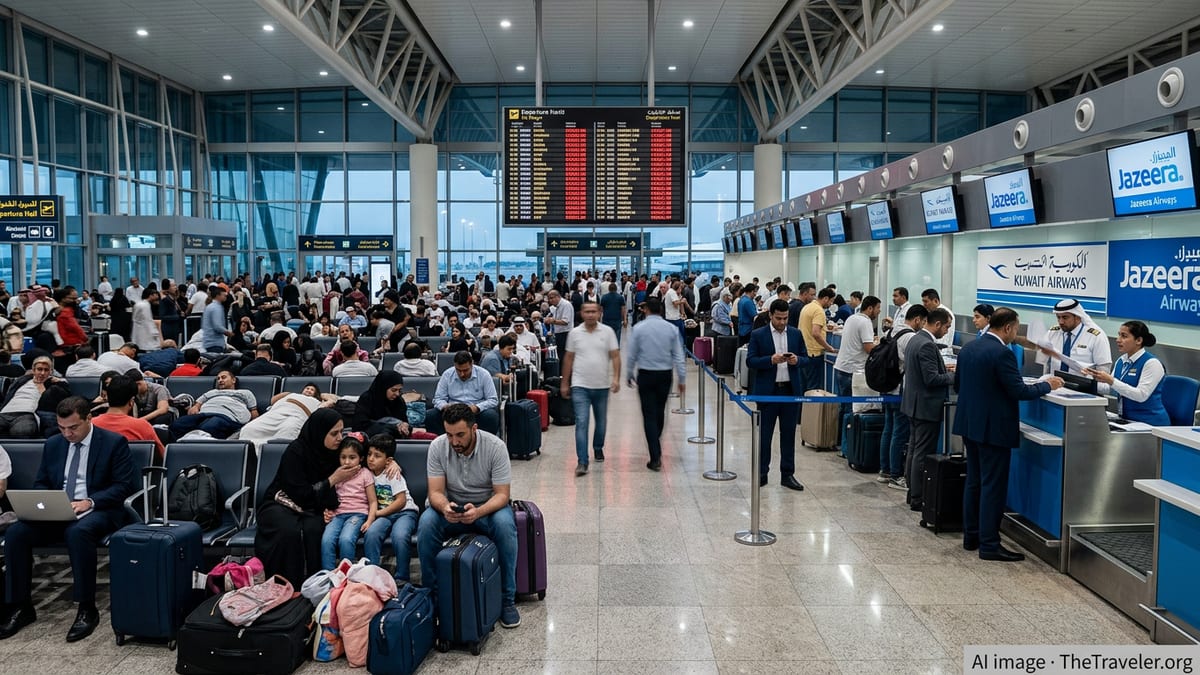
Dozens of passengers were left stranded at Kuwait International Airport on Friday after at least 20 flights operated by Gulf Air, Qatar Airways, Etihad Airways and other regional carriers were abruptly cancelled, disrupting key routes across the Gulf and to major long-haul destinations including New York and Madrid.
Get the latest news straight to your inbox!
Wave of Cancellations Hits Key Gulf and Long-Haul Routes
The disruption unfolded as a wave of last-minute cancellations appeared on departure boards at Kuwait International Airport, affecting services bound for Riyadh, Jeddah, Bahrain, Doha, Abu Dhabi, Dubai and onward connections to Europe and North America. Airport staff said the majority of affected passengers only learned of the cancellations after arriving at the terminal, intensifying scenes of confusion at check-in counters.
Among the grounded services were multiple departures operated by or codeshared with Gulf Air, Qatar Airways and Etihad Airways, as well as other regional partners that feed traffic into the main hubs of Bahrain, Doha and Abu Dhabi. Several passengers reported that onward sectors to New York and Madrid were also disrupted when their initial Gulf legs from Kuwait were cancelled, forcing them to scramble for scarce alternative seats.
While the precise breakdown of the 20 cancellations has yet to be formally detailed by authorities, flight-tracking data and airline advisories pointed to a mix of complete cancellations and heavily delayed services, many of which ultimately did not depart. The knock-on effect rippled beyond the Gulf, stranding passengers who had timed their travel to connect through Kuwait to long-haul flights operated by partner airlines.
Airport sources described an “unstable and fast-changing” operating environment, with airlines adjusting schedules in response to regional airspace restrictions and operational constraints at several major Gulf hubs. Those factors combined to make Kuwait particularly vulnerable to cascading disruptions when even a handful of key flights were withdrawn.
Passengers Face Long Waits, Limited Information
Inside the terminal, travellers spoke of long queues, overcrowded seating areas and inconsistent information from different airline desks. Families with small children and elderly passengers clustered around customer service counters, clutching paper itineraries and phone screens as they tried to confirm whether they would travel at all.
Some passengers reported receiving cancellation notifications on airline apps or via text only minutes before scheduled boarding, while others said they were still being asked to check in for flights that had already been removed from departure boards. The result was a patchwork of partial information that left many unsure whether to clear security or remain landside in case of rebooking.
With hotels near the airport quickly filling up, many stranded travellers were offered meal vouchers and overnight accommodation only after lengthy waits. Others said they were advised to arrange their own lodging and seek reimbursement later under airlines’ disruption policies. For passengers headed to religious events in Saudi Arabia or to time-sensitive business meetings in Europe and the United States, the delays carried not just inconvenience but real financial and personal costs.
Local ground staff appeared stretched as they handled mounting crowds, attempting to prioritise families, elderly passengers and those with medical needs. Yet the sheer volume of affected travellers meant many spent hours in limbo, waiting for word on new itineraries that depended on airspace decisions and hub capacity far beyond Kuwait’s control.
Airlines Cite Regional Operational Constraints
Gulf Air, Qatar Airways and Etihad Airways, along with other regional carriers, have all been navigating an exceptionally challenging operating landscape in recent days, with restrictions and security-related constraints affecting multiple airspace corridors across the Gulf region. While each airline has its own network and hub strategy, all rely on the efficient flow of flights through Bahrain, Doha, Abu Dhabi and Dubai.
Industry analysts note that Kuwait, positioned close to several of these hubs, often functions as an important feeder and alternate gateway for passengers linking to long-haul services. When hubs face temporary limitations in runway capacity, security holds or routing restrictions, flights from nearby points such as Kuwait are among the first to be trimmed or rescheduled, as carriers consolidate operations onto a smaller number of core services.
In recent days, major Gulf airlines have issued a stream of advisories warning customers of reduced schedules, aircraft substitutions and potential last-minute changes. Some have emphasised that only passengers with confirmed, operational flights should travel to the airport, reflecting a broader attempt to avoid overcrowding in terminals while networks remain fragile.
Aviation experts say that even when airspace is partially reopened, airlines typically restore operations in phases, prioritising repatriation flights and services for already-stranded passengers before adding back full commercial schedules. That step-by-step ramp-up is designed to maintain safety and reliability but can prolong disruption for travellers booked on secondary routes such as Kuwait–Riyadh or Kuwait–Madrid.
Authorities Urge Travellers to Check Flight Status
Kuwait’s aviation authorities and airport management have urged travellers to closely monitor airline channels and flight-status tools before heading to the airport, stressing that conditions can change rapidly. They also highlighted that some airlines are consolidating passengers from multiple cancelled flights onto a smaller number of departures, making it essential for customers to respond quickly to any rebooking offers.
Travel agents in Kuwait City reported a spike in calls from anxious clients seeking to reroute via alternative gateways such as Istanbul, Cairo or European hubs less affected by Gulf airspace constraints. However, limited capacity and high last-minute fares have made such alternatives difficult to secure, especially for families or groups travelling together.
Consumer advocates reminded passengers that, while Gulf carriers are not bound by the same compensation rules that apply in some other regions, airlines generally provide rebooking, refunds or travel vouchers in cases of cancellations triggered by security or operational issues. The specific options available depend on the fare type and point of purchase, and travellers were advised to review their tickets carefully and document all communication with carriers.
At Kuwait International Airport, information screens and public announcements urged passengers whose flights had been cancelled to contact their airlines remotely where possible, reserving airport desks for those already stranded in transit or with imminent departures. Despite those efforts, crowding persisted as long-haul customers, in particular, weighed whether to wait in the terminal or seek accommodation until new flights could be confirmed.
Uncertain Outlook as Networks Slowly Rebalance
Looking ahead, aviation observers expect continued volatility in Gulf flight schedules over the coming days as carriers recalibrate their networks. Even as some hubs cautiously expand operations, lingering bottlenecks in airspace routing and ground handling are likely to keep on-time performance under pressure.
For passengers in Kuwait, that means more days of carefully watching airline apps and airport advisories, with little guarantee that existing bookings will operate exactly as planned. Those with flexible travel dates may choose to postpone journeys until schedules stabilise, while others with urgent commitments will continue to seek scarce seats on any available flights out of the region.
Travel industry insiders say the situation at Kuwait International Airport offers a stark illustration of the interconnected nature of modern air travel. A decision affecting runways or airspace hundreds of kilometres away can, within hours, ripple into last-minute cancellations for flights to Riyadh, Jeddah, Bahrain, Doha, Abu Dhabi, Dubai, New York and Madrid.
For now, the scene at Kuwait’s main gateway remains one of uncertainty and fatigue, as stranded passengers wait for slots to open, aircraft to reposition and airlines to gradually piece their disrupted networks back together.