

More news on this day
Drone damage and airspace closures at Kuwait International Airport have forced Kuwait Airways and major Gulf carriers including Etihad, Emirates, Qatar Airways, Oman Air and Saudia to cancel or severely curtail flights, leaving thousands of travelers scrambling to rebook or reroute across an already disrupted Middle East network.
Get the latest news straight to your inbox!
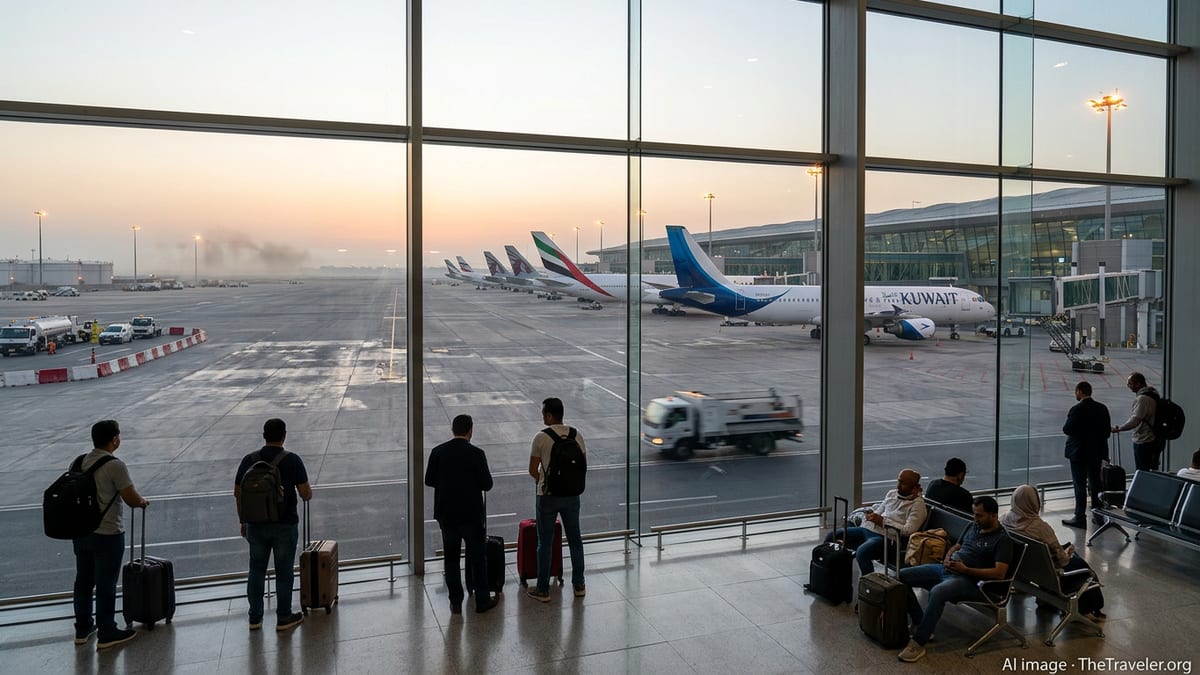
What Happened at Kuwait International Airport
Kuwait International Airport has remained effectively closed to regular civilian traffic since late February, after Iranian drone strikes hit airport facilities and nearby military infrastructure amid the expanding Iran–Israel conflict. Authorities initially grounded flights as a temporary safety measure, but continued regional strikes and the security risk to aircraft and passengers have delayed any full reopening of airspace.
Officials in Kuwait say the direct physical damage at the airport is largely limited to fuel storage and some airside infrastructure. However, the combination of security concerns, the need to verify runway and systems integrity, and the broader military situation in surrounding airspace has meant commercial operations cannot safely resume at scale.
The prime minister and senior civil aviation officials have publicly stressed that technical repairs and emergency systems are in place, but that traffic will only restart when regional risk levels drop sufficiently. For now, the airport is operating at best on an emergency and special-permissions basis, with ad hoc repatriation and humanitarian movements rather than normal scheduled services.
This prolonged shutdown has quickly rippled through airline schedules across the Gulf, converting what initially looked like a short-term disruption into a sustained crisis for passengers with journeys touching Kuwait or nearby hubs.
Kuwait Airways Joins Regional Carriers in Mass Cancellations
Kuwait Airways has cancelled the vast majority of its services to and from Kuwait City, including regional connections and long-haul flights that rely on Kuwait as a transfer point. Passengers report receiving cancellation notices just 24 to 48 hours before departure, while some itineraries have been rebooked multiple times as the closure drags on and aircraft are repositioned to other cities.
The carrier has introduced broad refund and rebooking policies for travel that was scheduled in the days and weeks after the drone strikes. Travelers holding unused tickets on cancelled flights are generally being offered full refunds or no-fee date changes, although processing times and communication have been uneven. In some cases, Kuwait Airways has been accused by passengers of slow or unclear updates, especially for those stranded mid-journey.
Because Kuwait Airways depends heavily on its home hub, the shutdown has effectively frozen much of its network. Transit passengers who were due to connect in Kuwait have been among the hardest hit, with some reports of travelers stuck in the country after onward legs to Europe or North America were cancelled once they had already arrived.
Where possible, the airline is attempting to reroute customers via alternative Gulf gateways, but capacity across the region is limited and subject to constant adjustment as other airports contend with their own security and congestion constraints.
How Etihad, Emirates, Qatar Airways, Oman Air and Saudia Are Affected
The closure of Kuwaiti airspace and the damage at Kuwait International Airport come on top of separate disruptions at other major Gulf hubs, as Iranian strikes and missile threats have prompted temporary shutdowns, diversions and tightened security at airports in the United Arab Emirates, Qatar and elsewhere. That has created a cascading effect for carriers that usually offer dense, reliable connections across the region.
Emirates and flydubai have been operating at significantly reduced capacity, focusing on repatriation and priority routes while cancelling or rerouting many flights that would ordinarily pass through nearby airspace. Etihad has likewise trimmed schedules and is selectively restoring services where risk assessments allow. Strict terminal entry controls are in place at some airports, with only passengers holding confirmed, operating flights being allowed inside to prevent overcrowding.
Qatar Airways has reported repeated cancellations and schedule changes as Qatari airspace has been periodically restricted and as Doha manages the influx of diverted and disrupted traffic. Oman Air and Saudia have also been drawn into the turmoil, adjusting frequencies and routing to avoid conflict zones and accommodate passengers whose original itineraries can no longer be flown as planned.
For travelers, this means that even if they are not booked on Kuwait Airways or flying to Kuwait directly, their journeys can still be upended. A single cancelled sector, or a new routing that adds several hours of flying time, can cause missed connections and require overnight stops, all in an environment where hotel rooms and alternative flights are in high demand.
What Travelers With Upcoming Flights Should Do Now
Passengers booked on Kuwait Airways or on any itinerary touching Kuwait International Airport in the coming days should assume significant disruption and act proactively. The safest course is to check booking status at least daily and again on the day before travel, using the airline’s app or customer service channels rather than relying solely on airport departure boards.
If your flight has been cancelled, contact the ticketing airline or travel agent as soon as possible to discuss refunds or rebooking. Given the pressure on call centers, many travelers are having more success through airline social media teams, local ticket offices, or in-person help desks at other airports than via global phone hotlines. Keep copies of all communications and receipts in case you later need to claim additional expenses.
Travelers transiting through the Gulf without starting or ending in Kuwait should still prepare for last-minute changes. Build in extra time for connections where possible, avoid non-refundable onward arrangements on separate tickets, and be ready for extended layovers if your new routing adds fuel or crew-related delays.
Those with flexible plans, particularly discretionary leisure trips into or through the affected region, may wish to postpone travel until operational patterns stabilize. Business and essential travelers should monitor government travel advisories as well as airline updates, since advice can change quickly if the security situation deteriorates or improves.
Key Practical Advice for Stranded and Prospective Passengers
For travelers already stranded due to cancellations linked to Kuwait International Airport or neighboring hubs, the immediate priority is establishing who is responsible for care and assistance. Under most airline policies, passengers whose flights are cancelled after they have begun their journey should be offered rebooking on the next available service and, where required by local rules or carrier policy, meals and accommodation while they wait.
If you are in transit and your onward flight is cancelled, seek out your airline’s airport desk immediately, as same-day hotel availability and alternative seats tend to disappear quickly. Keep boarding passes and e-tickets handy, and ask staff to provide written confirmation of cancellations and new bookings that you can reference if plans change again.
Prospective passengers who have not yet started their trip should carefully read their fare conditions and any special advisories covering the Iran–Israel conflict and regional airspace closures. Many airlines, including Kuwait Airways and the major Gulf carriers, have introduced more flexible change and refund rules for travel within the affected period, but these may be time-limited and specific to certain routes or ticket types.
Finally, travelers should ensure they have appropriate travel insurance that covers war-related disruptions and airspace closures, as not all standard policies include such events. Given the evolving situation and the extent of damage and closures centered on Kuwait International Airport, flexibility, vigilance and rapid communication with airlines will be critical for anyone planning to fly through the region in the coming days.