

More news on this day
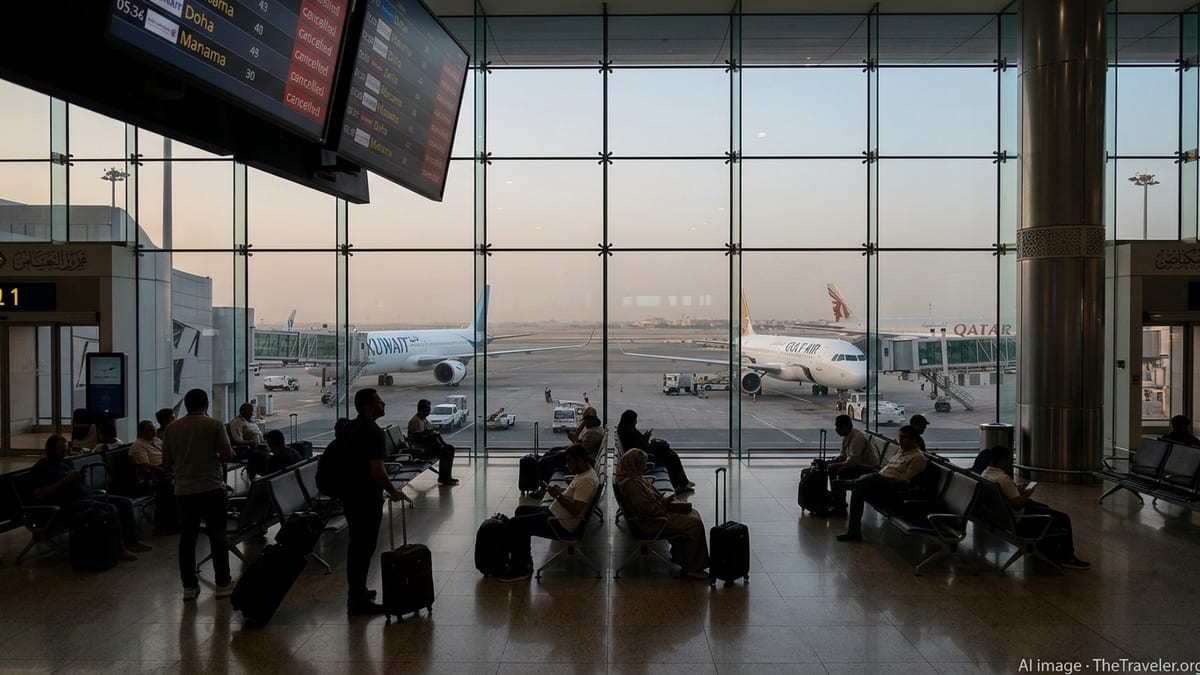
Passengers traveling between Kuwait, Doha and Manama have faced new disruption after nine flights were cancelled at Kuwait International Airport, affecting services operated by Gulf Air, Qatar Airways and Kuwait Airways amid wider regional instability in Gulf airspace.
Get the latest news straight to your inbox!
Targeted Strikes and Regional Airspace Turbulence
The latest cancellations at Kuwait International Airport come against the backdrop of an escalating security crisis in the Gulf region. Recent Iranian missile and drone strikes have targeted infrastructure across several Gulf states, including facilities in Kuwait and Qatar, prompting a series of airspace restrictions and operational suspensions that continue to ripple through commercial aviation.
Publicly available information shows that Kuwait International Airport has been directly referenced in reports on the wider pattern of Iranian attacks, with strikes and debris incidents contributing to heightened risk assessments. In parallel, Qatar’s Hamad International Airport and Bahrain’s aviation sector have experienced their own disruptions as authorities and airlines adjust to evolving security guidance.
The nine cancellations in Kuwait are a relatively small part of a much broader network-wide impact, but they illustrate how quickly localized security developments can translate into schedule instability far beyond the immediate conflict zones. Each cancelled flight can displace hundreds of travelers, compress capacity onto remaining services and complicate onward connections across Europe, Asia and North America.
While Kuwait International Airport remains open, operations are unfolding in a highly fluid environment where regional air corridors can shift at short notice. Airlines serving the Kuwait–Doha–Manama triangle are continually reassessing routings, crew duty times and fleet deployment as they navigate both safety considerations and commercial pressures.
Gulf Air Groundings Strain Bahrain–Kuwait Links
Among the carriers most visibly affected is Gulf Air, Bahrain’s national airline. According to publicly available advisories and passenger-facing updates, Gulf Air has been heavily constrained by disruptions in Bahraini airspace, with numerous services suspended or significantly reduced. This has directly affected links between Manama and Kuwait, traditionally an important short-haul business and transit corridor.
Gulf Air’s grounding has removed capacity from key city pairs at the same time that alternative regional hubs are also under strain. For Kuwait-bound travelers who would normally route via Manama or use Gulf Air as a connector to other Gulf destinations, the loss of frequencies has narrowed itinerary options and pushed more demand toward the remaining carriers.
The knock-on effect is that any cancellation touching Kuwait International Airport can have an outsized impact on travel to and from Bahrain. With fewer flights to rebook disrupted passengers onto, travelers are often being offered re-routing via more distant hubs or later travel dates, in some cases adding many hours and extra connections to journeys that are normally under one hour gate-to-gate.
This situation is particularly challenging for travelers with time-sensitive commitments, such as medical appointments, work reporting dates or academic schedules, who may find that even a single cancellation disrupts carefully coordinated multi-leg itineraries anchored around Bahrain–Kuwait services.
Qatar Airways Adjusts Amid Doha Hub Constraints
Qatar Airways, a key connector between Kuwait and global destinations through its Doha hub, has been contending with its own substantial operational challenges. Published coverage on the recent missile activity around Qatar and partial closure of Qatari airspace indicates that the airline has suspended or curtailed many scheduled services, relying at times on limited relief corridors and repatriation-style flights.
These constraints mean that flights between Kuwait and Doha are particularly vulnerable to cancellation when safety assessments change or when slots on constrained corridors are reprioritized for long-haul services. As a result, some passengers booked on Kuwait–Doha segments have reported multiple schedule changes, cancellations and rebookings, often with short notice as timetables are updated.
With Doha functioning below its normal capacity as a transfer hub, Qatar Airways has, according to publicly available information, explored workarounds such as rerouting some itineraries through alternative regional airports or adjusting connection windows. For passengers starting or ending their journey in Kuwait, this can translate into longer layovers, reroutes that skip Doha entirely or, in some cases, outright cancellations if no viable alternative can be secured.
The interplay between limited airspace availability over Qatar and the operational status of Kuwait International Airport leaves little margin for disruption. Even when Kuwait is able to handle departures and arrivals, restrictions around Doha can still force last-minute cancellations on Kuwait–Doha services that would otherwise be technically feasible from a purely local standpoint.
Kuwait Airways Faces Pressure on Passenger Options
Kuwait Airways, the national carrier, is also navigating a dynamic operating environment shaped by security concerns and regional airspace closures. Publicly accessible passenger discussions and airline communications suggest that the carrier has cancelled a range of services on select dates while maintaining others, leading to uncertainty among travelers planning connections through Kuwait.
Reports indicate that some passengers with itineraries involving Kuwait layovers have received confirmation of cancellations only within days of departure, reflecting the difficulty of planning schedules in an environment where airspace conditions and demand patterns can shift rapidly. This can place additional strain on customer support channels as travelers seek clarity on whether flights will operate, and what options exist for refunds, vouchers or rebooking.
The nine cancellations affecting Kuwait International Airport’s links with Doha and Manama have added to this pressure by temporarily shrinking the pool of alternative routes available to Kuwait Airways passengers. When neighboring hubs such as Doha and Bahrain are also under constraint, Kuwait Airways has fewer interline or codeshare options to offer as substitutes, which can leave some travelers facing longer waits or complex reroutes via more distant transit points.
For the airline itself, the challenge lies in balancing the need to maintain a viable schedule with the risk of overcommitting capacity that may later prove impossible to operate. The result has been a pattern of rolling adjustments that can be difficult for passengers to track without frequent checks of booking tools and status notifications.
Passengers Confront Uncertainty and Limited Alternatives
For travelers, the immediate impact of nine cancellations at Kuwait International Airport is measured less in statistics than in missed connections, extended layovers and disrupted plans. Many passengers moving between Kuwait, Doha and Manama use these routes as connective tissue in longer, multi-continent trips, so a single short-haul cancellation can cascade into missed long-haul departures and overnight stays.
According to published coverage and traveler accounts, the broader regional disruption has already resulted in thousands of cancellations across Gulf hubs, reducing the availability of spare seats that could otherwise absorb passengers from cancelled Kuwait services. This tight capacity environment means that rebooking options are often limited to dates several days away or to itineraries that involve detours via Europe, South Asia or alternative Middle Eastern gateways.
Travelers are increasingly being encouraged through public advisories and airline updates to monitor flight status frequently, build additional buffer time into itineraries and consider flexible tickets where possible. For those yet to depart, some aviation analysts suggest that avoiding tight self-arranged connections across multiple tickets may help reduce the risk of being stranded mid-journey if one leg is cancelled.
As the situation in Gulf airspace evolves, the pattern of cancellations at Kuwait International Airport, including the latest nine flights affecting routes to and from Doha and Manama, underscores how closely linked the region’s hubs have become. Even localized operational decisions now reverberate across a much wider network, making resilience and flexibility key considerations for anyone planning to travel through Kuwait and its neighboring capitals in the coming days.