

More news on this day
A drone strike that damaged facilities at Kuwait International Airport has triggered a full shutdown of Kuwait’s airspace, unleashing days of cascading flight disruptions across three continents as airlines scramble to reroute aircraft and stranded passengers search for alternative routes.
Get the latest news straight to your inbox!
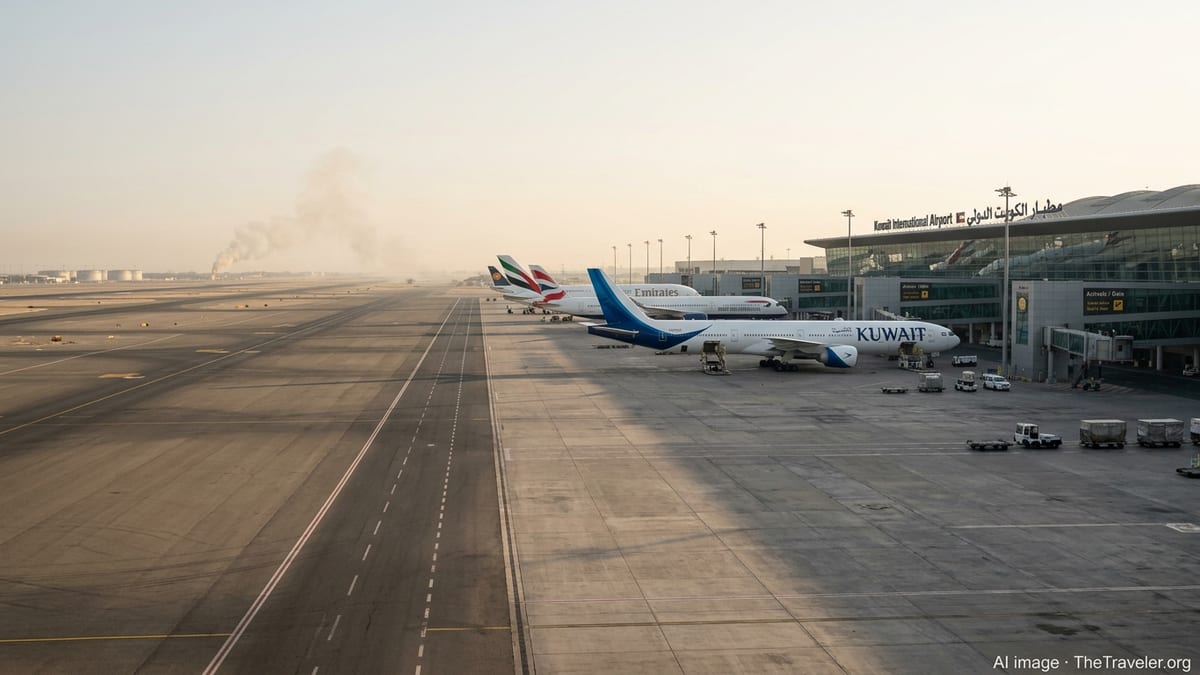
Drone Strike Hits Key Gulf Aviation Hub
The closure of Kuwait International Airport followed a series of Iranian drone and missile strikes linked to the wider Iran war that has flared across the Gulf region since late February 2026. Publicly available information indicates that one of the attacks struck infrastructure at or near the airport, including fuel and radar facilities, forcing aviation authorities to halt movements for safety reasons.
Reporting on the conflict notes that Kuwait’s main civilian gateway was already operating under heightened security conditions when drones hit facilities serving both commercial and military operations. The strikes formed part of a broader campaign targeting regional energy and logistics assets, with incidents also documented at ports and air bases elsewhere in Kuwait.
Aviation-focused situation reports state that the damage at Kuwait International Airport, combined with the risk of further unmanned aerial incursions, made continued operations untenable. As a result, flights were suspended and Kuwait’s airspace effectively sealed to routine commercial traffic, with only limited military and emergency movements reported.
Travel advisories compiled in the days after the incident describe images of smoke near airport installations and unverified social media accounts of passengers being turned back from terminals or informed of last-minute cancellations. While repairs on the ground have reportedly progressed, the overriding concern remains the vulnerability of aircraft and airport infrastructure to additional strikes.
Airspace Closure Sends Shockwaves Through Global Networks
Kuwait’s decision to close its airspace has had an outsized impact on international aviation because of the country’s position on major corridors linking Europe, Africa and Asia. Kuwait International Airport handles a steady mix of local origin and destination traffic, regional connections, and long-haul services that use the Gulf as a refuelling and transfer point.
Economic assessments of the 2026 Iran war note that multiple Gulf hubs have been affected simultaneously, with some closed outright and others operating at sharply reduced capacity. Combined with airspace closures over parts of the Gulf and surrounding states, the disruption has removed or constrained several of the most direct paths between continents, forcing airlines to adopt longer, more fuel-intensive routings that skirt conflict zones.
Flight-tracking data and airline statements collected in open sources show aircraft that would once have overflown Kuwait diverting via Saudi Arabia, Egypt, Turkey or the Indian Ocean. Some services have been extended by several hours, while others have been cancelled altogether where viable alternative paths could not be secured or crew duty limits would have been exceeded.
For carriers with significant Gulf operations, the sudden loss of Kuwait as a functioning waypoint has compounded delays triggered by incidents at other regional airports. Industry analysts argue that, taken together, these disruptions represent the most significant shock to Middle East aviation since the pandemic, with knock-on effects now visible as far afield as European secondary cities and African regional hubs.
Passengers Stranded as Airlines Reroute via Alternative Gateways
For travellers, the operational complexities have translated into days of uncertainty. Travellers posting on public forums describe finding their flights to or through Kuwait cancelled with little warning, often after overnight schedule changes as airlines attempted to rebuild networks around the closure. Many report being rebooked via alternative Gulf or European hubs, while others have been left to assemble their own multi-leg journeys on remaining open routes.
Some regional carriers have reportedly shifted limited Kuwait-bound traffic to airports in neighbouring Saudi Arabia, using cross-border ground transport to move passengers closer to their final destinations. This has turned what were previously straightforward point-to-point flights into multi-stage journeys involving long coach transfers through desert border crossings and secondary airports unaccustomed to handling such volumes of international travellers.
Publicly available travel security briefings warn that capacity at alternative hubs is under strain, with extended queues, packed departure halls and frequent last-minute gate changes. Stranded passengers in cities as distant as London, Johannesburg and Kuala Lumpur are encountering sold-out flights on traditional Gulf connectors, leaving them reliant on indirect itineraries through Central Asia, southern Europe or East Africa.
As airlines prioritise repatriation of travellers already in transit, many future departures to Kuwait have been removed from schedules or placed on temporary hold. Industry observers caution that even once Kuwait’s airspace formally reopens, the backlog of displaced passengers and aircraft will take time to clear, prolonging disruption well beyond the initial incident.
Wider Middle East Security Crisis Deepens Aviation Risks
The attack on Kuwait International Airport is part of a broader regional security crisis that has seen drones and missiles used against military bases, energy infrastructure and transport nodes across the Gulf. Open-source chronologies of the conflict list repeated strikes in Kuwait, including at Ali Al Salem Air Base and at a tactical operations centre near Port Shuaiba, underscoring the country’s frontline role in the confrontation.
Neighbouring states have also imposed temporary airspace closures in response to incidents or perceived threats, creating an unstable operating environment for commercial aviation. Previous strikes on airports and energy facilities in Qatar and the United Arab Emirates demonstrated that even highly secured hubs are not immune to disruption, prompting airlines and insurers to reassess their risk appetite for flights passing close to conflict zones.
Economic analyses highlight aviation as one of the sectors most immediately affected by the Iran war, alongside energy and shipping. With several Gulf airports collectively accounting for a substantial share of global connecting traffic, any prolonged shutdown has the potential to reshape established route networks and accelerate a shift toward alternative hubs in Europe, South Asia or Africa.
Travel risk consultants note that the increased use of drones in regional conflicts poses particular challenges because of their relatively low cost, flexibility and ability to threaten large fixed installations such as airports. Even attacks that cause limited physical damage can force closures for inspections, repairs and psychological reassurance to passengers and crews.
What Travellers Need to Know Right Now
For travellers with existing bookings to, from, or via Kuwait in the coming weeks, publicly available airline guidance generally recommends closely monitoring reservation details and using official channels to request rebooking or refunds. Many carriers have introduced temporary flexibility policies for travel involving Kuwait and nearby affected airspaces, allowing one-time changes without additional fees where inventory is available.
Industry bulletins suggest that travellers starting new trips should avoid planning tight connections through any Gulf hub, as knock-on delays from the Kuwait closure may ripple across the region’s schedules. Longer layovers and travel insurance policies that explicitly cover war-related disruption are being recommended in some advisory notes, especially for itineraries crossing between Europe and Asia.
Prospective visitors to Kuwait are being advised by travel risk analysts to treat the situation as highly fluid. While there are indications that technical repairs at the airport are advancing, the decisive factor for resuming normal operations is expected to be the broader security picture and any further escalation or de-escalation in the Iran war. Until a durable reduction in drone and missile threats is observed, aviation planners appear likely to maintain conservative routings that minimise exposure.
For now, Kuwait International Airport remains a symbol of how quickly a single strike on critical aviation infrastructure can reverberate far beyond national borders. As airlines, regulators and travellers adapt to the new realities of conflict-era flying, the closure has become a stark case study in the vulnerability of global mobility to targeted attacks on key transit hubs.