

More news on this day
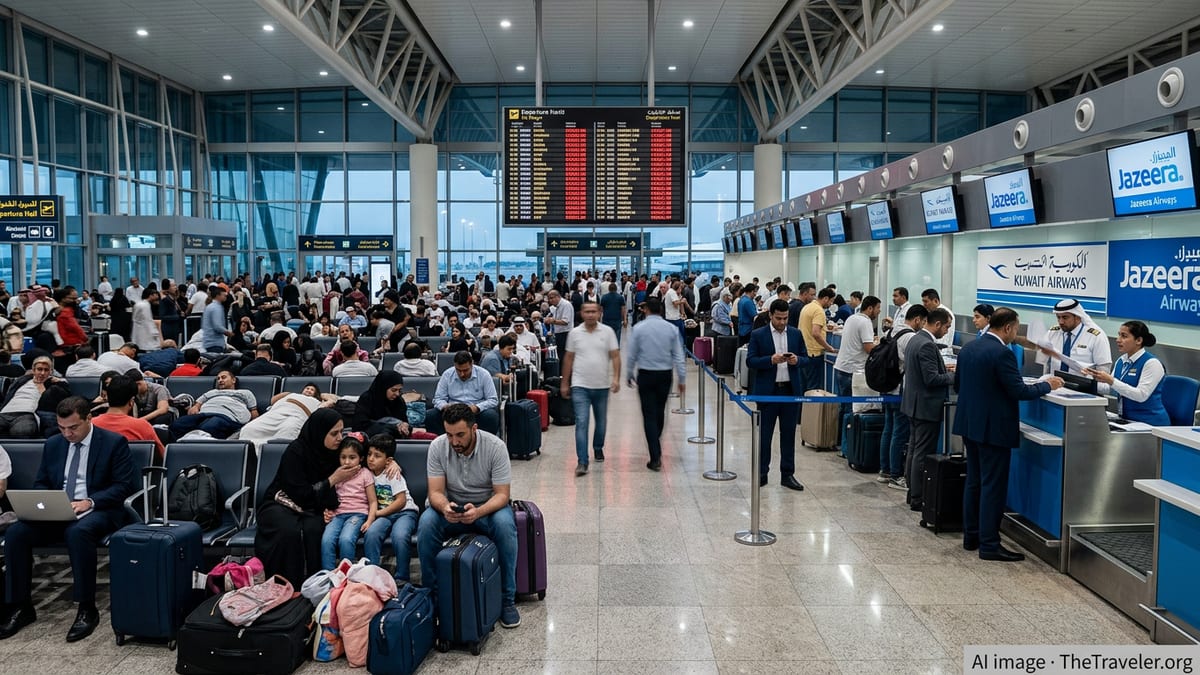
Hundreds of passengers were left stranded at Kuwait International Airport on Sunday, March 8, as 39 flights were cancelled and one delayed, disrupting services on major Gulf and regional routes and deepening travel turmoil triggered by the fast‑escalating Middle East security crisis.
Mass Cancellations Hit Key Gulf and Regional Routes
Kuwait’s main gateway ground to a near standstill as airlines scrubbed departures and arrivals across a wide network of regional destinations. Flights to and from Dubai, Riyadh, Doha, Cairo and Bahrain were among those most heavily affected, according to preliminary airport and industry data reviewed by TheTraveler.org.
By early evening local time, 39 flights serving Kuwait International Airport had been cancelled alongside a single significant delay, stranding departing travellers in long queues at check‑in and leaving arriving passengers marooned in transit halls. The disruption rippled across the broader Gulf network, complicating onward connections to Europe, Asia and Africa.
Airport staff said the situation evolved rapidly through the day as carriers adjusted operations in response to airspace restrictions and shifting security assessments. Display boards cycled repeatedly between “scheduled” and “cancelled” as new directives filtered through to airline operations centers.
Several passengers reported waiting for hours only to learn their flights were no longer operating, with some told to expect no alternative options for at least 24 hours. Others were moved onto future services that remain tentative given the volatility of the situation.
Major Carriers Among Those Forced to Ground Services
The cancellations impacted a broad cross‑section of airlines, from regional giants to low‑cost carriers. Services operated by Qatar Airways, flydubai and Gulf Air were among those hit, alongside flights from other Middle Eastern and international operators that rely on Kuwait as both a point‑to‑point and connecting market.
Qatar Airways, which typically runs multiple daily services between Kuwait and its Doha hub, was forced to cancel a number of rotations, affecting passengers bound for onward destinations in Europe and Asia. Travellers reported being rebooked on later dates or rerouted via alternative gateways where space was available.
Flydubai, a key operator on the busy Kuwait–Dubai corridor, also cut services, leaving business travellers and holidaymakers scrambling to salvage plans built around departures to the United Arab Emirates. Gulf Air flights linking Kuwait with Bahrain’s Manama hub were similarly disrupted, limiting connection opportunities across the Gulf and into the wider Middle East.
Smaller regional carriers and codeshare partners faced knock‑on effects as shared flights were removed from schedules. Some airlines activated flexible rebooking policies, waiving change fees and fare differences within limited windows, while others advised customers to contact their original point of sale for refunds or future travel credits.
Regional Security Crisis Closes Airspace and Disrupts Networks
The chaos in Kuwait is the latest manifestation of a regional aviation crisis that has intensified since late February, when heightened tensions and military activity prompted multiple Middle Eastern states to restrict or close sections of their airspace. Airlines across the region have been forced into large‑scale schedule overhauls, diversions and suspensions as they attempt to keep passengers and crew clear of conflict zones.
Industry analysts say Kuwait’s shutdown is particularly significant because the country sits at a crossroads of east‑west travel corridors. Even partial suspensions at Kuwait International Airport ripple outward quickly, affecting flights that never touch Kuwaiti soil but rely on the same air corridors to reach hubs such as Dubai, Doha, Riyadh and beyond.
In recent days, airports in other regional capitals have reported sharp spikes in cancellations on Middle East‑bound routes as carriers respond to evolving risk assessments. Flights to and from Gulf cities including Dubai and Bahrain, as well as to Cairo and other major North African gateways, have been repeatedly disrupted, leaving airline networks out of sync and aircraft and crew out of position.
While some carriers have begun cautiously restoring select services using longer routings to avoid restricted areas, operational planners warn that any renewed escalation could trigger further groundings or diversions with little warning, prolonging the instability facing travellers.
Passengers Face Long Waits, Confusion and Limited Information
At Kuwait International Airport on Sunday, stranded passengers described a confusing, emotionally charged scene, with families huddled around luggage carts, business travellers crowding airline counters and lines forming at information desks offering few concrete answers. Many said they first learned of cancellations from departure screens or mobile alerts only after passing through security.
Travellers attempting to reach Dubai, Doha and Riyadh reported particular difficulty finding same‑day alternatives, as remaining services quickly filled and nearby hubs also struggled with capacity constraints. Some passengers with fixed commitments, such as medical appointments or visa deadlines, faced the prospect of missing critical dates as they weighed whether to seek overland routes to alternative airports.
Passengers interviewed by local media and travel forums said access to timely information remained a major frustration. Several noted that airline apps and websites continued to display flights as “on time” long after airport boards marked them as cancelled, while call centers were overwhelmed by a surge in inquiries. Others said they received mixed messages from different airline touchpoints about whether they were entitled to hotel accommodation or meal vouchers.
Airport officials urged customers to remain inside terminal buildings and monitor official announcements, but with seating and amenities under pressure, many travellers settled in for overnight stays, improvising sleeping arrangements near gates and in public waiting areas.
Airlines and Authorities Urge Flexibility as Outlook Remains Uncertain
With the regional security situation still fluid, neither Kuwaiti authorities nor airline executives offered a firm timeline for a full resumption of regular services. Aviation officials emphasized that safety remained the overriding priority, even as the economic and personal costs for travellers and carriers continue to mount.
Several airlines serving Kuwait advised customers with non‑essential travel over the coming days to consider postponing journeys or seeking refunds where permitted. Those who must travel were urged to reconfirm flight status frequently, sign up for airline notification services and allow substantial extra time at the airport to navigate last‑minute changes.
Travel agents in Kuwait reported a surge in demand for alternative routings through less affected regional gateways, though availability was limited and fares climbed quickly as remaining seats sold out. Some passengers opted to reroute via more distant hubs in Europe or Asia, accepting longer journey times in exchange for a higher chance of departure.
For now, Kuwait International Airport remains a vivid illustration of how quickly a regional security crisis can spill over into global mobility, stranding ordinary travellers far from home and testing the resilience of the world’s interconnected aviation system. Until airspace restrictions ease and carriers can safely restore predictable timetables, passengers heading to or through the Gulf are being warned to prepare for a period of prolonged uncertainty.