

More news on this day
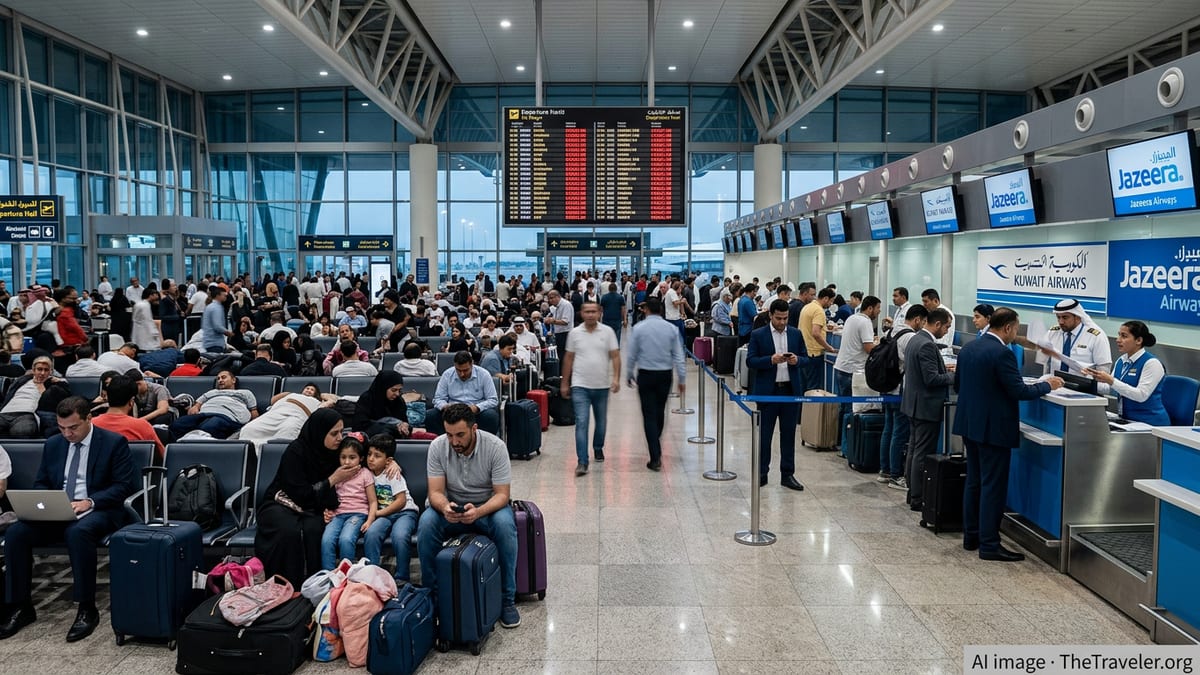
Numerous commercial flights to and from Kuwait International Airport have been cancelled or suspended since late February after regional airspace closures and strikes on key aviation sites, leaving thousands of passengers stranded across the Gulf and beyond.
Get the latest news straight to your inbox!
What Happened at Kuwait International Airport
Publicly available aviation data and news coverage indicate that Kuwait closed its airspace to civilian traffic at the end of February 2026 as part of a wider regional security crisis. Since then, Kuwait International Airport has not been handling regular commercial passenger services, and scheduled departures and arrivals have progressively disappeared from airline timetables.
Open-source reporting on recent strikes in Kuwait points to damage at both Kuwait International Airport and nearby military facilities, including impacts on radar and other critical systems. In response, Kuwait’s airspace was closed to routine traffic, and operations have been restricted to limited evacuation, repatriation, and state-approved movements. Cargo and commercial passenger services have largely been halted.
Industry advisories circulated to freight and travel clients in early March describe Kuwait International Airport as fully closed to civilian air traffic with no published restart date. Passenger accounts on travel and aviation forums align with these notices, describing abrupt cancellations, last-minute rerouting, and a lack of clear timelines for normal services to resume.
Current Status: Cancellations, Limited Exceptions and No Firm Reopening Date
As of late March 2026, the situation remains highly disrupted. Travel bulletins for the region continue to list Kuwait International Airport among the facilities that are closed or heavily restricted, alongside neighboring hubs where airspace is also constrained. Passenger-focused updates describe all commercial flights to and from Kuwait as cancelled or suspended until further notice.
Some flight-tracking activity showing Kuwait Airways services in recent days has led to confusion among travelers. Travel community discussions suggest these movements are largely special operations, including repatriation flights operating into other regional airports, rather than a broad restart of public commercial service at Kuwait International Airport itself.
Several airlines serving Kuwait have reportedly extended their cancellation waivers and refund windows through late March, reflecting expectations that regular schedules will not be restored quickly. At the same time, many ticketed passengers report receiving only short, generic notifications that flights are “suspended due to current circumstances,” often within days of travel.
So far, publicly accessible advisories do not contain a confirmed reopening date. Aviation risk analysts and travel risk consultancies continue to characterize the outlook as uncertain, emphasizing that the timing of any restart will depend on evolving security conditions and infrastructure readiness at the airport.
How Airlines Are Handling Stranded Passengers
The sudden shutdown has left passengers scattered across multiple continents, particularly those using Kuwait as a connection point between Asia, Europe, Africa, and North America. Travel forums carry numerous accounts of travelers whose Kuwait Airways or other Gulf-region tickets were cancelled mid-journey, sometimes after leaving their origin cities.
Published customer advisories reviewed by TheTraveler.org show that some carriers are offering full refunds for tickets on flights scheduled between late February and specific dates in March, provided no segment has been used. In cases where the outbound leg has already been flown, passengers are typically being offered refunds or credits for the unused return portion in line with each airline’s rules.
However, traveler reports describe inconsistent experiences. Some passengers say they have received clear instructions on refunds or rebooking, while others note long response times, limited call-center availability, and confusion over whether future-dated flights beyond current closure windows will also be cancelled. In several cases, passengers report being advised to “check back closer to departure,” creating additional uncertainty.
People stranded in Kuwait itself face a different set of challenges. Social media posts and community forums reference transit passengers stuck airside for extended periods, as well as residents abroad who cannot return home. Some local carriers are reported to be operating to alternative airports in neighboring countries and arranging onward ground transport, but such arrangements appear limited and are not a comprehensive solution for all travelers.
Travel Options and Workarounds Now
With Kuwait’s main gateway effectively offline, many travelers are looking at alternative routings through other Gulf and regional hubs that remain partially operational. Airports in the United Arab Emirates, Oman, and Saudi Arabia continue to handle varying levels of traffic according to airline notices, although regional airspace congestion and security assessments are prompting schedule cuts and diversions there as well.
Some Kuwait-based travelers are reportedly reaching foreign airports by road via neighboring countries, then flying onward on carriers that are still operating. Logistics advisories describe similar patterns for cargo, with shipments rerouted through regional ports and airports that retain capacity. These workarounds often involve longer journey times, new tickets, and additional visa or entry requirements, which not all passengers can easily meet.
For those who have not yet departed, published recommendations from travel risk firms and consular advisories emphasize checking whether the first leg of any multi-stop routing actually operates, and whether transits through nearby hubs are still permitted at short notice. It is also important to consider whether return flights may be affected, especially for itineraries originally planned via Kuwait International Airport.
Travel insurance may offer some relief in cases of documented closures and security-related disruptions, but coverage language varies. Policy documents often distinguish between government-ordered airspace shutdowns, airline operational decisions, and traveler-initiated changes, so passengers are advised in public guidance to review terms closely before assuming a claim will be accepted.
Key Advice for Travelers With Upcoming Kuwait Itineraries
For anyone holding tickets into, out of, or via Kuwait International Airport in the coming weeks, the most consistent message across airline updates, travel advisories, and passenger reports is to avoid assuming that a “scheduled” status guarantees operation. In the current environment, timetables may not reflect short-notice cancellations tied to security developments and airspace restrictions.
Travel industry guidance suggests contacting airlines or booking agents well in advance of departure to confirm options. In many cases, carriers are permitting free date changes, rerouting via alternative hubs, or full refunds for flights falling within published closure windows. Where a booking was made through a third-party agency, several airlines are directing passengers to work directly with that agency on changes and refunds.
Passengers already abroad who were planning to connect through Kuwait may find it safer to seek entirely new routings that bypass the country, even if their original carrier has not yet formally cancelled future legs. Publicly available information on regional conditions indicates that disruption across Gulf air corridors is likely to continue in the short term, and a conservative approach may help avoid being stranded mid-journey.
Given the fluidity of the situation, travelers are encouraged in open-source guidance to monitor multiple information channels: airline status pages, airport operational notices, and official travel advisories issued by their home governments. Conditions can change quickly in response to new security developments, and the status of Kuwait International Airport may evolve with little warning, affecting both outbound and inbound itineraries.