

More news on this day
Questions about whether Kuwait International Airport is open or shut have intensified as drone and missile attacks linked to the Iran conflict push Gulf aviation into its most unstable period in years, leaving travelers across the region grappling with closures, diversions and prolonged uncertainty.
Get the latest news straight to your inbox!
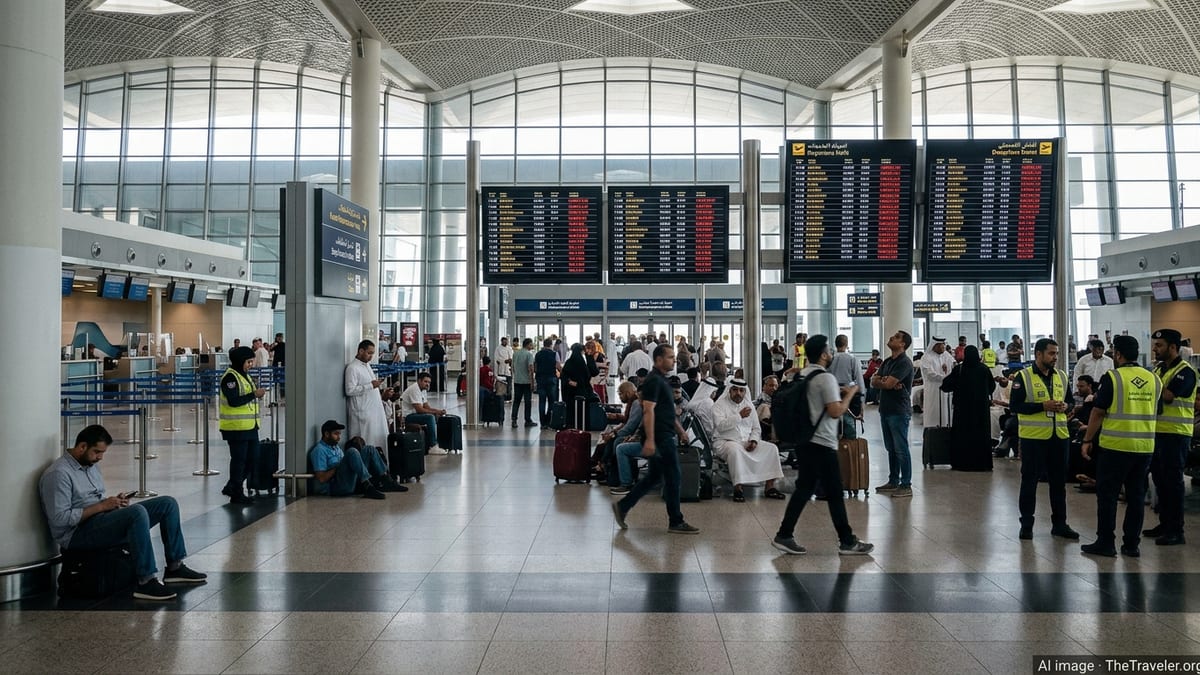
Kuwait International Airport: What Is Known So Far
Publicly available information indicates that Kuwait has been directly affected by the regional drone campaign since early March 2026, including incidents involving critical infrastructure. Regional reporting on Iranian strikes against Arab countries notes that Kuwait has condemned attacks on its territory, explicitly mentioning Kuwait International Airport among the sites at risk, even as detailed operational updates remain limited.
Local media and community reporting describe a pattern of precautionary shutdowns and airspace restrictions rather than a single, clearly announced long term closure. Discussions on public forums in early March referred to Kuwait Airport being closed and suggested repairs had been carried out, but that reopening was constrained by wider airspace safety concerns rather than damage alone. These accounts align with the broader regional picture of airports oscillating between suspension and limited operations as the security situation evolves.
As of late March 2026, there is no consistent public evidence that Kuwait International Airport has fully returned to normal commercial schedules. Instead, fragmented reports suggest a mix of grounded services, rerouted flights and a cautious approach to resuming regular traffic while drone activity and missile alerts continue in nearby airspace.
How the Gulf Drone Campaign Is Disrupting Airspace
The uncertainty in Kuwait is part of a wider aviation shock across the Gulf. Since late February 2026, Iran-linked missile and drone strikes have targeted multiple Gulf states, including Qatar, the United Arab Emirates, Saudi Arabia and Oman. In Qatar, closure of national airspace led to widespread cancellations and a shift to emergency evacuation and cargo flights only, sharply curtailing normal passenger traffic from Doha’s main hub.
In the UAE, Dubai International Airport has experienced several security incidents tied to incoming drones. Public reporting describes at least one fuel tank hit and fire, brief airport closures, suspended flights and road shutdowns around the airport, followed by carefully managed resumptions of limited operations. Social media posts from passengers and residents have documented evacuations, circling aircraft and “no flights in or out” windows as air defenses intercept targets overhead.
These patterns illustrate how even when direct damage is contained, debris from interceptions, temporary loss of visibility and the risk of follow-up strikes can force airports to halt movements at very short notice. For Kuwait, positioned just north of the core conflict zone and hosting important logistics and military sites, similar risk calculations are likely driving highly conservative operational decisions at its main civilian gateway.
Are Thousands of Travelers Stranded?
Travelers across the Middle East have already faced cascading disruption as airlines navigate closed airspace over Iran, Iraq, Kuwait and other states, along with intermittent restrictions inside the Gulf. International coverage has shown images of passengers sleeping in terminals from Dubai to far-flung airports such as Bali, where flights to the region were canceled following the first large strikes at the end of February and early March.
For Kuwait specifically, anecdotal accounts on travel and expatriate forums describe passengers unable to depart, tickets repeatedly rebooked, and families weighing overland routes to neighboring Gulf states in search of outbound flights. Some posts suggest that airlines have advised customers not to proceed to Kuwait International Airport until they receive explicit confirmation that their flight will operate.
However, the available evidence points to a patchwork of experiences rather than a single mass stranding event at Kuwait’s terminals. Many airlines appear to have preemptively canceled or rerouted services before passengers reached the airport, shifting the disruption into homes, hotels and alternative hubs in the region. The net effect remains severe inconvenience and financial loss for travelers, but not necessarily tens of thousands trapped inside Kuwait’s airport buildings at any one moment.
Safety Calculus and the Role of International Advisories
Global aviation and security advisories have reinforced the cautious stance seen in Kuwait and other Gulf hubs. The European Union Aviation Safety Agency has advised airlines not to operate within affected Middle East airspace at all flight levels, listing Kuwait alongside Iran, Iraq, Israel, Jordan, Lebanon, Oman, Qatar, Saudi Arabia and the United Arab Emirates. Private security consultancies echo these warnings, describing persistent missile and drone activity and elevated risk around major airports.
These advisories do not directly order airports to close, but they strongly influence airline scheduling and insurance decisions. Carriers weighing whether to use Kuwait International Airport must account for the threat to low flying aircraft, the possibility of sudden airspace shutdowns and the operational knock-on effects if aircraft and crews are stranded. As a result, even in periods when runways and terminals are technically available, the volume of flights using them can remain sharply reduced.
For travelers, this environment translates into fragile itineraries that can change within hours. Standard advice circulating among airline customers and regional residents is to monitor flight status repeatedly on the day of departure, remain flexible about routing via alternative Gulf or European hubs, and prepare for extended delays if security alerts spike while they are already en route.
Regional Outlook for Gulf Aviation
The evolving conflict has raised questions about how long Gulf aviation can operate under intermittent drone and missile threats. Analysts cited in recent international coverage note that the Gulf’s hub and spoke model, built on reliable long haul connections through airports such as Dubai, Doha and the broader Gulf network, is uniquely vulnerable to disruptions that close critical corridors or create no fly zones over Iran and neighboring states.
Reports on energy infrastructure attacks emphasize that the targeting of ports, power plants and gas facilities is intertwined with pressure on civilian transport systems, including airports. Kuwait’s experience, where its main airport is referenced among threatened or affected sites, illustrates how quickly a country’s connectivity can be curtailed even when direct physical damage is relatively limited.
For now, there is no clear public timeline for a full normalization of operations at Kuwait International Airport or at other key Gulf hubs. As long as drones and missiles remain a recurring feature of the region’s security landscape, aviation planners are likely to prioritize redundancy, emergency routing and conservative safety margins, leaving travelers to navigate a period of prolonged uncertainty in what was once one of the world’s most predictable transit regions.