

More news on this day
Kuwait’s abrupt airspace closure amid the widening regional conflict has forced low cost carrier Jazeera Airways to divert its passenger operations to Saudi Arabia, creating long overland journeys, mounting delays and a scramble for scarce alternatives among thousands of stranded travelers.
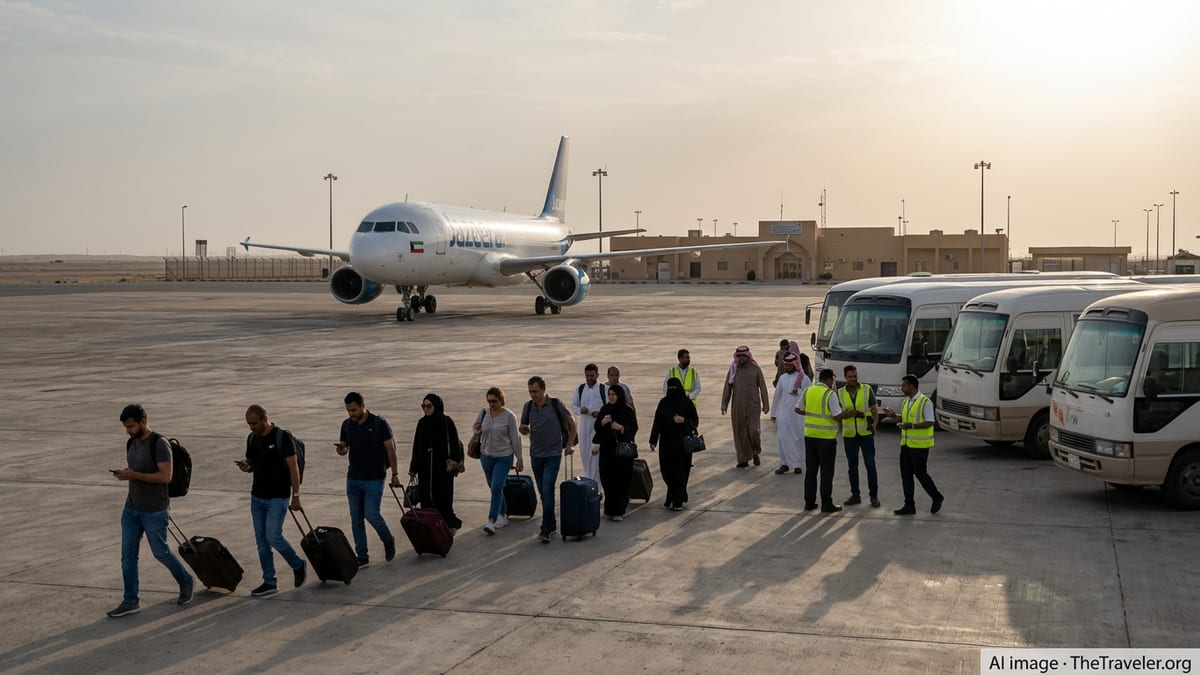
Jazeera Airways Shifts Operations to Remote Saudi Airport
On Sunday 8 March, Kuwait based Jazeera Airways confirmed it is relocating its operations to Qaisumah Airport in Hafr al Batin in Saudi Arabia’s Eastern Province after Kuwait shut its airspace to all commercial traffic. The move, announced through Kuwait’s state news agency and regional media, marks one of the most dramatic responses yet by a Gulf carrier to the cascading airspace closures triggered by the conflict with Iran.
With Kuwait International Airport closed since late February following drone strikes and damage on the airfield, Jazeera has effectively lost its home hub. The airline, which normally shuttles passengers between Kuwait and destinations across the Middle East, South Asia and Europe, is now operating select services into Qaisumah, a relatively small regional airport close to the Kuwaiti border.
Jazeera has told passengers that those arriving in Qaisumah may continue their trip by road into Kuwait, while those departing from Kuwait must travel overland into Saudi Arabia to catch their flight, provided they hold a valid Saudi visa. That requirement immediately limits who can use the workaround, particularly among migrant workers and transit passengers who never planned to enter Saudi Arabia.
The carrier has stressed that the measure is temporary and subject to ongoing safety assessments and regulatory approvals, but has not offered a clear timeline for a return to Kuwait’s skies. For now, its Saudi detour underscores how deeply the war has upended even short haul regional travel.
Regional Conflict Leaves Kuwait’s Skies Quiet
The closure of Kuwaiti airspace on 28 February came as part of a wider shutdown across much of the Middle East, after US and Israeli strikes on Iran triggered retaliatory attacks and drone incidents around the Gulf. Kuwait’s main airport was hit in the initial wave of strikes, causing physical damage and forcing authorities to halt all regular commercial operations.
Aviation data firms and airport officials across the region report hundreds of cancellations in the days since, with Kuwait Airways and Jazeera among the hardest hit. While some neighboring states, including parts of the United Arab Emirates and Qatar, have started cautiously reopening limited corridors, Kuwait’s skies remain officially closed to normal traffic while security risks are reassessed and repairs continue.
The shutdown has severed a critical link in the global aviation network. Kuwait ordinarily serves as a mid sized transfer point and a key gateway for South Asian workers heading to Gulf jobs, as well as for business and family travel across the region. With airlines either canceling flights outright or rerouting around the country’s airspace, journey times have lengthened and fares on remaining services have climbed.
Officials have framed the closure as a necessary safety measure in an unpredictable security environment. But as days stretch into weeks with no firm reopening date, airlines and passengers are being forced into improvised, often uncomfortable solutions.
Travelers Face Long Detours, Land Borders and Unclear Refunds
For Jazeera customers, the shift to Qaisumah means their trip now involves at least one road leg through the desert in addition to a flight, transforming what was previously a straightforward point to point journey. Travelers must organize their own ground transport between Kuwait and the Saudi airport, a drive of several hours, and pass through a busy land border already strained by repatriation traffic.
Many passengers booked on Kuwait bound services report confusion over whether their flights are canceled, rerouted or converted into so called “land bridge” itineraries via Saudi Arabia. With call centers overwhelmed and online booking systems lagging behind fast changing operational plans, some travelers say they have received multiple schedule changes with little practical guidance on visas, accommodation or compensation.
The requirement for a Saudi entry visa has emerged as a major obstacle. While some Gulf citizens can enter visa free or on simplified terms, a large share of Jazeera’s customer base comes from countries whose nationals face stricter visa rules, meaning they cannot legally take the overland route. Those passengers are left seeking refunds or alternative routings via still open hubs such as Riyadh, Jeddah or airports outside the conflict zone, often at substantially higher cost.
Reports from regional airports including Dhaka and others show Jazeera and Kuwait Airways flights among dozens canceled on individual days due to the ongoing Middle East airspace crisis. Passengers are spending nights in terminals, rebooking repeatedly or abandoning trips altogether as options narrow.
Limited Alternatives Across a Fragmented Gulf Aviation Map
The strain on Jazeera’s network is amplified by the fact that neighboring carriers are facing their own constraints. Saudi Arabia’s airports remain operational, but airlines such as flynas have suspended or reduced services to a swath of regional destinations affected by airspace closures, including Kuwait, Qatar and parts of the United Arab Emirates. This makes it harder for stranded travelers to simply switch airlines or route around Kuwait’s shutdown.
Regional overflight patterns have been redrawn almost overnight. With swathes of airspace over Iran, Iraq, Kuwait and Jordan restricted, international carriers have extended flight times, rerouted via the Arabian Sea or North Africa, or pulled out of certain markets altogether. Seats on remaining services through open hubs such as Riyadh, Jeddah and some UAE airports are in high demand, pushing up prices and limiting availability for last minute rebookings.
Travel agents in South Asia and the Gulf say the usual web of one stop connections to Kuwait has effectively disappeared for now. Instead, customers are being quoted multi stop itineraries that loop through Europe, North Africa or Southeast Asia, often combining long haul flights with separate tickets and uncertain protection in case of further disruption.
For leisure travelers and expatriates, the upheaval means missed holidays, postponed family visits and added expense. For migrant workers on tight budgets and fixed reporting dates for jobs in Kuwait, the lack of predictable, affordable air links is far more serious, raising the risk of lost work contracts or overstays on existing visas elsewhere.
Airlines and Officials Weigh Safety Against Economic Pain
Kuwaiti authorities have provided few public details about the damage at Kuwait International Airport or the criteria needed to reopen the country’s skies, beyond citing ongoing security threats tied to the war. International aviation analysts note that after direct strikes on airport infrastructure, regulators tend to take a conservative approach, balancing safety imperatives with mounting political and economic pressure to restore connectivity.
For Jazeera Airways, the forced pivot to Saudi Arabia underscores both its vulnerability and its agility as a relatively small, point to point focused carrier. The airline has moved quickly to secure temporary approvals in Qaisumah and to communicate basic overland options, but its business model depends on unfettered access to Kuwait as a home base. Prolonged closure could test its finances and erode traveler confidence just as competition from larger Gulf airlines intensifies.
Across the region, the crisis is accelerating conversations about redundancy and resilience in air connectivity. Governments and airlines are reassessing their reliance on single hubs, dense overflight corridors and narrow geopolitical assumptions that underpinned years of rapid aviation growth in the Gulf.
For now, however, the reality for passengers is far more immediate. Until Kuwait’s airspace reopens and regular schedules resume, travelers booked on Jazeera and other affected airlines will continue to navigate a patchwork of diversions, road transfers and improvised itineraries, with few guarantees that their next flight will depart as planned.