

More news on this day
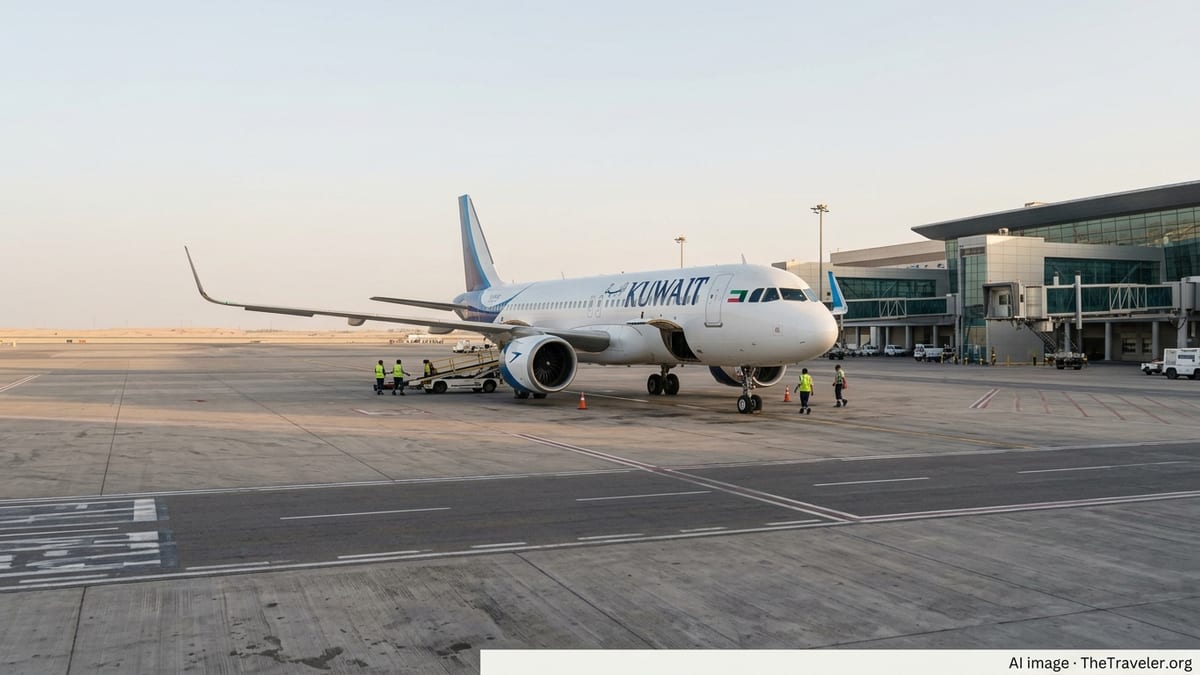
Kuwait Airways is preparing to launch a new nonstop service between Kuwait City and Moscow Domodedovo, using Airbus A320neo aircraft in a move that reconnects the Gulf carrier with Russia’s capital and adds fresh capacity on a strategically important corridor between the Middle East and Eastern Europe.
Get the latest news straight to your inbox!
New Kuwait–Moscow Link Targets March 2026 Start
Publicly available schedule data and industry reports indicate that Kuwait Airways is set to inaugurate its Kuwait–Moscow route in March 2026, with services operating to Moscow Domodedovo Airport. Aviation-focused outlets describe the launch as part of a broader 2026 network expansion that also adds new destinations across Europe and Asia.
Information released through regional airline associations and industry publications points to three weekly flights planned between Kuwait International Airport and Domodedovo. While some earlier filings suggested slightly different start dates and seasonal adjustments, more recent coverage aligns around a mid-March 2026 launch window for the new Russia service.
The move places Kuwait Airways back into the Russian market at a time when Gulf carriers are reassessing their capacity and routing strategies. With many global airlines having reduced or reshaped their Russia networks in recent years, the Kuwait–Moscow link stands out as a targeted restoration of connectivity rather than a simple frequency increase on an established route.
Scheduling data shows that the westbound leg from Kuwait to Moscow is timed for daytime departures, with the return to Kuwait in the late afternoon or evening. This pattern is designed to feed into onward connections at Kuwait International Airport while offering reasonable arrival times for origin-and-destination traffic at both ends.
A320neo Brings Efficiency and Range to a Mid-Haul Market
The route will be operated by the Airbus A320neo, a narrowbody that has become a workhorse for Kuwait Airways as it renews and modernizes its fleet. Manufacturer information and airline fleet disclosures highlight the type’s improved fuel burn, quieter engines, and extended range compared with earlier A320 variants, all of which are advantageous on a roughly five-hour sector between Kuwait and Moscow.
By assigning the A320neo to the new Russia service, Kuwait Airways is aligning product consistency with operational efficiency. Cabin layouts typically feature a two-class configuration, with business and economy cabins designed to meet regional and medium-haul expectations, while the aircraft’s economics allow the airline to sustain thinner, developing markets without relying on widebody capacity.
Industry analyses of Kuwait Airways’ recent fleet strategy note a growing reliance on next-generation narrowbodies to open or restore mid-haul routes that balance business, leisure, and transit demand. The Kuwait–Moscow pairing fits this pattern, combining a sizeable local market with transfer flows that can be built up over time as the route matures.
From an environmental perspective, the A320neo’s lower fuel consumption per seat compared with older aircraft types supports regional targets to reduce emissions intensity. While the overall climate impact of added air services remains under scrutiny, the deployment of more efficient equipment is seen in industry reporting as a key lever for incremental improvements on established corridors.
Reigniting Gulf–Russia Travel Flows
The new Kuwait–Moscow route arrives in a complex but gradually reconfiguring Russia travel landscape. Published aviation statistics and route maps show that while some European and Asian carriers have cut back or withdrawn services to Russian cities in recent years, carriers based in the Gulf and other non-European hubs have partially filled the gap, offering alternative connection points between Russia, the Middle East, and Asia.
With Kuwait Airways entering the market alongside other Gulf-based operators already serving Russian destinations, travelers from Moscow are expected to gain an additional option for reaching cities in South Asia, Southeast Asia, and parts of the Middle East through one-stop itineraries via Kuwait. Travel trade commentary suggests that this is especially relevant for price-sensitive and VFR (visiting friends and relatives) traffic that values flexibility in routing.
On the Kuwait side, the route broadens access to Russia for both business and leisure passengers. Russia remains a sizable outbound market with interest in Gulf tourism, shopping, and medical travel, while inbound demand from Kuwait and neighboring states includes winter tourism, cultural visits, and niche business links in energy and services sectors.
Analysts note that the Gulf–Russia market has been moving toward a more hub-centric model, with passengers funneled through a handful of key airports rather than relying on a wide assortment of point-to-point services. The addition of Kuwait City as another connection node subtly reshapes that map, giving travelers and travel agents more options for constructing itineraries that avoid crowded or capacity-constrained hubs.
Competitive Landscape and Network Strategy
According to flight schedule aggregators and industry coverage, Moscow Domodedovo is already used by several carriers from the Middle East, making Kuwait Airways’ entry a competitive but not saturated play. Other Gulf-based airlines focus their Russia operations on different Moscow airports or on secondary Russian cities, creating a patchwork of overlapping yet differentiated services.
For Kuwait Airways, the Moscow launch forms part of a multi-destination expansion that includes new routes to leisure hotspots and major Asian gateways. Commentators in regional business media have framed the 2026 schedule as an attempt to position Kuwait as a more prominent transfer point between Asia, the Indian Ocean, and Europe, leveraging the airline’s renewed fleet and the ongoing development of airport infrastructure at Kuwait International.
Competition is expected to revolve around schedule convenience, fare levels, and onboard product rather than pure capacity. With three weekly frequencies, the Kuwait–Moscow route is calibrated more toward steady, sustainable growth than aggressive market capture. This measured approach allows the airline to gauge demand conditions in a changing geopolitical and economic environment.
Travel analysts point out that the presence of Gulf competitors on Russia routes can also expand overall market size by improving awareness and marketing reach. In that context, Kuwait Airways’ new flights are likely to contribute incrementally to the wider Gulf–Russia air travel ecosystem rather than simply shifting passengers from one airline to another.
Implications for Transit Passengers and Future Growth
The structure of the planned timetable suggests that Kuwait Airways aims to integrate the Moscow flights into its broader bank of connections through Kuwait. Publicly available booking and schedule data show that arrivals from Moscow are expected to connect onward to destinations in South Asia, the Indian subcontinent, and select European cities, using relatively short transfer windows.
This approach mirrors the hub-and-spoke strategies of larger Gulf carriers, but on a scale tailored to Kuwait Airways’ network. Travel experts note that such routing can appeal to passengers seeking alternatives to the busiest hubs, particularly when visa policies, airport transfer experiences, and overall travel times compare favorably.
Looking ahead, industry commentary leaves open the possibility of frequency increases or seasonal adjustments on the Kuwait–Moscow route if demand proves resilient. Additional capacity could be added through more A320neo services or, at peak times, the deployment of larger narrowbody or medium-size widebody aircraft, depending on fleet availability and commercial performance.
For now, the planned A320neo-operated link marks a significant step in Kuwait Airways’ efforts to re-engage with the Russian market and to strengthen its role in connecting the Gulf with a shifting network of destinations across Europe and Asia. As the route beds in during 2026, its performance is likely to serve as a bellwether for further Gulf–Russia air service developments.