

More news on this day
A drone strike that damaged facilities at Kuwait International Airport has pushed Kuwait City into the same high-alert aviation category as Dubai, Doha, Riyadh, Abu Dhabi, Manama, Muscat, Amman and Beirut, intensifying security concerns and adding fresh disruption to already fragile airline networks across the Gulf and wider Middle East.
Get the latest news straight to your inbox!
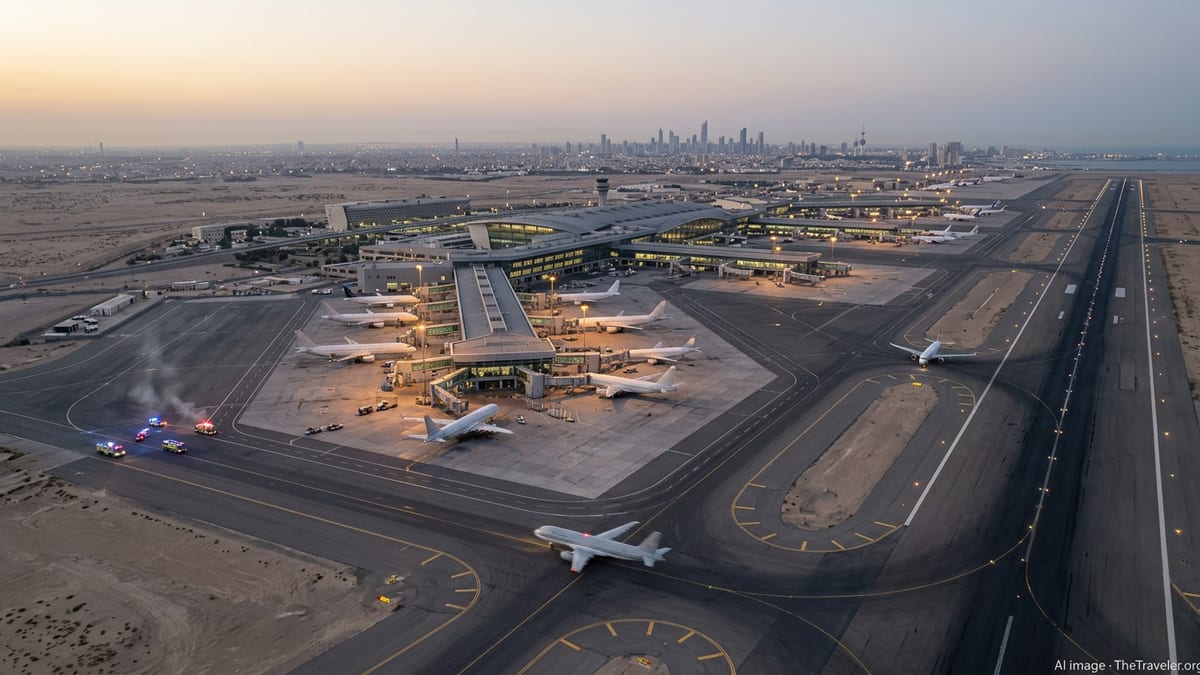
Drone Strike Hits Key Kuwait Aviation Hub
Kuwaiti and international security sources say Iranian drones targeted Kuwait International Airport and nearby military infrastructure in early March, with material damage reported at civilian facilities but no immediate mass casualties. The incident, part of a wider barrage of Iranian strikes across the region, marked the first time since the conflict escalated that Kuwait’s main passenger gateway has sustained a direct hit.
The attack followed earlier Iranian drone and missile operations against U.S. and allied positions in Kuwait, including a deadly strike on a logistics operations center at Port Shuaiba and reported damage at Ali Al Salem Air Base. Aviation analysts note that the spread of attacks from military and industrial sites to civilian aviation infrastructure represents a sharp escalation in both risk and political signaling.
Kuwaiti air defense units reported tracking multiple hostile drones in the 24 hours surrounding the airport incident, intercepting most of them before impact. Officials said one drone fell outside designated danger zones, while fragments from intercepts were recovered near the wider airport area, underscoring how even successful defenses can create hazards for civil aviation.
The Directorate General of Civil Aviation imposed immediate traffic restrictions, temporarily reducing movements at Kuwait International as security teams assessed damage and swept runways and aprons for debris. Airlines operating into Kuwait City were instructed to review approach profiles and prepare for short-notice schedule changes while authorities evaluated the evolving threat.
Gulf Mega-Hubs Under Coordinated Aviation Alerts
The strike on Kuwait International comes as major Gulf and Levant hubs, including Dubai, Doha, Riyadh, Abu Dhabi, Manama, Muscat, Amman and Beirut, operate under heightened security protocols in response to the regional conflict between Iran, the United States and Israel. In recent days, Iranian drones and missiles have variously threatened or struck airports from Dubai and Bahrain to facilities in Iraq and Kuwait, forcing aviation regulators to treat the entire corridor as a single high-risk theater.
Dubai International Airport, one of the world’s busiest global hubs, has already endured disruption following drone incidents and nearby interceptions that prompted temporary runway closures and diversions. Flights into Doha’s Hamad International, Abu Dhabi’s Zayed International and Bahrain International have faced rolling restrictions, with several carriers canceling or rerouting services to avoid congested or potentially exposed airspace.
Saudi authorities have placed parts of the kingdom’s eastern airspace under tighter control after shooting down drones near strategic energy facilities, while keeping core commercial routes to Riyadh and Jeddah open under reinforced procedures. Oman’s Muscat International has become a preferred diversion and relief hub for some airlines, leveraging relatively calmer skies while coordinating closely with regional air navigation authorities.
In the Levant, airports in Amman and Beirut have also transitioned to elevated alert levels, adjusting arrival and departure corridors and increasing coordination with military radar to track possible threats transiting over contested airspace. Although neither airport has reported direct drone impacts in recent days, operators are preparing contingency plans in case attack patterns shift westward.
Airlines Reroute and Trim Schedules Amid Evolving Threat
Global and regional airlines are scrambling to adapt networks that traditionally rely on Gulf hubs as the primary connection points between Europe, Africa and Asia. With Kuwait City now effectively joining Dubai, Doha, Riyadh, Abu Dhabi and other key airports on high alert lists maintained by risk consultancies and insurers, route planners are reassessing the viability of transiting large volumes of traffic through the region in the near term.
Carriers have implemented a mix of suspensions, reroutes and frequency cuts. Some have temporarily halted direct services to Kuwait, Dubai or Bahrain, while others are threading narrow corridors of controlled airspace approved by national and international regulators. Flight times on many intercontinental routes have lengthened as aircraft detour around sensitive zones over the northern Gulf, Iraq and western Iran.
Industry specialists note that the risk calculus has shifted from isolated incidents to a sustained pattern of strikes and intercepts that intersect with civil flight paths. Insurance premiums for overflight and ground risks in affected flight information regions have risen, and some corporate travel managers are instructing staff to avoid itineraries that require connections through the most affected hubs until the situation stabilizes.
At Kuwait International, ground handlers and airline station managers are contending with a backlog of displaced passengers, repositioning aircraft and crew while infrastructure inspections continue. Airport authorities have prioritized limited slots for repatriation and essential travel, warning that schedules could change with little notice if further drone activity is detected.
Security Measures Tighten from Runways to Airspace Control
In response to the Kuwait City strike and broader regional attacks, civil aviation authorities across the Gulf have rolled out additional layers of protection, combining military air defense with tighter civil airspace management. Emergency security controls of air traffic, similar to those recently imposed in the United Arab Emirates, allow regulators to instantly halt or re-sequence flights when sensors detect potential threats.
Airports in Kuwait, the UAE, Qatar, Saudi Arabia, Bahrain and Oman have stepped up patrols around perimeter fences, fuel farms and radar installations, while also enhancing screening at terminals. Drone detection systems, some of which were initially installed to curb unauthorized hobbyist flights, are now integrated with national air defense networks to identify and classify hostile aircraft quickly.
Air navigation service providers are working from updated risk assessments that factor in the demonstrated range and payload of Iranian drones, as well as the possibility of misdirected intercepts or debris. Controllers have been briefed on contingency procedures for rapid runway closures, altitude changes and holding patterns if intercept operations occur near civil flight paths.
Kuwait’s aviation regulators, who had already been working with international partners on long-term drone management frameworks, are now revisiting those plans under wartime conditions. Officials are weighing further restrictions on civilian drone usage and reviewing how best to segregate military and civil traffic in a small airspace that hosts both a major commercial airport and large foreign military contingents.
Travelers Face Uncertainty as Crisis Ripples Outward
For travelers, the most immediate impact of the Kuwait City incident and regional alerts is a fresh wave of uncertainty around flight reliability. Even as some Gulf air corridors begin to reopen in a controlled fashion following earlier closures, each new drone strike or interception can trigger sudden delays, diversions or cancellations that ripple through global schedules.
Passenger accounts from Kuwait, Dubai and other hubs describe crowded terminal halls, long rebooking queues and difficulty obtaining clear information amid a fast-moving security environment. Airlines say they are prioritizing safety and compliance with national directives, asking customers to monitor flight status closely and remain flexible about routing and timing.
Travel advisors are increasingly steering leisure travelers and some corporate clients away from itineraries that depend on tight connections in Kuwait City or the busiest Gulf hubs, recommending alternative routings via Istanbul, Cairo or European gateways where feasible. However, for many routes between South Asia, East Africa and Europe, Gulf hubs remain the most practical options, leaving travelers to weigh disruption risk against necessity.
With Iran signaling that its drone and missile operations could continue and regional governments vowing robust responses, aviation experts warn that the security environment around Kuwait City and neighboring hubs is likely to remain volatile. While the damage at Kuwait International Airport has so far been contained, its addition to the roster of airports directly affected by drone strikes cements the crisis as a defining test for modern air travel in one of the world’s most strategically important flight corridors.