

More news on this day
Middle East air travel is facing a new phase of disruption and danger as Kuwait joins the United Arab Emirates, Saudi Arabia, Bahrain, Iraq, Azerbaijan and other states dealing with missile and drone activity linked to Iran that has repeatedly targeted airports, fuel depots and critical aviation infrastructure.
Get the latest news straight to your inbox!
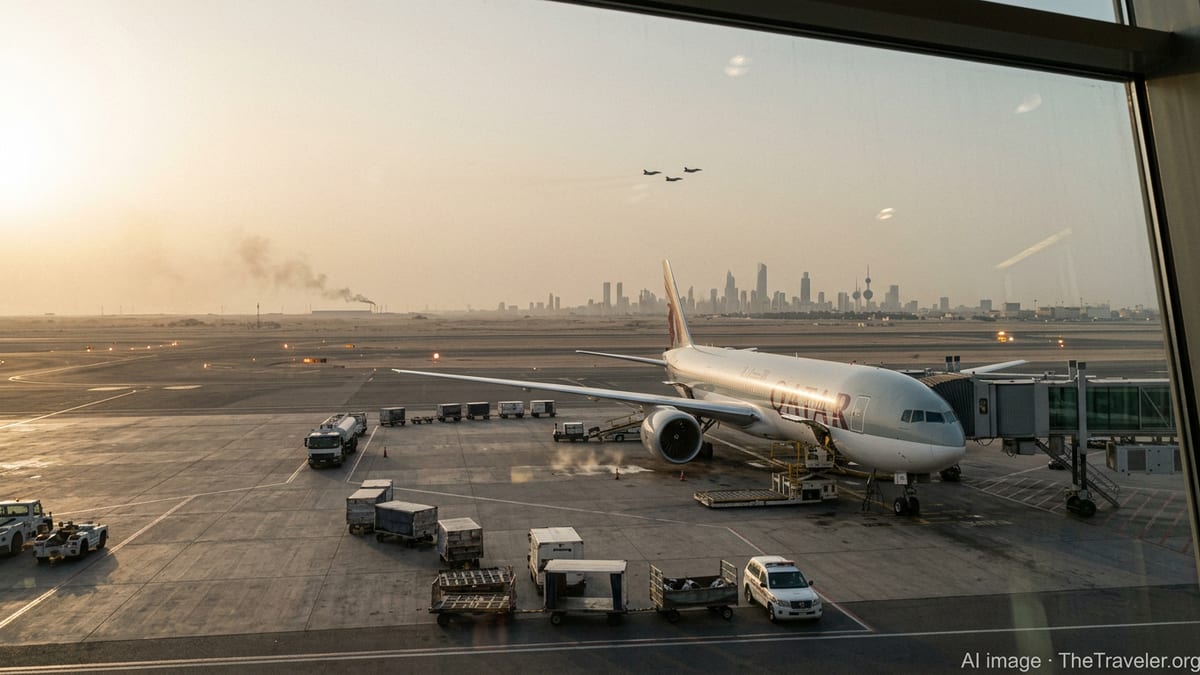
Kuwait Becomes Latest Flashpoint in Regional Aviation Threats
Recent attacks attributed to Iran and its expanding confrontation with the United States and Israel have pushed Kuwait directly into the front line of aviation risk. Publicly available information shows that drones have struck facilities linked to Kuwait International Airport and that the country has been forced to confront waves of incoming missiles and drones in its airspace as the wider conflict intensifies.
According to regional and international coverage, a drone incident at Kuwait International Airport caused injuries to ground workers and damage around Terminal 1, while separate reports indicate that fuel infrastructure connected to the airport has also been targeted. These incidents highlight how aviation nodes in smaller but strategically located Gulf states are now squarely in the crosshairs of a widening confrontation.
Analysts note that Kuwait’s aviation system is particularly exposed because of its position on key north–south and east–west routes between Europe, the Gulf and South Asia. Even short-lived disruptions force airlines to divert around Kuwaiti airspace or cancel services, multiplying the knock-on effects across already stressed regional networks.
UAE, Saudi Arabia, Bahrain, Iraq and Azerbaijan See Airports and Airspace Hit
The threat to civil aviation is not confined to Kuwait. Over the past two years, missile and drone barrages linked to the Iran–Israel and Iran–US confrontations have repeatedly impacted or directly targeted airports in the United Arab Emirates, Saudi Arabia, Bahrain and Iraq, and have driven airspace restrictions affecting routes over Azerbaijan and other states along the northern arc of the Gulf.
Published accounts describe damage to terminal areas and support facilities at major hubs in the UAE, including Dubai International Airport, which is one of the world’s busiest intercontinental gateways. Separate reporting notes that airports in Abu Dhabi, Bahrain and Kuwait have all sustained some level of damage from Iranian strikes or debris as missiles and drones have crossed their airspace.
Iraq has experienced particularly acute pressure, with its airspace used repeatedly as a transit corridor for drones and missiles in both directions and with US military installations on Iraqi soil listed among Iranian targets. Each major exchange has triggered temporary nationwide airspace closures, halting flights in and out of Baghdad and adding further strain to regional carriers seeking safe, predictable routings.
Airspace Closures and Travel Disruptions Ripple Across the Region
Every major spike in hostilities has translated almost immediately into widespread airspace closures. During large-scale Iranian attacks or retaliatory strikes on Iranian territory, states such as Kuwait, Bahrain, Iraq, Jordan, Qatar, Saudi Arabia and the UAE have repeatedly shut their skies for hours at a time, effectively severing some of the most heavily used long-haul corridors between Europe, Africa and Asia.
Reports from aviation tracking organizations and regional media describe hundreds of thousands of passengers stranded or diverted as long-haul flights are rerouted around the conflict zone. Aircraft bound for Gulf mega-hubs have been sent to secondary European or South Asian airports, while some carriers have turned back mid-route when notified that destination airspace was suddenly closed.
These disruptions have come on top of earlier closures triggered by Iran’s April 2024 mass drone and missile launch toward Israel, which prompted multiple neighbors, including Kuwait and Iraq, to suspend flight operations temporarily. Since then, successive rounds of escalation have further normalized the idea that Gulf and Levantine airspace can be withdrawn at short notice whenever regional tensions spike.
Global Regulators Warn of “High Risk” to Civil Aviation
International aviation regulators have responded by hardening their risk assessments for the entire region. A recent conflict-zone information bulletin from European regulators, cited in specialist aviation media, advises airlines to avoid or carefully manage operations in the airspace of Bahrain, Iran, Iraq, Israel, Jordan, Kuwait, Lebanon, Oman, Qatar, Saudi Arabia and the UAE, citing a high risk to civil aviation from missile and drone activity.
Industry coverage notes that many major global carriers have already adjusted their routings to bypass Iranian and Iraqi skies entirely, lengthening flight times between Europe and destinations in the Indian subcontinent and Southeast Asia. Some airlines have temporarily suspended flights to Gulf hubs during peak periods of bombardment, only cautiously restoring limited schedules once local authorities reopen airports and airspace.
Risk advisories emphasize that even in the absence of a deliberate attack on a passenger jet, the dense concentration of missiles, drones and air-defense fire in relatively confined corridors above the Gulf and Levant substantially increases the danger of miscalculation or stray debris. The presence of large US and allied military contingents in countries such as Kuwait, Qatar and Iraq further complicates the picture, blending civil and military traffic in the same general region.
What Travelers Need to Know When Flying Through the Middle East
For travelers planning to transit the Middle East, the evolving pattern of attacks on airports and aviation infrastructure means that flexibility and awareness are now essential. Travel and aviation reports recommend that passengers build in additional buffer time for connections, particularly when itineraries involve hubs in the UAE, Qatar, Saudi Arabia, Bahrain, Kuwait or Iraq, as schedules can change with little warning when airspace is closed.
Travel industry guidance generally encourages passengers to monitor airline notifications closely, keep contact details up to date, and consider booking through carriers with multiple alternative routings in case a primary hub is disrupted. Travel insurance policies that cover war-related route changes and extended delays are also gaining prominence for trips that cross the wider Gulf and Levant region.
Experts following the conflict caution that the pattern of Iranian missile and drone strikes, coupled with retaliatory actions and the proximity of large civilian airports to military and energy infrastructure, suggests elevated aviation risk is likely to persist. For now, Kuwait’s experience mirrors that of the UAE, Saudi Arabia, Bahrain, Iraq, Azerbaijan and other states at the edge of the confrontation, underscoring how quickly airport terminals and control zones can become part of a much broader regional battlefield.