

More news on this day
Kuwait has moved to tighten emergency travel warnings in step with the United Arab Emirates, Bahrain, Oman, Saudi Arabia, and Qatar, as governments across the Gulf respond to fast-escalating military tensions with Iran and regional airspace closures that have left thousands of travelers stranded and triggered fresh calls for foreign nationals to leave high-risk areas without delay.
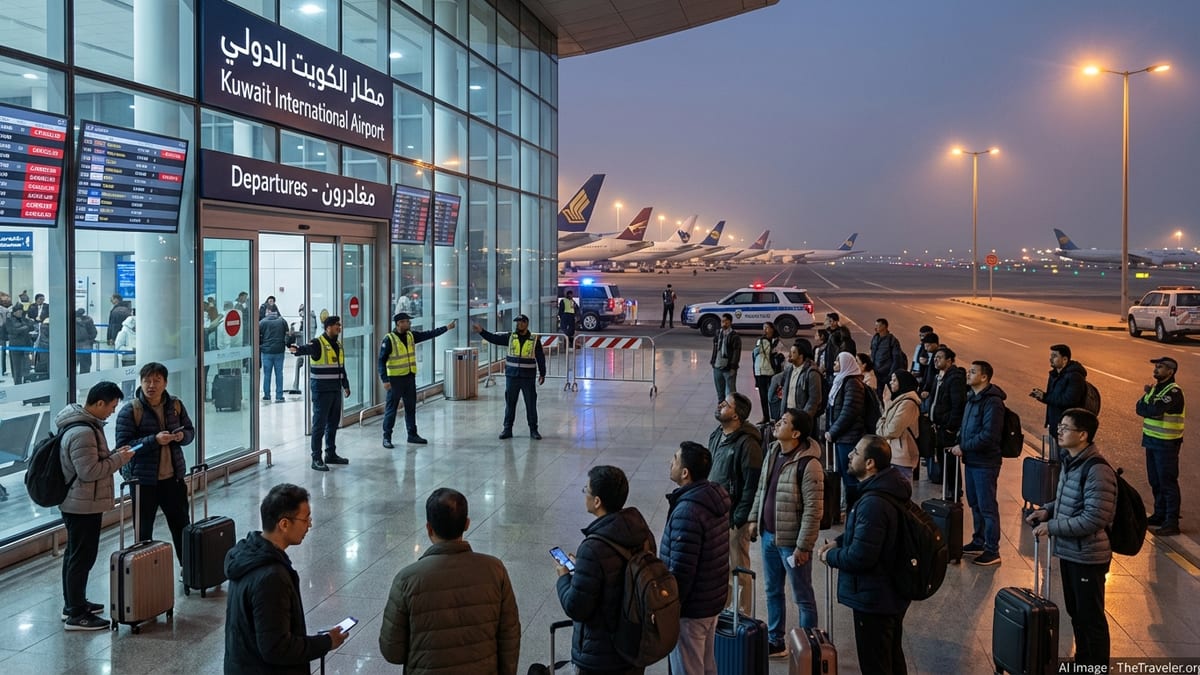
Gulf States Synchronize Emergency Alerts as Airspace Closes
Authorities in Kuwait have imposed heightened security measures and effectively joined neighboring Gulf states in issuing the strongest travel and safety guidance seen in years, following joint United States and Israeli strikes on Iran and subsequent missile barrages across the region. Kuwait’s airspace was among several in the Gulf ordered shut or severely restricted from February 28, after Iranian projectiles targeted military and strategic sites, prompting emergency risk assessments for foreign citizens in the country.
The move aligns Kuwait with the United Arab Emirates, Bahrain, Qatar, Oman, and Saudi Arabia, all of which are now operating under upgraded threat postures. Regional media and aviation authorities report that Qatar and Kuwait implemented full airspace closures, while the UAE and Bahrain introduced sweeping restrictions that forced carriers to cancel or divert hundreds of flights. Major hubs in Dubai, Abu Dhabi, Doha, Kuwait City, and Manama have seen operations sharply curtailed, with knock-on disruption rippling through airline networks worldwide.
European governments have begun warning against travel across much of the Middle East, explicitly naming Kuwait and its Gulf neighbors in updated advisories. Germany has issued formal travel warnings for Israel, Bahrain, Iraq, Jordan, Qatar, Kuwait, Lebanon, Oman, Saudi Arabia, and the UAE, while the United Kingdom now strongly discourages nonessential trips to several Gulf states and has instructed its nationals in Bahrain, Kuwait, Qatar, and the UAE to shelter in place. Officials caution that further closures and route suspensions could be imposed with little or no notice.
The closures and alerts come on top of existing long-running warnings for Iran itself, creating an unprecedented patchwork of restricted air corridors. Airlines are in many cases choosing to avoid the entire northern Gulf, lengthening Europe–Asia flight times and complicating efforts by embassies to move their citizens out of affected zones, particularly from smaller communities in Kuwait, Bahrain, and Qatar.
Taiwan Raises the Alarm and Tracks Nationals Across the Gulf
Against this backdrop, Taiwan’s Ministry of Foreign Affairs has tightened its own travel posture, urging citizens to avoid nonessential journeys to the broader Middle East and moving to a red alert for Israel while maintaining its highest warning level for Iran. Officials in Taipei say they have activated emergency response mechanisms at overseas missions and are in direct contact with communities of Taiwanese nationals across the region, including in Kuwait and its fellow Gulf states.
Recent briefings from the ministry indicate that approximately 3,000 Taiwanese citizens are currently in the Middle East, concentrated largely in Saudi Arabia and the United Arab Emirates, with smaller numbers in Qatar, Jordan, Kuwait, Oman, Bahrain, Israel, and Iran. While there have been no confirmed Taiwanese casualties, consular staff have been ordered to keep regular communication with expatriates and business travelers, monitor their movements, and prepare contingency plans should rapid evacuations become necessary.
For Taiwan, the latest surge in tensions is particularly sensitive. President Lai Ching-te has publicly identified the safety of citizens overseas as a priority, instructing agencies to track both security and economic fallout from the conflict. The foreign ministry has indicated that travel advisories will be adjusted in line with developments on the ground, but officials are already signaling that those in areas most directly exposed to missile or drone strikes should consider leaving while commercial options remain available.
Although the strongest immediate warnings and direct calls to depart have so far focused on Israel and Iran, diplomats and security analysts in Taipei acknowledge that the rapid spread of missile threats across Bahrain, Kuwait, Qatar, and the UAE raises the risk profile for Taiwanese nationals in the wider Gulf. With multiple governments now advising their own citizens to shelter indoors and avoid all travel, pressure is growing on vulnerable communities to make early decisions rather than wait for official evacuation orders.
Travel Chaos Deepens as Airspace Restrictions Strand Passengers
The synchronized closure of airspace over Kuwait, Qatar, and parts of the UAE and Bahrain has plunged regional and long-haul travel into disarray. International media estimate that more than 3,000 flights were canceled or rerouted over the weekend alone, with major carriers in the Gulf suspending large portions of their schedules. Passengers bound for or transiting through Dubai, Abu Dhabi, Doha, Kuwait City, and Manama have faced last-minute diversions, overnight delays, and abrupt flight cancellations with limited rebooking options.
Travelers with connections onward to Asia, Africa, and Europe have been particularly hard hit, as Gulf hubs normally serve as critical junctions between continents. With Iran, Iraq, and parts of Syria also restricting or closing their skies, alternative routing has become difficult and expensive, forcing airlines to fly longer detours around the conflict zone. Aviation analysts note that the Middle East’s role as a global crossroads means disruptions here can quickly cascade across itineraries in Europe, North America, and the Asia-Pacific.
In Kuwait, the sudden clampdown on air traffic has left tourists, business visitors, and foreign workers facing uncertain timelines for departure. Embassies are advising nationals to remain in secure accommodation, closely monitor local announcements, and register contact details with consular staff while options for charter or overland evacuation are explored. Some countries, including the United Kingdom, have publicly discussed contingency planning to move citizens out of the Gulf should conditions worsen.
Airlines, meanwhile, are walking a fine line between passenger safety and commercial necessity. While many have been quick to suspend flights directly exposed to missile trajectories, they are also eager to preserve viable corridors through safer neighboring states such as Jordan or parts of Oman. Industry observers warn that as long as missile alert sirens continue to sound over Gulf cities, however, traveler confidence is likely to remain deeply shaken.
Security Calculations Shift for Expatriates and Short-Term Visitors
The escalating crisis is forcing both expatriates and short-term visitors in Kuwait and other Gulf states to reassess their risk tolerance. For long-term residents, particularly those employed in the oil, gas, construction, and aviation sectors, remaining in place may still be feasible where employers have robust security plans and contingency arrangements. But for tourists, students, and business travelers with more flexibility, authorities and security experts increasingly recommend early departure from high-risk locations.
In practical terms, this means that Taiwanese nationals and other foreign citizens now find themselves weighing complex factors: the availability of flights, the proximity of military or strategic targets, the reliability of local shelter infrastructure, and the likelihood of further escalation. For many, the closure and reopening of airspace may prove decisive; delays in leaving could translate into being stranded for days or weeks if renewed missile threats prompt fresh shutdowns.
Taiwanese officials have reiterated that their consular teams stand ready to assist with documentation, emergency travel arrangements, and coordination with host governments, but they also emphasize that individuals on the ground must make timely decisions in light of rapidly changing security conditions. As more Western and Asian governments tighten travel advisories for Kuwait, the UAE, Bahrain, Oman, Saudi Arabia, and Qatar, the window for relatively orderly departures could narrow quickly.
For now, the message emerging from multiple capitals is clear: avoid new travel to the region, keep plans flexible, and, where possible, consider leaving conflict-adjacent areas before options contract further. In the uncertainty hanging over Kuwait and its Gulf neighbors, proactive moves by travelers and expatriates may prove to be the safest route out.